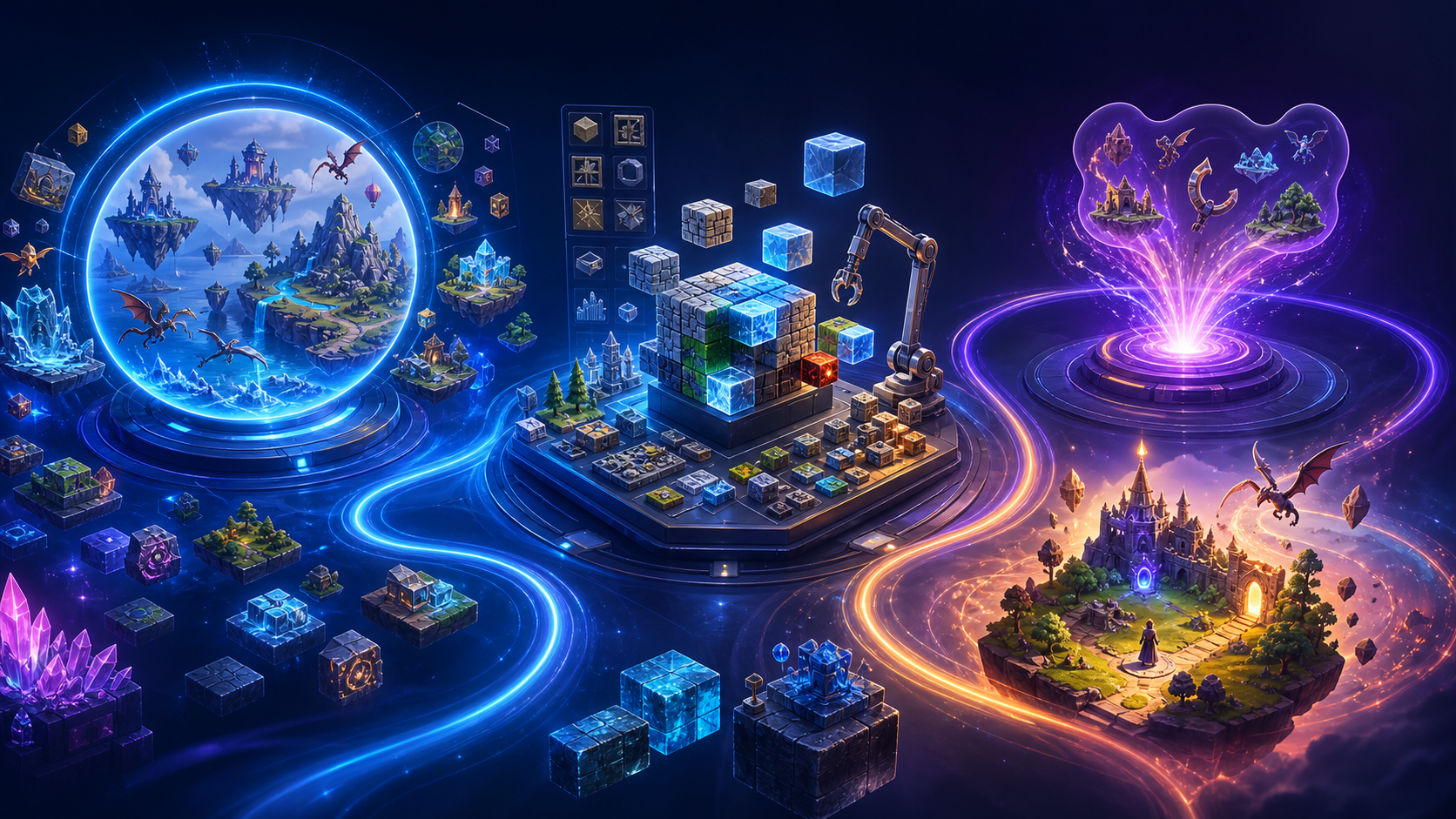
AI game platform, AI game maker, and AI game generator are often used as if they describe the same product. They do not. One helps produce a starting point, another supports the work of building, and the third provides an ecosystem in which games can be created, played, shared, discovered, and changed over time.
The boundaries are already blurry, and these labels are not formal industry standards. Still, the distinction is useful when you are comparing products. It tells you whether a tool is designed for a quick experiment, a sustained production workflow, or an ongoing community of creators and players.
The short answer: three different problems
| Category | Main purpose | Typical output | Best fit |
|---|---|---|---|
| AI game generator | Turn an idea or prompt into game content or an early prototype | Concepts, characters, dialogue, environments, levels, mechanics, or a small playable draft | Rapid experimentation and first-pass validation |
| AI game maker | Help a creator assemble, customize, test, and refine a game | A more deliberate project with connected assets, rules, and gameplay | Beginners, indie creators, and teams that want AI-assisted production |
| AI game platform | Connect creation with play, publishing, discovery, sharing, and community participation | A growing catalog or ecosystem of playable and remixable experiences | People who want to create and participate in a broader network |
The easiest way to remember the difference is by intent:
- Use a generator when you have an idea and want to see a first version quickly.
- Use a maker when you want to keep building and shaping that idea.
- Use a platform when creation is only one part of a larger play, publish, discover, and remix loop.
What is an AI game generator?
An AI game generator uses a prompt, reference, or structured input to produce one or more parts of a game. Depending on the tool, that may include a story premise, a character concept, dialogue, an environment, a level layout, art assets, code suggestions, rules, or a basic playable prototype.
The emphasis is generation. A creator describes a result—perhaps a puzzle in a magical castle or a survival challenge on a frozen moon—and the system produces a starting point. That first result may be useful on its own, but it is usually better understood as material for evaluation and iteration.
Why creators use game generators
Fast experimentation
Game ideas are cheap; prototypes are not. A conventional prototype can require design, programming, art, audio, testing, and coordination before anyone knows whether the central mechanic is fun. Generation lowers the cost of exploring multiple directions.
Instead of committing to one concept too early, a creator can compare several premises, visual styles, level structures, or rule sets. The value is not that every result becomes a finished game. It is that more ideas can reach a form that can be discussed or tested.
Learning game design
For a beginner, a generator can make abstract design questions visible. What is the player's goal? Which action repeats? What creates difficulty? How does the level teach a rule? What feedback tells the player that an action succeeded?
The generated result will not answer all of those questions well, but it gives the learner something concrete to examine. That can be a more approachable entry point than beginning with an empty engine project.
Creating a first version
Early drafts are often the hardest part of creative work. Generators can help creators move from a sentence to a rough asset set, a scene, or a playable concept. A human can then reject weak assumptions, simplify the design, and decide what deserves further investment.
For visual preproduction around a game idea, tools such as text-to-image can also help explore environments or mood boards. That is visual ideation, not game construction: the rules, interaction model, rights review, and production decisions still belong to the development workflow.
Limits of an AI game generator
A generator is not automatically a complete development environment or a durable game service. A one-off result may lack:
- consistent systems across many levels;
- reliable control over complex mechanics;
- debugging and performance tools;
- versioning and team collaboration;
- persistent worlds or player data;
- publishing, discovery, moderation, and community features;
- a clear path from prototype to a maintainable production build.
Generation also creates review work. A plausible-looking mechanic may not be balanced. Generated code may be insecure or inefficient. Art may be inconsistent or too close to protected material. A playable draft can still need extensive human design, engineering, testing, accessibility work, and rights clearance.
What is an AI game maker?
An AI game maker focuses on the process of building a game, not only producing isolated content. It may combine generation with tools for arranging scenes, defining rules, connecting interactions, customizing assets, testing gameplay, and revising the result.
The central shift is from “give me something” to “help me construct and improve this project.” A maker may begin with a prompt, but it should give the creator ways to make deliberate decisions after the first output appears.
Who uses AI game makers?
AI makers can serve several groups:
- People with a game idea but little or no programming experience can use guided workflows to learn how a project fits together.
- Independent creators can reduce repetitive setup work and spend more time on mechanics, writing, level design, and playtesting.
- Designers and artists can build interactive proofs of concept before requesting a full engineering implementation.
- Experienced developers can use AI assistance for drafts, boilerplate, asset variations, or test scenarios while retaining professional tools for the final build.
“AI-assisted” does not mean “skill-free.” As the project grows, creators still need judgment about scope, systems, pacing, failure states, accessibility, performance, safety, and maintenance.
AI game maker vs traditional game engine
A traditional game engine is designed for deep production control. It typically exposes rendering, physics, animation, audio, input, scripting, profiling, platform export, and a large ecosystem of technical tools. That control is powerful, but the learning curve can be steep.
An AI game maker usually offers a different starting point: describe the intended experience first, then refine the generated project. This can shorten the distance between an idea and a testable build, especially for creators who are not ready to write every system from scratch.
The trade-off is control. A guided maker may hide implementation details, support fewer platforms, restrict advanced mechanics, or make it difficult to leave its ecosystem. Before choosing one, check whether you can edit the underlying logic, export assets or code, integrate external tools, collaborate with a team, and maintain the project if the service changes.
For a serious release, the choice is not always maker or engine. A team may use a maker for prototyping and then move into an engine, or use AI assistance inside an established engine workflow.
What is an AI game platform?
An AI game platform extends beyond the creation interface. It provides a place where users can play games, publish their own work, discover other creators, share feedback, and sometimes remix or extend existing experiences.
A platform therefore needs more than generation. Its value comes from the connections among several activities:
- A creator proposes or builds an experience.
- Players try it and reveal what works.
- The creator updates the project using feedback or observed behavior.
- Other participants discover, share, or—with permission—remix the idea.
- The catalog and community continue to evolve.
This loop can reduce the distance between player and creator. Someone may begin by playing, make a variation, and eventually publish an original project. A developer may release a system that other people use in unexpected ways. A community may turn a small prototype into a persistent format.
Why platforms are described as the next step
Generators make content abundant, but abundance alone does not create a healthy creative ecosystem. People also need ways to find worthwhile projects, understand their origins, collaborate, receive feedback, manage versions, and establish rules for reuse.
That is why platform-oriented products are often presented as the next stage of AI game creation. The claim is directional rather than settled fact: platforms can connect creation and play, but they also inherit difficult responsibilities involving moderation, attribution, intellectual property, privacy, child safety, creator compensation, and community governance.
A strong platform should make these policies understandable instead of treating generation volume as the only measure of success.
Which one should you choose?
Choose based on the next outcome you actually need.
Choose an AI game generator if you need to:
- explore several ideas quickly;
- create a rough concept or first prototype;
- test a mechanic before committing resources;
- learn basic design relationships through examples;
- generate selected assets for a larger workflow.
Choose an AI game maker if you need to:
- turn a promising idea into a connected project;
- customize rules, scenes, assets, and interactions;
- iterate through repeated build-and-test cycles;
- collaborate beyond a single generated output;
- retain more control over the finished experience.
Choose an AI game platform if you need to:
- publish and distribute experiences in the same environment;
- play and discover work from a community;
- collect feedback from real participants;
- support permitted remixing or shared creation;
- maintain a growing identity, catalog, or audience.
Before paying for any category, run a small test. Confirm what can be exported, who owns inputs and outputs, which third-party assets are allowed, how user data is handled, and whether a prototype can survive outside the service.
These categories will continue to blend
The neat three-part distinction is unlikely to remain neat. Generators are adding editing and project controls. Makers are adding hosting and community galleries. Platforms are integrating more powerful generation directly into play and remix workflows.
The more useful question may eventually be: how much of the full lifecycle does this product support?
- Ideation: Can it turn a concept into testable material?
- Construction: Can you connect and customize systems?
- Iteration: Can you inspect failures and revise intentionally?
- Publishing: Can you distribute a stable version?
- Participation: Can players discover, respond, or create safely?
- Portability: Can you preserve your work if you leave?
Products will answer those questions differently even when they use the same marketing label.
Why the distinction matters for the future of games
AI can lower some barriers to prototyping, but the important change is not simply faster asset production. It is the possibility that more players participate in design, more creators test unconventional ideas, and more projects evolve through feedback.
That possibility depends on human craft and responsible systems. Creative direction, technical reliability, community trust, attribution, and consent do not disappear when generation becomes easier. They become more important because more content can be produced and shared.
If you use generative visuals or motion in a game-production pipeline, work only with material you have the right to use, avoid misleading imitations of protected characters or brands, and review every output before publication. DeepFake's model catalog can support visual experimentation, but it should be one accountable part of a broader design and production process.
Final thoughts: from isolated outputs to evolving worlds
An AI game generator is best for reaching a starting point. An AI game maker helps turn that start into a structured project. An AI game platform connects projects to players, creators, discovery, and ongoing change.
None of the three is universally better. The right choice depends on whether your immediate problem is ideation, construction, or participation. Define that problem first, test the product with a small real project, and judge it by the control, portability, and community safeguards it provides—not by the word “AI” in its name.
Frequently asked questions
Is an AI game generator the same as a game engine?
No. A generator usually creates content or a prototype from an input. A game engine provides the technical systems and low-level control needed to build, debug, optimize, and ship a game. Some products combine parts of both.
Can an AI game maker create a complete game without coding?
Some makers can produce small games through guided or no-code workflows, but project complexity, export options, performance, and maintainability vary. A polished commercial release may still require programming, art direction, testing, and platform-specific work.
Does a platform automatically let me remix other users' games?
No. Remix rights depend on the platform's terms and the creator's chosen permissions. Availability does not equal permission. Check licenses, attribution requirements, and restrictions before reusing another person's work.
Which category is best for beginners?
A generator is often the fastest way to understand what a prompt can produce. A maker is usually better for learning how a game fits together. A platform is useful when the beginner also wants examples, feedback, and a community. The best starting point is the one that supports the next skill you want to learn.