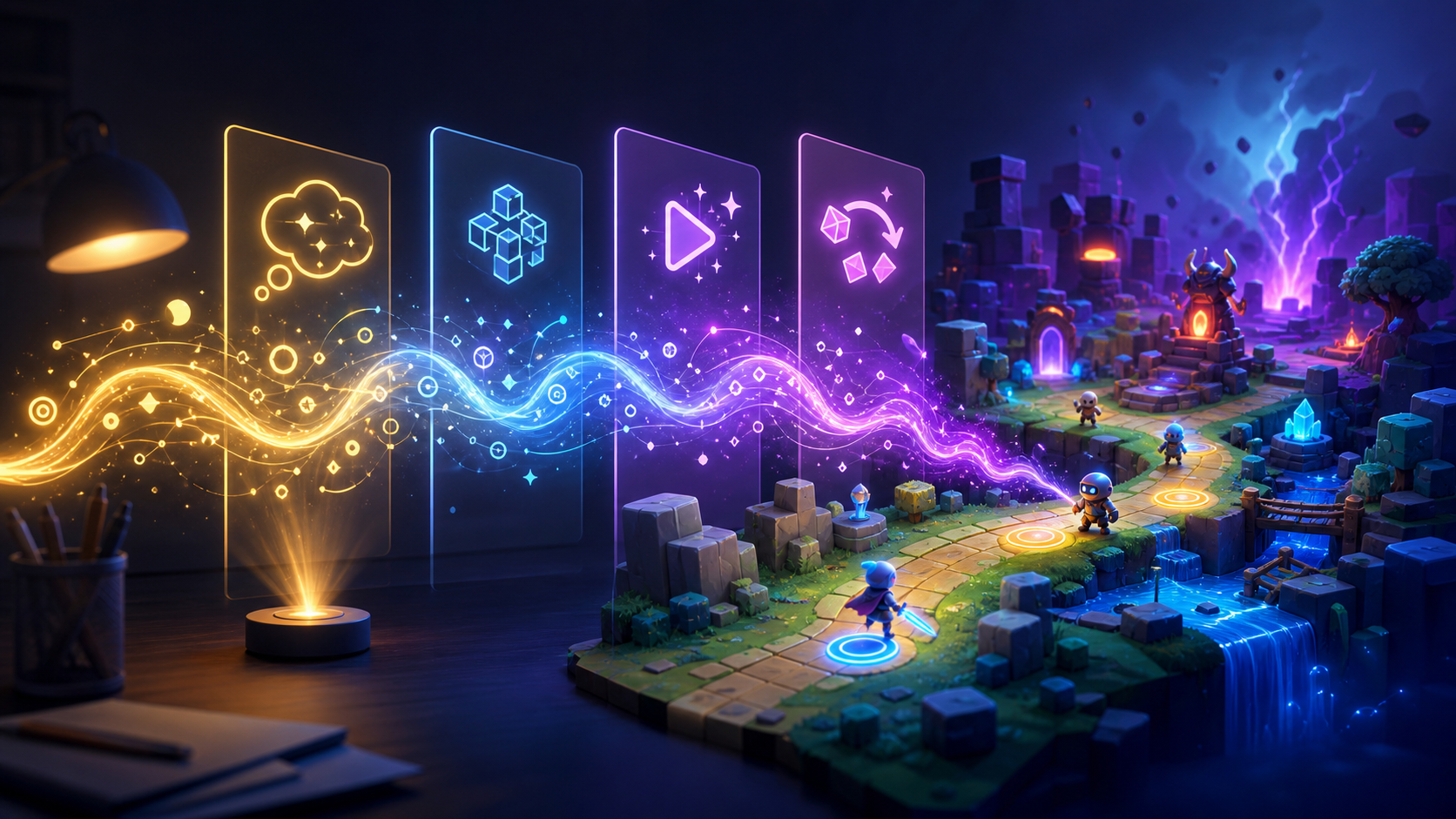
Many game ideas begin with a simple wish: “I want to make something like this, but with my own world, character, or mechanic.” A player imagines an unexplored fantasy land. A writer wonders how a reader might move through a story. A designer invents a rule that does not fit an existing game.
For a long time, the path from that thought to anything playable was intimidating. Building even a small game could require programming, 3D modeling, animation, level design, familiarity with a game engine, and repeated technical testing. Beginners often spent weeks learning an interface before they could evaluate whether the original idea was enjoyable.
AI-assisted game tools can shorten part of that path. Natural-language instructions, reusable systems, generated placeholder assets, and code assistance can help a creator reach an early test sooner. But “sooner” is not the same as “finished,” and tool capabilities vary widely. Some products assemble limited interactive prototypes; some suggest code; others generate only images, audio, or text that still need to be implemented in an engine.
A tiny demonstration may sometimes appear quickly when the idea matches a supported template. A polished game still needs coherent rules, level design, performance work, accessibility, rights review, debugging, playtesting, and often substantial human development. The realistic beginner goal is therefore a small playable prototype: the fastest honest way to learn whether one core idea deserves another iteration.
Why Game Creation Has Traditionally Been Difficult
Every game begins with a question such as “What would happen if…?” The difficult part is turning the answer into a responsive system.
Consider this idea:
A tiny robot explores a forgotten planet.
It is evocative, but it does not yet tell a computer what the player can do. To become playable, the premise needs at least:
- a controllable robot with movement and feedback;
- an environment with boundaries, routes, and landmarks;
- rules that define what can be touched, collected, repaired, or avoided;
- a goal that gives exploration direction;
- obstacles or choices that create uncertainty;
- interactions that change the state of the world; and
- test conditions for success, failure, and unexpected behavior.
Traditional development asks a creator to express each of those pieces through an engine and its programming model. Visual assets may need to be modeled, rigged, textured, and animated. A level must guide the player without feeling like a corridor. Mechanics need tuning. Saving, input, menus, sound, performance, and different devices add further work.
AI can reduce the distance between the sentence and a test by helping decompose intent into components. A capable system might propose a robot controller, a simple landscape, collectible energy cells, broken beacons, and a loop of explore–collect–repair. The creator still has to decide whether that loop is clear and fun. AI changes the starting point from a blank technical project to an editable proposal; it does not remove design judgment.
Quick Prototype vs. Polished Game
This distinction should guide every step.
A quick prototype answers a narrow question. Can the robot’s magnetic jump create interesting routes? Does searching a floating island feel mysterious? Can a resource rule support a five-minute strategy scenario? Placeholder shapes, rough sound, and one small level may be enough.
A polished game must answer many more questions. Does the mechanic remain interesting over time? Are controls accessible? Can players recover from mistakes? Do levels teach the rules? Is the frame rate stable? Are assets original or licensed? Do saving, localization, moderation, and platform requirements work? Has the game been tested by people who did not design it?
Do not measure an early AI-assisted build by how complete it looks in a screenshot. Measure it by whether it gives useful evidence about the core experience. Attractive concept art cannot compensate for unclear rules, and a generated level is not successful merely because the player can walk through it.
Four Types of Game Ideas to Explore
AI-assisted prototyping is most useful when the first scope is small. The following four categories offer different kinds of questions to test.
1. Story-Based Adventure Games
A story game turns narrative information into player decisions. Instead of only describing a mystery, ask what the player investigates, which evidence can be missed, and how a choice changes the next scene.
Possible starting points include:
- a mystery set in a futuristic city where street signs change after each clue;
- a fantasy journey through a magical forest whose paths react to promises;
- a survival story on an alien planet where every repair consumes limited oxygen; or
- the tiny robot on the forgotten planet, restoring old beacons to reconstruct what happened.
For the robot idea, a first prototype does not need a planet-sized world. Build one valley, three beacons, one movement challenge, and one discovery at the end. The design question might be: “Does repairing beacons make exploration feel purposeful?” If the answer is unclear, adding more story will not solve it.
Story prototypes also expose the difference between text and interactivity. A paragraph can state that a place is dangerous; a game must communicate danger through space, timing, sound, resources, or consequences. Let the player learn something through action that narration alone would not deliver.
2. Casual Games
Casual prototypes are often well suited to early experiments because they can focus on one verb and one feedback loop. Examples include:
- a spatial puzzle built around rotating rooms;
- a short arcade challenge about guiding sparks through moving gates;
- a reaction game where sounds, not colors, signal the safe choice; or
- a quiet exploration experience about finding changes in a familiar location.
The smaller scope does not make design automatic. A reaction game still needs readable cues and fair timing. A puzzle needs rules the player can infer. An arcade challenge needs feedback that explains why an attempt failed. AI may help draft variants, but only playtesting reveals whether the activity is satisfying rather than merely functional.
Keep the first session brief and define one success condition. If a new player understands the goal, performs the core action, fails for a reason they can explain, and wants another attempt, the prototype has produced valuable evidence.
3. Strategy and Simulation Games
Strategy and simulation ideas explore connected systems rather than a single action. They may involve:
- allocating limited resources;
- choosing between short-term security and long-term growth;
- building a small world whose parts affect one another;
- managing characters with competing needs; or
- allowing earlier decisions to change later options.
These genres can benefit from AI-assisted rule drafting and scenario generation, but they are not automatically simple. A small change to income, cost, or timing can reshape the entire system. Generated rules may contradict each other or produce a dominant strategy that makes every other choice irrelevant.
Start with a toy economy: two resources, three possible actions, and a short end condition. For example, players manage water and power on one floating settlement for six turns. Each turn, they can expand, repair, or conserve. The prototype question is not “Can AI build a simulation?” It is “Do these three choices create meaningful trade-offs?”
4. Personal Worlds
Not every game needs a mass audience. A personal world might be made for one creator, a classroom, a group of friends, or a small community. You could explore:
- an original fantasy kingdom built around your preferred atmosphere;
- a private walking world that stores fictional memories in different rooms;
- a short adventure shaped around favorite animals or hobbies; or
- a social space designed for a recurring community event.
Personalization can affect theme, pace, difficulty, session length, and accessibility. It should not mean copying a favorite copyrighted story, character, map, or visual identity. Use the qualities you enjoy—gentle exploration, political intrigue, floating architecture, comic timing—as ingredients for a new setting.
A personal prototype can be modest. If it creates one meaningful experience for its intended players, it has succeeded at its chosen scale.
A Four-Step Beginner Workflow
The following process keeps imagination first while giving each phase a concrete test.
Step 1: Start With an Idea
Write one sentence that identifies the player, place, activity, and goal. It does not need to contain every mechanic.
This floating-island premise offers a useful starting point:
Create a fantasy adventure in which players explore a floating island and uncover hidden secrets.
This supplies atmosphere but remains too broad for a first build. Make it testable:
The player is a courier exploring one abandoned floating island. They climb and glide between three signal towers, collect wind crystals to activate them, and reveal a hidden observatory before a storm arrives.
Now the idea contains a role, a small location, core actions, three objectives, a resource, and an ending. You can still revise it, but an AI-assisted game tool or human collaborator has clearer constraints.
Use this prompt pattern:
The player is [role] in [small location]. They repeatedly [core verb] to [goal] while [obstacle or pressure]. The prototype ends when [testable condition].
Avoid asking for an open world, deep combat, dynamic dialogue, crafting, multiplayer, and a branching story in the first prompt. Scope is a design tool.
Step 2: Define the Experience
Decide what the player should feel and what actions will produce that feeling. “Mysterious” is not a mechanic. Limited visibility, distant signals, incomplete maps, and discoveries that reframe earlier spaces can create mystery.
Ask:
- Should the prototype feel exciting, relaxing, strange, funny, or demanding?
- What are the two or three actions the player performs most often?
- What feedback confirms that an action worked?
- What can go wrong, and how does the player recover?
- What does the player learn between the first and final minute?
- What is deliberately outside this version?
For the floating-island prototype, choose “curious with gentle urgency.” Climbing and gliding support curiosity; the approaching storm provides pressure. Falling might return the player to the last tower rather than end the whole attempt. This is enough to guide the first level, movement speed, audio, and visual hierarchy.
Write a minimal loop:
- Spot a tower.
- Navigate to a crystal.
- Use the crystal to activate the tower.
- Receive a clue pointing toward the next route.
If the loop is unclear on paper, generation will not make it clearer by itself.
Step 3: Generate and Play
Use a tool that actually supports the type of prototype you need. Confirm whether it generates executable logic, editable code, a scene inside a game engine, or only media assets. Read its export and ownership terms before investing in a workflow.
Generate the smallest playable pass, then inspect it before adding content. Check:
- Can a new player move and understand the immediate goal?
- Do interactions change the world consistently?
- Are objectives reachable in the intended order?
- Can the player become trapped or skip the entire loop?
- Does failure provide useful feedback?
- Which parts are genuinely implemented and which are decorative placeholders?
Play immediately. The main advantage of a fast prototype is not that development is over; it is that uncertainty becomes visible. The floating island may look beautiful but make the towers impossible to find. Gliding may be enjoyable enough to become the real focus. The storm timer may create tension or merely hurry players past the scenery. These are design discoveries, not generation failures.
Invite at least one person who has not seen the prompt. Do not explain the controls unless they are blocked. Observe where they look, what they try first, and how they describe the goal. A prototype tested only by its creator carries the creator’s assumptions.
Step 4: Improve and Remix
The first version is a question, so revise based on the answer. Change one major variable at a time:
- replace or simplify the player character;
- alter the environment’s routes and landmarks;
- clarify the objective;
- adjust one rule or interaction;
- tune challenge and recovery; or
- remove a feature that distracts from the core loop.
For example, if players enjoy gliding but ignore crystals, do not immediately add more collectibles. Try making each crystal alter the wind route. If the storm timer prevents exploration, change it into a visible environmental escalation rather than a hard deadline. Each remix should test a hypothesis.
Keep versions and notes. Save the prompt, tool settings, known problems, playtest observations, and the reason for each change. Reproducibility matters when generated components can vary between runs.
The Imagine → Create → Play and Remix Pattern
Many AI-assisted creation experiences can be understood through three recurring modes. They are useful as a mental model even when tools expose different features.
Imagine
Begin with a prompt, character premise, story situation, or mechanic. The purpose is to express intent without pretending every detail is known. Ask the system to surface missing decisions: player role, verbs, objective, obstacle, feedback, and end condition.
Imagination remains active throughout the process. A prompt is not a contract handed to the machine; it is the first design draft.
Create
Translate the idea into components that the chosen platform can execute. Depending on the tool, that might include a scene, scripts, rules, placeholder geometry, dialogue, or assets. Verify what has actually been created. A rendered environment is not a playable world until input, collision, state, objectives, and feedback work together.
Human editing matters here. Generated code needs review. Generated layouts need navigation checks. Generated assets need rights and consistency checks. If a tool cannot create executable systems, use its outputs as references in an engine rather than calling them a game.
Play and Remix
Interaction reveals what descriptions hide. Play the earliest stable build, gather observations, and revise. Remixing may change a rule, combine a successful mechanic with a new setting, or branch the prototype for different audiences.
The loop continues: a playtest produces a new idea, the idea becomes another build, and the next build creates better evidence. This cycle is more important than any promise of one-click completion.
Where Visual AI Fits—and Where It Does Not
Character and environment references can help a team agree on tone before final asset production. DeepFake can support this narrow visual stage: text-to-image can explore original character or location concepts from a written brief, and image-to-image can vary artwork you created or have permission to modify.
DeepFake is not a game generator. It does not create executable game logic, responsive playable worlds, level collision, rules, AI behaviors, save systems, or balance. A concept image of the tiny robot does not make the robot controllable; a floating-island illustration does not implement climbing, gliding, towers, or a storm timer. Those elements must be built and tested in appropriate game-development software.
Use original or licensed inputs. Do not copy protected characters, branded worlds, or another artist’s work into a commercial project without permission. Visual exploration is most useful when it clarifies function—for example, making the robot’s magnetic feet readable—not when it merely adds decoration.
Who Can Benefit From This Workflow?
AI-assisted prototyping is not limited to programmers, although technical experience remains valuable.
Gamers with a mechanic idea can test one interaction rather than waiting until they can build a whole game.
Writers can learn how a story changes when players control pacing, exploration, and choices.
Artists and designers can place visual concepts into rough interactive contexts and discover functional requirements.
Educators can explore small learning experiences, provided they review accuracy, privacy, accessibility, and classroom suitability.
Community and content creators can make original experiments for a specific audience without assuming every prototype needs to become a commercial release.
Professional developers can use rapid drafts to communicate a mechanic, compare layouts, or discard weak directions earlier. AI assistance does not eliminate their expertise; it can move some questions closer to the start of production.
Why Experiment With AI-Assisted Game Creation in 2026?
The value of trying these workflows now is not a guarantee that every idea becomes a game in minutes. It is the opportunity to learn a developing medium while keeping expectations grounded.
Experimentation can teach you:
- which instructions produce editable systems rather than attractive mockups;
- how to reduce a large fantasy into a testable loop;
- where generated code and assets fail unpredictably;
- how playtesting changes a prompt-driven design;
- which parts of game creation still demand specialized skill; and
- how to document rights, sources, and human decisions from the beginning.
Tools will continue to change, so focus on durable skills: scoping, communicating intent, reading generated output, testing player behavior, recognizing accessibility problems, and revising from evidence. These abilities transfer between platforms.
Starting early also helps build healthy skepticism. You learn to ask whether a demo is truly interactive, whether an export is maintainable, whether the creator owns the inputs, and whether a claimed shortcut simply moves work to a later stage.
A First-Prototype Checklist
Before calling the first pass successful, confirm:
- The build tests one clearly stated design question.
- The player role, core action, goal, obstacle, and ending are understandable.
- Interactions alter state consistently rather than playing only an animation.
- Placeholder assets are marked and licensed appropriately.
- A new player has tried the build without a full explanation.
- Bugs, accessibility issues, and dead ends are recorded.
- The next revision has one hypothesis, not a pile of unrelated additions.
- You describe the result as a prototype unless it has completed the work expected of a release.
Frequently Asked Questions
Can an AI tool create a complete game in minutes?
Do not assume so. A tool may assemble a small template-based demo quickly, but a complete game includes design depth, reliable code, content, performance, accessibility, rights clearance, testing, and distribution requirements. Judge the actual output and export options, not the headline.
Do I need to know how to code?
Some tools let beginners create a limited prototype without writing code. Coding knowledge becomes increasingly useful when generated behavior breaks, the project needs a custom mechanic, or the prototype grows beyond supported templates. Even in no-code workflows, game-design and testing skills remain necessary.
Which first idea is easiest to prototype?
Choose one core verb, one small space, and one win condition. A short puzzle, reaction challenge, or exploration loop is usually easier to evaluate than an open-world role-playing game or a multiplayer simulation.
How long should the first prototype be?
Long enough to answer the design question and no longer. One room, one encounter, a handful of turns, or a brief route may be sufficient. Scope should be defined by evidence, not by an arbitrary promise about minutes or hours.
Can I use generated concept art directly in the game?
Only after checking the tool terms, input rights, output quality, consistency, and technical requirements. Concept art may need redesign, optimization, animation, and accessibility review before it functions as a production asset.
How does DeepFake fit into the process?
It can help explore original character and environment visuals through image generation or permitted image variation. It cannot generate the playable world, game rules, code, or balance. Use a real game engine or an appropriate game-building platform for executable development.
Conclusion
AI-assisted tools can help a beginner move from “I have an idea” to “I have something I can test” with less initial friction. That is a meaningful change. It lets creators experience a mechanic earlier, discover flaws before building a large project, and learn through play rather than planning alone.
Begin with one sentence. Turn it into a small player role, location, action, objective, obstacle, and ending. Define the intended feeling, generate only what the chosen tool truly supports, play the result, and remix one variable at a time.
Your first build does not need to be impressive or complete. It needs to answer a question honestly. A quick prototype can be the beginning of a game; a polished game is what happens after many informed choices, revisions, and tests.