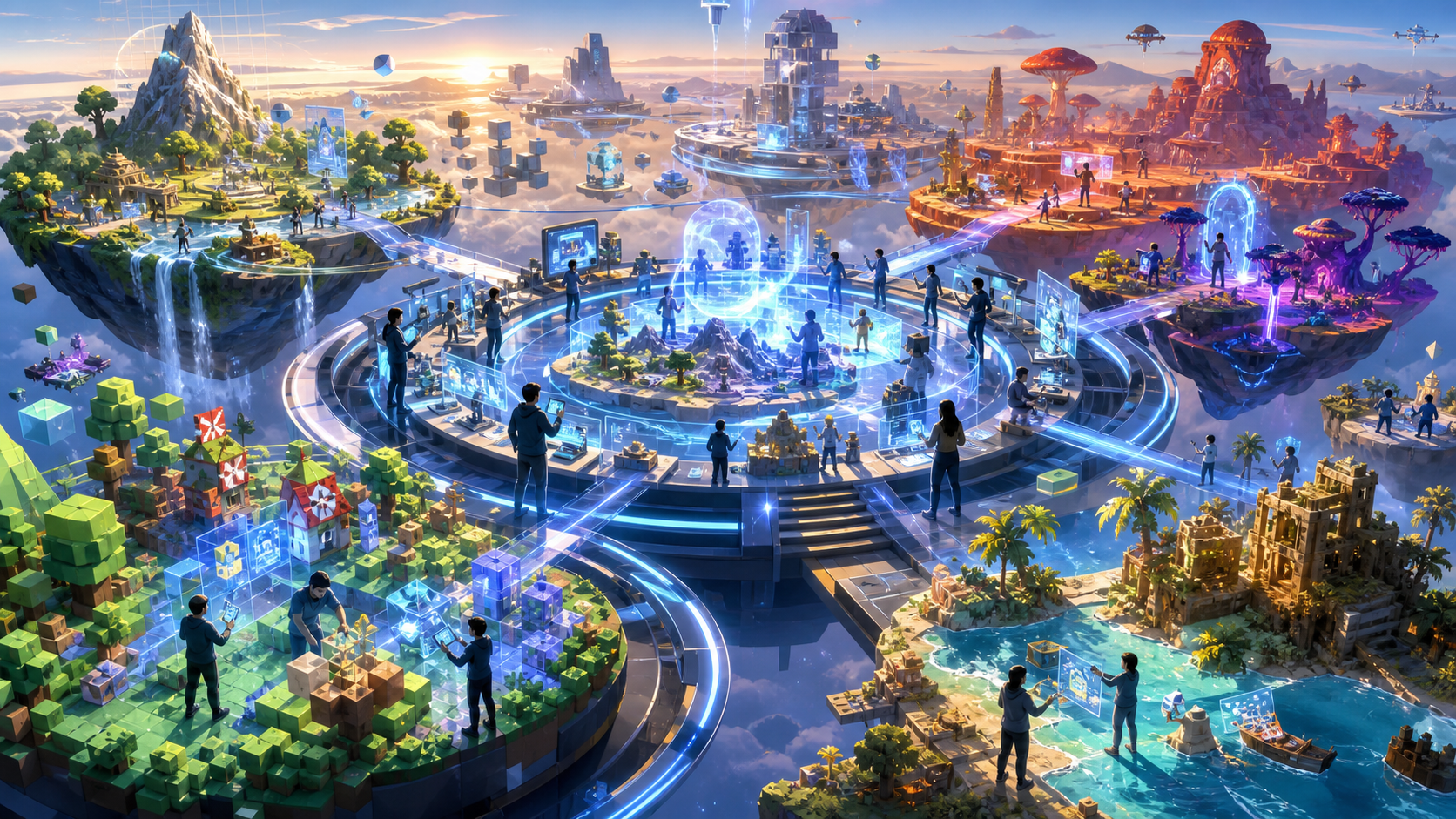
Finding an AI game platform in 2026 is different from choosing a single game. A game gives you one designed experience; a platform may let you discover worlds, create or remix them, publish your own ideas, and participate in a community.
The category is still developing. Some products focus on open-ended characters, some add AI assistance to established creator ecosystems, and others explore worlds that respond to actions in real time. The right choice depends on whether you primarily want to play, tell stories, build, research, or reach an existing audience.
This guide explains the qualities that matter, compares the main platform types, and separates an AI game platform from a one-purpose game generator.
What Makes an AI Game Platform Different?
Traditional games are usually finished products. Their environments, systems, missions, and dialogue are prepared before release, even when the game offers many possible paths. A handcrafted experience can deliver exceptional polish because designers control those details.
An AI game platform adds another possibility: the player can become part of the creation process. The same person might explore a world, change its premise, create a variation, and share that version with others. AI can help interpret natural-language ideas or generate pieces of an experience, while the platform supplies the surrounding tools, rules, hosting, discovery, and community.
That does not replace authored games. It creates a different category where the boundary between playing and building becomes less rigid.
The Rise of Interactive AI Worlds
Early generative entertainment often produced one output at a time: a character image, a short scene, a dialogue response, or a piece of music. AI game platforms are now trying to connect those outputs into experiences.
An interactive world needs more than attractive content. It must respond to actions, preserve important context, and turn choices into consequences. A character should do more than talk; it should affect a quest, relationship, location, or resource. A generated environment should do more than look different; it should create a new possibility for play.
Research into world models—including work such as Google DeepMind's Genie family—points toward environments that can be generated or adapted around actions. Much of this direction remains experimental, but it illustrates the longer-term goal: worlds that are not entirely fixed before the player enters them.
What the Best AI Game Platforms Should Offer
An impressive demonstration is not enough. A usable platform needs to turn technical capability into a satisfying player and creator experience.
1. Instant Access to Something Playable
Players should not have to configure a complex toolchain before anything interesting happens. A platform needs an inviting first experience, clear controls, and a short route from discovery to interaction.
For creators, low friction matters too. Templates, understandable building blocks, and useful defaults make it possible to test an idea before investing in a larger project.
2. Worlds That Respond to Players
The presence of AI is less important than its effect. Ask whether the platform interprets unusual choices, remembers relevant context, and changes the experience in a way the player can understand.
Responsive does not mean random. If a world changes without preserving rules or causality, players cannot form plans. The strongest systems combine flexibility with stable constraints.
3. Meaningful Choices
Interactive storytelling has existed for decades. AI adds value when it gives players more ways to express an intention without making every outcome interchangeable.
Good choices reveal information, alter relationships, change available actions, or reshape future events. Unlimited text generation is not a substitute for consequences.
4. A Community of Creators
The largest game platforms have benefited from people who make, share, review, and improve experiences. AI can reduce the barrier to creating, but a healthy ecosystem also needs discovery, attribution, moderation, versioning, and clear ownership terms.
Creation should be the beginning of a loop: make, test, revise, publish, learn from players, and improve. A platform that produces a single disposable result is closer to a generator than a community.
AI Game Platform Categories to Watch
The market includes very different products, so a numbered ranking can be misleading. These categories provide a more useful comparison.
AI Playable-World and Creation Platforms
Best for: people who want to explore, create, and remix AI-assisted games.
These platforms are built around the idea that an imagination can become the starting point for a playable world. Users move between roles: player, storyteller, builder, and publisher.
Evaluate how far the workflow extends beyond the initial generation. Can you revise rules, maintain character consistency, test with other people, and keep improving a published world? A platform becomes more valuable when it supports an ongoing creative process rather than a one-click result.
Roblox AI Experiences
Best for: social play and creators already working in a large user-generated-content ecosystem.
Roblox demonstrates the long-term value of player-made games, community discovery, and shared social spaces. AI-assisted tools can potentially make parts of creation faster or more accessible, while the established platform supplies an audience and familiar distribution model.
The tradeoff is that creators work within an existing ecosystem's technical rules, moderation systems, economics, and audience expectations. Faster creation does not remove the need for quality control or responsible community management.
Fortnite Creative and UEFN
Best for: creators who want advanced building tools and access to an established gaming audience.
Fortnite Creative and Unreal Editor for Fortnite sit between casual creation and traditional development. They offer a mature environment for constructing and publishing experiences, with more control than many prompt-first tools.
This path is useful when production depth and audience reach matter more than instant natural-language generation. It can also require more learning, design effort, and compliance with a defined publishing ecosystem.
AI Roleplay and Character Platforms
Best for: conversation-led stories and personalized character interaction.
Character platforms offer something fixed dialogue trees struggle to provide: players can phrase unexpected questions, goals, or emotional responses. The next step is connecting that conversation to game systems.
A roleplay platform feels more like a game when characters remember important history, pursue goals, unlock or close actions, and influence the world. Conversation without state or consequence remains interactive fiction, but not necessarily a complete game platform.
AI World-Generation Research Platforms
Best for: understanding where real-time interactive environments may go next.
Research demonstrations explore systems that infer or generate environments around user actions. They are important because they test a future in which a world can emerge during interaction rather than being fully authored in advance.
Treat experimental access as research, not a production promise. Look closely at consistency, control, duration, resolution, reproducibility, and the conditions under which a demonstration was produced.
AI Game Platform vs. AI Game Generator
The distinction comes down to what happens after generation.
| Question | AI game generator | AI game platform |
|---|---|---|
| Primary result | One concept, scenario, asset, or prototype | A playable and often publishable ecosystem |
| Iteration | Regenerate or edit an output | Build, test, revise, and maintain experiences |
| Community | Optional or absent | Discovery, sharing, feedback, and remixing |
| Player role | Usually consumes the generated result | Can move between playing and creating |
| Best use | Fast ideation or a focused task | Ongoing creation, distribution, and participation |
Choose a generator when you need to prove a small idea quickly. Choose a platform when you want the surrounding workflow: persistent projects, playtesting, publishing, community discovery, and continued iteration.
How to Choose the Right AI Game Platform
Start with your actual goal rather than the most dramatic demo.
- Decide your role. Are you mainly a player, storyteller, casual builder, experienced developer, educator, or researcher?
- Test the first ten minutes. A good platform should make its core value clear without hours of setup.
- Check whether choices persist. See if characters and worlds remember actions and preserve their own rules.
- Inspect creator control. Determine what can be edited, locked, reused, exported, or versioned.
- Review community safeguards. Look for moderation, reporting, age-appropriate controls, and transparent discovery rules.
- Read rights and privacy terms. Confirm how prompts, uploaded assets, generated content, personal data, and commercial use are handled.
- Understand the costs. Free access may limit generation, storage, publishing, compute, or advanced tools. Verify current pricing directly.
If you intend to combine generated media with an interactive prototype, keep a record of prompts, source files, licenses, and revisions. DeepFake's creative model catalog can support visual experimentation outside the game platform, but you should confirm that your chosen game ecosystem accepts the resulting formats and usage rights.
The Future of AI Game Platforms
The strongest direction is not simply “more generated games.” It is a tighter loop between imagination, interaction, and community. A player can discover a world today, create a variation tomorrow, and invite others to shape what happens next.
Future platforms will likely combine authored structure with adaptive systems. Creators will still define the premise, goals, visual identity, and safety boundaries; AI will help interpret ideas and produce variations inside those decisions. This balance matters because unlimited possibilities do not automatically create a better game.
The boundary between creator and player is disappearing, but judgment remains central. The platforms that last will make creation accessible while preserving coherent play, creator rights, community safety, and meaningful choices.
Frequently Asked Questions
What is an AI game platform?
It is an ecosystem for playing and often creating interactive experiences that use AI to interpret input, adapt content, or help build worlds. Unlike a single game, a platform usually supports multiple experiences, projects, creators, or a discovery community.
Do I need coding skills to create an AI game?
Not always. Prompt-first and template-based platforms can lower the entry barrier, while advanced ecosystems such as UEFN require more technical learning. The amount of control usually increases with complexity.
Are AI roleplay platforms the same as AI games?
They overlap. A roleplay product becomes more game-like when dialogue changes persistent state, objectives, relationships, resources, or the environment. Conversation alone may be better described as interactive storytelling.
Should I use a generator or a platform?
Use a generator for quick concepts and isolated prototypes. Use a platform when you need persistent creation tools, playtesting, publishing, community discovery, or an audience.