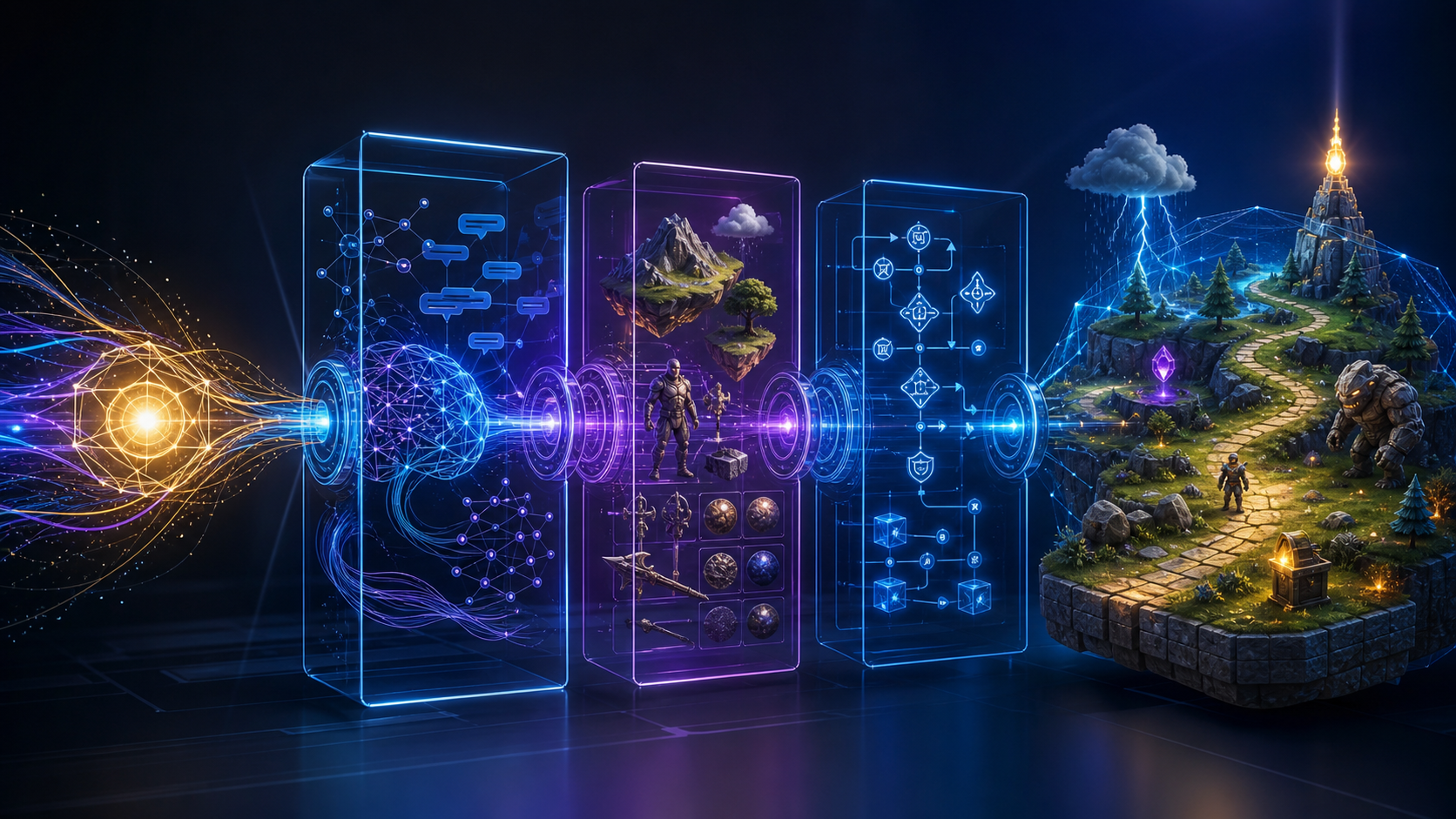
An AI game generator is best understood as an emerging category of creation tools, not a magic button with one fixed capability. Depending on the product, it may help turn a prompt into a design brief, generate placeholder assets, suggest code, assemble a scene, configure a template, or produce a limited interactive prototype.
The label is not standardized. A tool that generates character art and a tool that creates executable game logic may both appear under the same search term even though their outputs are fundamentally different. In 2026, the safest expectation is AI-assisted game creation: artificial intelligence can reduce friction in parts of the process, while people and game-development software remain responsible for integration, design, testing, rights, and release quality.
This guide explains the inputs these systems accept, the three layers behind a typical workflow, why the category is attracting attention, what kinds of experiences it can support, and how AI-assisted generators fit into the longer evolution from game engines to user-generated-content platforms.
What Is an AI Game Generator?
An AI game generator is a tool or platform that uses one or more AI systems to assist the creation of games, interactive prototypes, or virtual environments from creator input. That input might be:
- a text prompt;
- a gameplay idea;
- a character concept;
- a story outline;
- a visual reference the creator has permission to use; or
- a description of a world and its atmosphere.
The system may help propose or generate some combination of:
- mechanics: the actions and constraints that shape play;
- environments: layouts, locations, terrain, or scene concepts;
- characters: visual direction, roles, dialogue, or behavior drafts;
- objectives: goals, missions, challenges, and success conditions;
- systems: resources, state, progression, rewards, and failure rules; and
- interactions: what happens when the player acts on an object, character, or world state.
“May help” is important. Some tools stop at a written specification. Others provide media assets or code snippets. A smaller group can assemble a playable result within supported formats. Even then, a generated prototype is not automatically stable, original, accessible, secure, balanced, or ready to publish.
The practical purpose is to reduce the distance between an idea and something a creator can inspect. That can help professionals explore options earlier and let beginners approach game design before they have mastered every engine workflow. It does not erase the difference between a rough test and a complete game.
How Does an AI Game Generator Work?
Although implementations vary, a useful conceptual model has three layers: natural-language understanding, content creation, and gameplay logic or interactive systems. A real product may combine them, omit one, or rely on a conventional engine for execution.
Layer 1: Natural-Language Understanding
The first task is interpreting what the creator means. Consider this request:
Create a space exploration game where a small explorer discovers unknown planets.
The sentence provides a theme but leaves most design decisions unstated. A language model may identify:
- theme: discovery in space;
- genre: exploration adventure;
- player role: a small, potentially vulnerable explorer;
- goal: visit and learn about unfamiliar planets;
- emotional direction: wonder, isolation, or cautious curiosity; and
- gameplay expectations: travel, observation, collection, and environmental problem-solving.
A responsible system should turn ambiguity into questions rather than inventing an enormous project silently. How does the explorer travel? What makes one planet different from another? Is there danger? What information persists between visits? What ends the prototype?
For a small first version, the structured brief might become:
The player lands on one unknown moon, scans three unusual life forms, manages a limited battery, and returns to the ship before a radiation storm. Each scan reveals one clue about why the moon appears abandoned.
This is still a design draft, but it has a role, location, verbs, resource, objective, pressure, and end condition. Natural-language understanding is valuable when it produces a clearer specification—not merely a longer paragraph.
Layer 2: AI-Assisted Content Creation
Once the intent is structured, AI can help draft content for the experience. Depending on the tool, that might include:
Characters
- role and silhouette concepts;
- personality notes;
- dialogue alternatives; or
- behavior descriptions for later implementation.
Environments
- visual references;
- level-blockout suggestions;
- location lists;
- terrain or prop concepts; or
- mood and lighting directions.
Gameplay content
- mission outlines;
- challenge variants;
- reward ideas;
- item descriptions; or
- tutorial wording.
For the small explorer example, this layer could propose three life-form concepts, a scanner interface sketch, environmental landmarks, and placeholder mission text. Each output needs review. Generated dialogue may contradict the story. An attractive planet concept may be impossible to navigate. A visual asset may drift from the explorer’s approved design or resemble protected work.
Content is not the same as gameplay. A collection of characters, landscapes, and missions becomes useful only when the game’s rules connect them and the engine can execute those relationships.
Layer 3: Gameplay Logic and Interactive Systems
This is the most demanding layer. Games need rules that remain consistent while players behave unpredictably. A system must define or help implement:
- input and available player actions;
- collision and spatial constraints;
- interaction conditions and outcomes;
- game loops and feedback;
- resources and world state;
- progression and failure;
- character or opponent behavior; and
- saving, loading, and transitions where required.
In the moon prototype, scanning should work only within range, consume battery, record a discovery once, update an objective, and produce readable feedback. The storm must change the world according to a reliable rule. Returning to the ship should succeed only when the required scans exist. Those details are executable logic, not visual decoration.
Some emerging tools can scaffold portions of this layer, especially inside constrained templates. Generated code can be wrong, insecure, difficult to maintain, or inconsistent with the requested mechanic. Human review, engine testing, and playtesting remain necessary.
The overall workflow is therefore closer to:
idea → structured specification → candidate content → executable logic → engine integration → testing and revision
It is not safely summarized as “prompt → finished game.”
Why AI Game Generators Are Drawing Attention in 2026
No market-size claim is needed to explain the interest. Three practical pressures make the category appealing: access, prototype speed, and personalization.
1. Lowering the Technical Entry Barrier
Game creation traditionally requires familiarity with code, 3D production, level design, animation, engines, and systems thinking. Many people have interactive ideas but cannot yet express them through those tools.
A natural-language interface lets someone begin as a storyteller, teacher, artist, designer, or player. The system can translate a premise into a checklist, a template, or an early draft. This does not mean technical skill stops mattering. As the project becomes more original or complex, creators need deeper control and better debugging ability.
Lower entry is still meaningful. A teacher might test a lesson structure, a writer might explore a branching scene, and a gamer might prototype one rule for friends before committing to a long learning path.
2. Reaching a Prototype Faster
Traditional game work can take weeks, months, or years depending on scope, team, quality target, and platform. Those time ranges are illustrative, not a benchmark or a promise about every project. A tiny paper puzzle and a networked open world are not comparable production tasks.
AI can accelerate early experimentation by drafting alternatives, generating placeholders, or scaffolding a supported mechanic. The benefit is earlier evidence:
- Does the core loop make sense?
- Is the world easy to navigate?
- Does the mechanic create a real choice?
- Which part of the idea should be removed?
A prototype that appears quickly may still need extensive rewriting. Speed at the first draft should not be confused with speed to a reliable release.
3. Exploring Personalization
AI-assisted systems may help vary themes, characters, difficulty, story details, or learning material for a particular audience. A calm exploration experience could use different settings; a lesson could offer alternate examples; a puzzle set could adjust after the player demonstrates mastery.
Personalization must preserve stable rules and player agency. It also raises privacy, safety, moderation, and quality questions. A system should not gather sensitive preferences without permission, generate inappropriate material, or change difficulty so opaquely that success feels arbitrary.
The responsible goal is controlled adaptation under clear constraints, not an endlessly improvised world that nobody can test.
The Imagine → Create → Explore → Remix Loop
A four-stage cycle explains the creative value better than a one-click metaphor.
Imagine
Begin with a story, character, mechanic, lesson, or world concept. State the player role, main action, intended feeling, objective, and limitation. For the explorer example, narrow “unknown planets” to one moon and one scanning loop.
Create
Use appropriate tools to produce the first executable test. AI may assist with the specification, placeholders, code drafts, or a scene where supported. Confirm what is actually interactive. A rendered planet and character image are not a game until the player can act and the world responds.
Explore
Play the result and observe it without defending the prompt. Can a new player identify the goal? Does the battery create an interesting route choice or only inconvenience? Can the player trigger scans twice, become trapped, or wait out the storm? Exploration includes both player discovery and creator investigation.
Remix
Revise one assumption at a time. Change battery capacity, move a life form, alter scan feedback, or branch the setting while preserving the loop. Keep version notes so each remix answers a question rather than adding random novelty.
The cycle repeats. A playtest changes what the creator imagines next, and the new idea becomes a more informed build.
Five Types of Experiences to Prototype
Different categories demand different systems. AI assistance is most credible when the tool’s output matches the experience being tested.
1. Story Adventures
Story games connect exploration and choice to narrative consequences. A useful small example is a mystery in a futuristic city where decisions affect the ending. The first prototype might include one district, three clues, and two mutually exclusive conclusions.
AI can help organize branches or draft dialogue variations, but creators must check continuity, characterization, and whether the player’s decisions genuinely change state. More text does not automatically create more agency.
2. Puzzle Games
Puzzle prototypes work well when they isolate one rule. Imagine a physics puzzle inside a magical laboratory where players redirect gravity to move a sealed object. The system needs consistent cause and effect, readable feedback, and a solution that follows from taught rules.
Generated puzzle variants require validation. An AI-proposed level may be impossible, trivial, or solvable through an unintended shortcut. Human playtesting remains the authority.
3. Strategy Experiences
Strategy games involve connected resources, decisions, exploration, or competition. Start with a compact system: two resources, three actions, and a short end condition. AI may suggest scenarios or simulate defined choices, but balance cannot be inferred from plausible prose.
Test for dominant strategies, meaningless choices, runaway advantages, and rules that contradict. A working economy is a relationship among numbers and player incentives, not a list of resources.
4. Sandbox Worlds
Sandboxes give players tools and let them create their own goals. A first version might offer a small island, a handful of building pieces, and one environmental system rather than an unlimited open world.
The challenge is interaction consistency. Pieces need predictable placement, physics, saving, and recovery from mistakes. Content volume matters less than whether a few tools combine in interesting ways.
5. Educational Games
An educational prototype can turn a lesson into decisions, practice, or simulation. A science activity might let students balance a fictional habitat; a history exercise might compare sources rather than reward memorization alone.
Educators must review factual accuracy, age suitability, accessibility, privacy, and learning outcomes. Generated explanations and adaptive difficulty should never bypass subject-matter review.
From Game Engines to UGC to AI-Assisted Generators
AI game generators are part of a longer tool evolution, not a replacement for everything before them.
Game engines expanded professional production
Engines package rendering, physics, input, scene management, animation, audio, and deployment so teams do not rebuild every foundation. They provide deep control but still require technical and design expertise.
UGC platforms expanded community creation
User-generated-content platforms combine editors, reusable assets, a runtime, publishing, discovery, and a community. They let more players become builders inside a defined ecosystem, though creators still learn platform logic, scripting, level design, and moderation rules.
AI-assisted generators add an intent layer
AI tools can place natural language and multimodal references earlier in the workflow. They may turn intent into a structured brief, draft components, or configure supported systems. The engine still executes the game, and a platform may still provide distribution and community.
These layers can coexist:
creator intent → AI assistance → UGC editor or engine → playable build → community feedback
The most useful future tools may be those that preserve editability. A creator should be able to inspect rules, change generated output, export or maintain the project where promised, and understand which component produced a behavior.
What AI Game Generators Still Do Not Solve
Emerging systems can be impressive within a narrow demo and unreliable outside it. Before treating a result as a game, check:
- Coherence: Do story, art, rules, and feedback agree?
- Editability: Can the creator inspect and revise generated logic?
- Reliability: Does the same action produce predictable outcomes?
- Performance: Does the build run acceptably on target devices?
- Accessibility: Are controls, cues, text, timing, and difficulty usable by more players?
- Rights: Are inputs and outputs original or properly licensed?
- Security: Has generated code been reviewed for unsafe behavior?
- Moderation: Can public or personalized content be kept appropriate?
- Testing: Have people unfamiliar with the prompt played the build?
- Maintenance: Can bugs be fixed after the generating system changes?
Fun is also not a generated checkbox. A tool can produce a functioning loop that feels repetitive or confusing. Designers develop taste through observation, iteration, and understanding players. AI may increase the number of options, which makes selection and testing more important.
How to Evaluate a Tool Before You Commit
Do not judge an AI game generator only by a cinematic demo. Ask practical questions:
- What inputs does it accept, and what rights must you hold?
- Does it output a design, media asset, code, engine project, hosted demo, or editable game?
- Which genres and mechanics are genuinely supported?
- Can you inspect and change the logic?
- What can be exported, and in which format?
- Who owns or may use the inputs and outputs?
- How are generated assets, training concerns, and provenance handled?
- What data does personalization collect?
- How are safety, moderation, and accessibility addressed?
- What happens when the service or model changes?
A tool may be useful even if it generates only a narrow prototype, as long as its limits match your goal. Problems begin when a visual concept generator is mistaken for a game engine or a hosted demo is mistaken for a maintainable project.
Where DeepFake Fits—and Does Not Fit
DeepFake is not an AI game generator. It cannot create executable game mechanics, world state, objectives, interaction logic, progression, collision, or a playable engine project.
It can support visual exploration before implementation. Text-to-image can help draft an original small explorer, unknown moon, or laboratory environment from a written brief. Image-to-image can help explore controlled variations of artwork you created or are authorized to modify.
Those images are concept references, not interactive worlds. Use original or licensed inputs, avoid copying protected characters or artists, and verify rights before placing generated media in a commercial pipeline. A game developer still needs appropriate software to build, animate, optimize, integrate, and test the final assets.
Frequently Asked Questions
Can an AI game generator make a complete game from one prompt?
Some systems can create limited, template-based, or experimental playable results. That does not establish mature one-click generation for every genre or production target. A complete release still requires coherent design, implementation, testing, performance, accessibility, rights review, and maintenance.
Is an AI game generator the same as a game engine?
Not necessarily. A game engine provides the runtime and development systems that execute a game. An AI generator may work inside an engine, export to one, create code or assets for one, or provide only a hosted prototype. Check the actual architecture and export format.
Do I need programming skills?
Some constrained tools let beginners prototype without writing code. Programming becomes valuable when generated behavior fails, a custom system is required, or the project must be maintained outside a template. No-code entry does not remove the need for game design and playtesting.
Are AI-generated games faster to create?
AI can make some early drafts and experiments faster. The total schedule depends on scope, tool fit, team, quality, and release requirements. References to weeks, months, or years are illustrative comparisons, not universal benchmarks.
Can AI personalize every session safely?
Personalization can be useful under clear constraints, but it needs consent, privacy protections, moderation, stable rules, and quality review. Unlimited improvisation may create inconsistent or inappropriate results.
Can AI automatically balance a strategy game?
It may help run defined simulations or identify patterns, but balance depends on real player behavior, incentives, maps, accessibility, and evolving strategies. Human analysis and playtesting remain necessary.
Is DeepFake an AI game generator?
No. DeepFake can help explore original visual concepts through supported image workflows. It does not generate a playable game, interactive world, or gameplay logic.
Conclusion
An AI game generator is an assistance layer that can connect creative intent to parts of a game-development workflow. It may understand a prompt, draft content, scaffold logic, or assemble a constrained prototype. Its real capability depends on the product, engine, supported genre, and output format.
The most useful mental model is not one-click completion. It is Imagine, Create, Explore, and Remix: define a small idea, build what the tool genuinely supports, play it, and revise from evidence.
Game engines made complex production more manageable. UGC platforms brought creation to communities. AI-assisted generators may lower the language barrier between an idea and those tools. That can invite more people to experiment—but polished games will still depend on human imagination, technical skill, responsible rights handling, and rigorous testing.