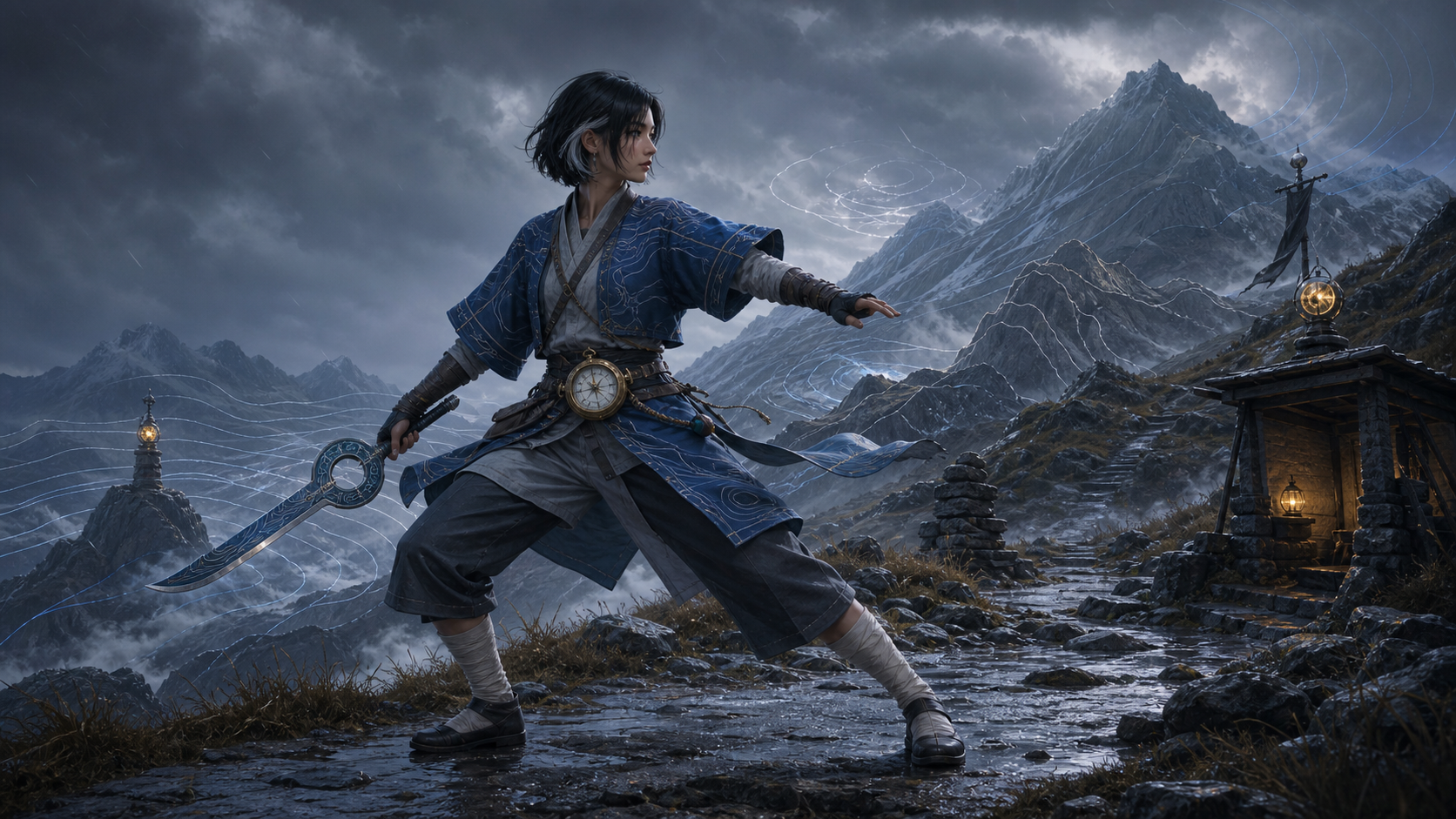
Fan-work notice: This is an unofficial Demon Slayer: Kimetsu no Yaiba-inspired character-design guide. It is not affiliated with, authorized by, licensed by, or endorsed by the franchise’s creators, publishers, animation partners, or other rights holders. Mio Arakida, Barometer Breathing, the five forms, blade, costume, effects, and story below are fan concepts—not canon, leaks, official assets, screenshots, announcements, or upcoming content.
A convincing fan-made slayer needs more than a weather word followed by a powerful attack. The theme should shape how the character moves, what they notice, how they trained, why the blade looks the way it does, and what happens when their technique fails. The most useful limitation attacks the character’s deepest goal, forcing growth that cannot be achieved by striking harder.
This guide builds Mio Arakida, a clearly adult mountain-route escort in her late twenties. Her original Barometer Breathing concept uses subtle changes in pressure as a timing discipline. It does not grant literal control over storms. The design stays deliberately bounded: Mio can anticipate committed movement when calm, but repeated pressure shifts damage her balance and make her judgment unreliable.
1. Begin With Mio Arakida’s Human Conflict
Start with a person before inventing a technique.
Name: Mio Arakida
Age and role: Clearly adult woman in her late twenties; former mountain courier and current route escort responsible for guiding travelers through exposed passes, fog, rockfall zones, and narrow tunnels.
Want: Mio wants to prevent travelers from being surprised by danger in the way her own family once was. She plans routes obsessively and treats preparation as a promise.
Contradiction: She reads the atmosphere with extraordinary patience, yet makes emotional decisions too quickly. She can wait for a pressure drop but struggles to wait for another person’s judgment.
Fear: Her central fear is hesitating for one second too long and losing someone she was meant to protect.
Limitation: Her method depends on controlled breathing and stable inner-ear balance. Rapid or repeated pressure shifts cause vertigo, nausea, muffled hearing, and unreliable distance judgment. The sensation that normally helps her anticipate movement eventually corrupts the information she trusts.
This limitation is inseparable from the desire. The longer Mio tries to protect everyone alone, the less capable she becomes of telling near from far or real motion from apparent motion. In a difficult encounter, endurance is not automatically noble; stopping, sharing information, and accepting help become tactical skills.
Avoid giving her a hidden ability that cancels the cost. The pressure gauge at her belt can confirm broad atmospheric change, but it cannot predict an attack, cure vertigo, or replace judgment. A weakness that disappears whenever the plot needs a finishing move is not a real limitation.
2. Define Barometer Breathing as Movement Logic
Barometer Breathing is an original fan-made concept, not a statement about official lore. Its consistent physical idea is this:
Mio adjusts stance height, breath volume, and step timing to notice pressure around a moving opponent, then commits during the brief drop before acceleration.
The discipline relies on observation and timing rather than visible weather magic. Its recurring movement language includes:
- low, circular footwork that protects balance;
- a measured change in inhale before commitment;
- brief stillness used to separate real pressure from noise;
- short attacks timed to an opponent’s acceleration;
- coat edges drawing inward before Mio moves; and
- retreat or redirection instead of continuous forward force.
This logic determines what the style cannot do. It performs poorly when Mio is already dizzy, when loud pressure waves create false readings, when several motions overlap, or when unstable terrain prevents a reliable stance. A feint can defeat anticipation if she treats sensation as certainty.
The style should never become “she predicts everything.” It lets her make a better-informed guess under controlled conditions. Wrong guesses have visible consequences.
3. Create Five Forms With Different Costs
Each form should solve a distinct tactical problem and expose a distinct risk. Names alone do not create variety.
First Form: Falling Needle
Mio holds a low guard and watches for the pressure shift created by a committed forward movement. She answers with one compact diagonal draw, entering just off the attacker’s line rather than meeting force directly.
Best use: A single opponent commits to a readable advance in a confined route.
Cost and counterplay: Falling Needle depends on timing. A feint, delayed step, or broken rhythm can make Mio draw early. Because the attack is short and committed, a missed read leaves her side open and gives little room to correct. Repeating it encourages the opponent to manipulate her expectation.
Second Form: Closed Isobar
Mio uses circular steps and measured blade placement to preserve a fixed distance around herself or one nearby traveler. The form is a moving defensive boundary rather than an impenetrable shield.
Best use: Creating a brief protected route through falling debris, close pressure, or a single line of attack.
Cost and counterplay: Maintaining distance requires stable breath, clear footing, and room to turn. Narrow ledges, obstacles, or multiple people entering the circle strain the pattern. Sustained use tires the legs and inner ear, so the boundary tightens and becomes easier to break.
Third Form: Sudden Front
Mio becomes completely still for one beat, then changes direction through two steps: a short false entry followed by a sharper diagonal approach. The stillness makes the acceleration legible as part of this fan style.
Best use: Breaking a predictable exchange or moving around a guarded line.
Cost and counterplay: The preparation cannot be skipped. During that still beat, Mio is vulnerable to an opponent who recognizes the setup or forces unstable footing. If vertigo has begun, the second angle may overshoot, placing her farther from safety than intended.
Fourth Form: Low-Pressure Hollow
Mio withdraws along a curved path and leaves the opponent’s committed attack in empty space. The purpose is to redirect momentum and open an escape route, not to vanish or teleport.
Best use: Drawing a powerful linear strike away from travelers or a tunnel entrance.
Cost and counterplay: The form gives up ground. Near a cliff, crowded shelter, or injured civilian, there may be nowhere safe to retreat. It also relies on accurate distance perception—the first faculty damaged by her vertigo. A small error can turn a controlled hollow into a collision.
Fifth Form: Storm Warning
Mio performs a risky sequence of tight turns and short repositioning steps, attempting to read several incoming movements long enough to call a route for others. It is an emergency coordination form, not a superior version of every other technique.
Best use: A brief evacuation window when several threats or pressure bursts overlap.
Cost and counterplay: Every rapid turn compounds inner-ear strain. Visual focus narrows, sound becomes indistinct, and distance estimates degrade. After the sequence, Mio may be unable to attack safely or walk without support. Storm Warning cannot be chained repeatedly, and using it for personal glory rather than evacuation should fail.
The fifth form is deliberately the most costly. A finishing technique with no aftermath would undermine Mio’s fear, training, and story. Her success must come from choosing the right moment and relying on other people—not from overpowering every established character.
4. Create a Training History That Explains the Style
Mio did not discover pressure awareness in combat. She learned it as a mountain courier, noticing fog, falling temperature, wind shifts, and strain in her own ears while carrying messages between remote settlements. That background gives her knowledge a daily purpose before it becomes a fighting method.
Her later teacher does not “invent” the sensory talent. They teach Mio to distinguish observation from certainty. The central lesson is that a bodily signal is evidence, not prophecy.
Use five training exercises:
- Cross suspended logs with eyes closed. Mio learns to distribute weight through the feet and stop when the surface moves unexpectedly. A spotter and safety line are part of the training; the goal is balance, not reckless injury.
- Identify weather shifts through ear pressure. She records predictions, then compares them with actual conditions so mistakes remain visible. Correct guesses do not erase incorrect ones.
- Maintain slow breathing while irregular bells sound. The bells disrupt rhythm and teach her not to accelerate simply because noise creates urgency.
- Stop immediately when balance degrades. This is the most important safety rule and the one she resists. The exercise is failed if she “pushes through” dizziness.
- Map safe mountain shelters. Mio turns individual skill into shared preparation by marking routes, supplies, wind cover, and fallback locations for ordinary travelers.
The fifth exercise prevents training from becoming a montage about personal strength. A route map can protect people when Mio is absent or incapacitated. That idea becomes essential in the story climax.
5. Build Mio’s Silhouette Around Six Anchors
Use a clearly adult visual brief: Mio is a woman in her late twenties, medium height, with a low balanced stance, long oval face, dark brown eyes, and practical proportions suited to mountain travel. Her base clothing is dark charcoal and original rather than a copy of a canon uniform.
Lock exactly six recognition anchors:
- Chin-length black hair with a thick, simple shape that stays clear during motion.
- One pale gray streak behind the right ear, always on the same side.
- A short storm-blue outer coat that leaves leg movement readable.
- A restrained contour-line pattern at the hem, concentrated low rather than covering the entire garment.
- A small round pressure gauge at the belt, treated as a practical reference rather than a magical detector.
- White ankle wraps that make the low circular footwork easy to follow.
The short coat serves animation. The hem pattern supports the pressure theme without reproducing a recognizable franchise motif. The gauge connects to Mio’s courier history. The wraps emphasize stance and recovery.
Do not reproduce a canon character’s hairstyle, garment cut, pattern, color arrangement, emblem, or distinctive accessory. Avoid official uniforms and ranks. If the design remains recognizable only because it copies those elements, it is not an original OC design.
Neutral visual prompt
Clearly labeled unofficial fan-made action-anime slayer concept, original adult woman in her late twenties, medium height, low balanced stance, long oval face, dark brown eyes, chin-length thick black hair with one pale gray streak behind the right ear; original dark-charcoal practical mountain uniform with no emblem, short storm-blue outer coat, restrained topographic pressure-line pattern only near hem, white ankle wraps, small round pressure gauge at belt; neutral three-quarter production pose on plain background, clean line art, controlled cel shading, no existing character, no official logo, no text.
If you use text-to-image to explore the concept, keep “unofficial fan-made” in the surrounding caption and project metadata even if generated text inside an image is unreliable. DeepFake does not provide an official franchise template, canon validation, or rights clearance.
Generate the neutral reference before adding sword motion or pressure effects. Confirm apparent adult age, gray-streak side, coat length, hem-pattern placement, gauge position, and ankle wraps. Reject visual drift before it spreads into action images.
6. Design an Original Fan-Made Blade
The blade should serve Mio’s mountain role and movement logic rather than collecting weather ornaments.
Use these construction decisions:
- a slightly shorter katana-style blade for narrow trails, brush, and tunnels;
- a muted blue-gray blade tone rather than a glowing elemental surface;
- a circular guard with one open segment, like an incomplete pressure ring;
- a dark braided handle with one white wrap as a restrained grip marker;
- a plain charcoal scabbard with small handmade altitude notches; and
- no official insignia, copied guard, or canonical weapon detail.
The open guard reflects incomplete certainty: Mio reads signs, but no circle of information is ever fully closed. The shorter length supports her compact draws and route work. The altitude marks are personal records, not a power system.
Blade prompt
Original unofficial fan-made sword concept for an adult mountain-route escort, practical slightly short blue-gray katana-style blade, circular dark guard with one clean open segment, dark braided grip with one white wrap, plain charcoal scabbard with subtle handmade altitude notches, functional construction, neutral product view, no logo, no official insignia, no existing weapon, no text.
Do not present the blade as an official Nichirin design, production prop, game asset, or collectible. “Nichirin-inspired” in a fan discussion does not create commercial rights.
7. Keep Animation and Vertigo Effects Consistent
Create a small visual grammar and reuse it. Barometer Breathing should not look like unrelated lightning in one scene, water in another, and a tornado in the next.
Fixed action effects:
- the outer-coat hem pulls slightly inward before movement;
- thin gray-blue contour lines suggest compressed air;
- a small dust compression appears at the feet;
- motion follows one visible beat of stillness; and
- the camera favors side or three-quarter views that reveal timing and footwork.
Fixed vertigo effects:
- the horizon tilts gradually rather than spinning at random;
- foreground and background distance become difficult to separate;
- hearing loses clarity or sounds arrive muffled;
- Mio touches the ground or wall to restore orientation; and
- contour effects weaken or misalign as her reading becomes unreliable.
Do not represent dizziness through an explosion of unrelated colors. The viewer should understand that the inner-ear cost disrupts distance and balance. The effect must change Mio’s choices, not simply decorate a heroic pose.
Action prompt
Mio Arakida, clearly adult fan-made mountain escort, lowers into her approved balanced stance and holds still for one beat; the short storm-blue coat hem pulls inward, then she steps diagonally during an opponent’s committed movement and performs one compact controlled draw; side-on camera shows timing and footwork; preserve long oval face, gray streak behind right ear, hem pattern, round belt gauge, white ankle wraps, short blue-gray blade, and open circular guard; restrained gray-blue pressure contours and small dust compression, no lightning, no water, no copied official effects.
For a clearly labeled fan-concept motion study, image-to-video may help animate artwork you created or are authorized to use. It does not guarantee character consistency, official animation language, or a finished combat scene. Review every frame for identity drift, unsafe sword motion, copied imagery, and misleading presentation.
8. Write a Six-Step Mountain Story That Attacks the Technique
The story should force the limitation to matter and make shared preparation more valuable than solitary power.
Step 1: Mission
Mio escorts villagers through a high mountain pass before incoming weather closes the route. The group includes an injured traveler and a family carrying supplies. Her maps identify tunnels and shelters, but part of the marked trail has collapsed.
Step 2: Problem
Inside the tunnels, an original fan antagonist produces loud pressure bursts that rebound from several directions. Mio’s sensitivity provides too much information at once. She can anticipate the first burst, but every prediction worsens the vertigo that will eventually make her route calls dangerous.
Step 3: Midpoint
A child is separated from the group during a rockfall. Mio refuses the required balance stop because waiting feels identical to repeating the loss she fears. She uses Closed Isobar and Sudden Front in quick succession, succeeds briefly, then misjudges the tunnel wall’s distance.
Step 4: Choice
The villagers use copies of Mio’s shelter map to organize themselves. One marks the safe turn with a bell rhythm from her training; another supports the injured traveler. Mio must choose between continuing alone while disoriented or trusting the people she assumed were only her responsibility.
Step 5: Climax
Mio stops, grounds herself, and listens to the timing signal. After recovering enough orientation for one accurate read, she uses Falling Needle—not Storm Warning—at the antagonist’s committed advance. The villagers clear the route according to the shared plan. Victory depends on their timing and her restraint.
Step 6: Growth
Mio redefines responsibility as preparation people can share. She updates the maps, teaches the bell signal, and records where her own senses failed. Her fear does not vanish, and Barometer Breathing does not lose its cost. She becomes more reliable because she accepts limits before they become other people’s danger.
This chain makes movement logic, weakness, training, prop, and character arc one system. A larger finishing effect would be less satisfying because it would avoid the lesson the story built.
9. Fan-Work and Rights Boundaries
Label every image, character card, comic, animation test, and social post as unofficial fan work. Keep the label visible in the caption and surrounding context. Do not rely on an AI model to render the disclaimer correctly inside the artwork.
Do not:
- copy a canon character’s face, hairstyle, uniform, garment pattern, emblem, or weapon;
- reuse official manga panels, anime frames, screenshots, game assets, music, voices, logos, or typography;
- imitate an official website, update card, casting notice, trailer, or product announcement;
- market Mio as canon, leaked, licensed, approved, balanced, or scheduled for release;
- use a real actor’s face or voice without informed authorization; or
- treat participation in a fan community as a commercial license.
If you want to commercialize Mio as a fully independent character, rebuild the project comprehensively. Change the world, organization, enemy rules, sword terminology, uniform system, ability framework, visual language, history, and story conflicts. Removing the franchise name or renaming one technique is not enough when the surrounding expression remains derivative.
Commercial use involves copyright, trademark, contract, and publicity-right questions that vary by place and project. Obtain permission or qualified legal advice for meaningful commercial plans. This guide offers creative boundaries, not a guarantee of rights.
Frequently Asked Questions
How do I invent a coherent breathing-style fan concept?
Choose one physical or emotional principle, translate it into repeatable movement, assign each form a different tactical job, and attach a cost that changes decisions. Keep the effect language consistent. The theme should appear in training, clothing, blade, story, and failure—not only names.
Can Mio be stronger than every canon character?
Private fan fiction can explore many scenarios, but an OC who wins without cost usually loses tension and connection to the setting. Mio is designed to excel at one kind of anticipation and fail under sensory overload. Do not erase that limit or use her to invalidate established characters.
Why does Storm Warning need such a severe cost?
It asks Mio to process several pressure changes through rapid turns, directly stressing the inner-ear system her style depends on. The aftermath prevents it from becoming a default solution and creates a reason to evacuate, coordinate, or stop.
Can I use a Nichirin-style blade in fan art?
You can discuss and depict a clearly unofficial fan concept subject to applicable law and platform rules, but the franchise terminology and world remain protected context. Do not claim official status, and do not assume fan art automatically carries commercial rights.
How do I keep Mio consistent in generated images?
Lock the six visual anchors before action scenes: hair length, gray streak behind the right ear, short blue coat, contour pattern at the hem, round belt gauge, and white ankle wraps. Also preserve the blade length and open-segment guard. Compare every output with the neutral reference.
Should the pressure gauge predict attacks?
No. It can reinforce Mio’s courier origin and confirm slow environmental change, but it should not provide perfect combat information. Her observations must remain fallible, and the tool should not cancel vertigo.
Can I make the effects look like lightning or water?
That would weaken this concept and risk visual overlap with familiar material. Use restrained pressure contours, cloth pull, dust compression, stillness, and footwork. Consistency makes the fan style readable without copying named official effects.
Can AI make this character official?
No. Image or motion generation cannot create canon status, obtain a franchise license, approve a blade, or turn fan art into an official asset. Only the relevant rights holders control official content.
Conclusion
Mio Arakida works as a fan-made OC because every part of the design argues with another part. She wants to prevent surprise, yet her fear makes her rush. She reads pressure patiently, yet emotional decisions come too quickly. Barometer Breathing rewards calm timing, while overuse produces vertigo and bad distance judgment. The six visual anchors, short blade, open guard, training exercises, fixed effects, and mountain story all express that conflict.
Keep the forms limited, let costs survive the climax, and give other characters meaningful agency. A fan concept becomes more compelling when ingenuity, preparation, and trust matter more than an ever-larger attack.
Final fan-work notice: This remains an unofficial Demon Slayer: Kimetsu no Yaiba-inspired guide with no affiliation, authorization, license, or endorsement from the franchise’s rights holders. Mio, Barometer Breathing, the blade, forms, costume, effects, and story are not canon, leaks, announcements, screenshots, or official assets; label any resulting work clearly and never present it otherwise.