Fan-work notice: This is an unofficial creative exercise inspired by broad themes associated with One Piece. It is not affiliated with, endorsed by, or licensed by the franchise's rightsholders. Do not present a fan OC, ability, crew, island, bounty, or story as canonical, leaked, playable, or officially announced.
A memorable pirate OC needs more than a dramatic coat and an overpowered ability. The character should have a dream large enough to generate a journey, a practical reason to be aboard a ship, a flaw that creates conflict, a readable silhouette, and a power whose limits force interesting decisions.
This guide builds those parts as one system. The running example is Ada “Drydock” Morrow, an adult fan-made shipwright whose load-routing ability is useful, dangerous, funny, and inseparable from the way she approaches people.
Start with the impossible dream
Pirate-adventure stories become memorable when a character wants something that sounds impossible but is specific enough to inspire questions.
Ada's dream is:
Build a ship that can cross a sea with no water.
That one sentence immediately creates a world-building engine. Why is the sea dry? Does the water return? What kind of hull can travel across salt flats, mud, or exposed reefs? What did Ada lose there? Why has nobody solved the problem already?
Give the character a place shaped by the dream. Ada comes from the Ledger Shoals, an original island chain where extreme tides leave harbors dry for long periods. Local builders use replaceable hull parts, skids, collapsible cranes, and salvage engineering because a conventional vessel may be stranded for weeks.
Then connect the dream to a shipboard role:
- Role: shipwright and emergency structural engineer.
- Goal: design a vessel that can survive both open water and the dry shoals.
- Contradiction: she can redesign almost anything under pressure but refuses to revise a plan after announcing it publicly.
- Comic habit: every repair receives an absurdly formal project name.
The role makes Ada valuable outside combat. The contradiction means her strength also causes problems. A good OC should be able to repair the ship, argue with the crew, make a bad decision, and grow—not simply arrive to win fights.
Design a fan-made Devil Fruit concept
For a distinct fan ability, begin with four elements:
- one clear action verb;
- one category of target;
- one physical rule or limitation;
- one consequence that creates strategy or comedy.
Do a canon-overlap check before committing to the name or visuals. Compare the mechanic, target class, transformation behavior, restoration rule, and practical uses—not only the fruit name. For example, reject a concept that softens solid objects into foldable sheets: the official character profile for Diamante identifies the canonical Hira Hira no Mi and says it can turn touched objects into fluttering material. Renaming a substantially similar mechanism would not make it distinct.
Ada's revised unofficial fan concept is the Load-Load Fruit. This is not an official Devil Fruit name or canonical ability. It is a design exercise built around rerouting mechanical force, not transforming matter.
Core rule
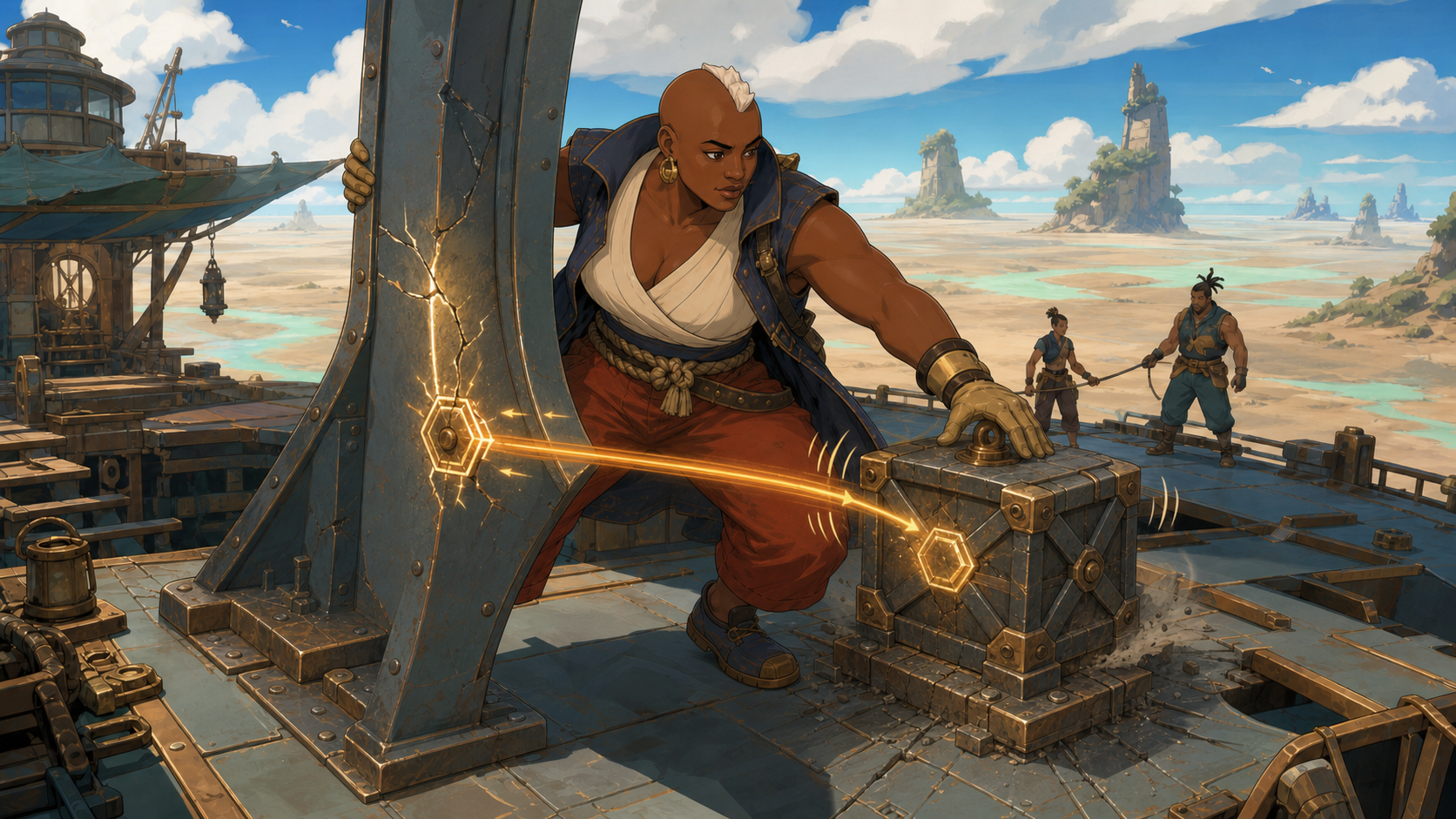
Ada can place one amber load mark on each of two nonliving structures she touches. For a few seconds, she can reroute one mechanical load entering the first mark—impact, compression, tension, recoil, or torsion—so that it exits through the second mark in the same direction.
The verb is reroute. The targets are loads traveling through two marked nonliving structures. Force is transferred, never erased. The target material stays rigid, keeps its mass, and does not repair itself.
Practical uses
- send the impact striking a cracked hull rib into a reinforced sacrificial block;
- redirect a cannon's recoil into a deployed anchor instead of the deck;
- move the tension from a failing mast stay into a temporary support cable;
- route a crane's downward load across two healthy beams while a damaged beam is replaced;
- transfer a gate's torsion into a capstan so the crew can turn it deliberately;
- make a loose barrel launch itself across the deck when Ada misjudges where a shock should emerge.
Limits
- The marks can be placed only on nonliving solids; Ada cannot route force into a body.
- She can maintain one paired route at a time, and both marks must remain within sight.
- The outgoing structure receives the full redirected load. If it cannot withstand the force, it cracks or moves.
- The power cannot erase an existing fracture, replace missing material, or make an object lighter.
- A load arriving from several directions cannot be separated cleanly; Ada must choose one dominant path.
- Large impacts numb her hands and forearms, reducing the precision of the next route.
- If concentration breaks, the link ends and new force follows ordinary physics again.
The conserved force is the important constraint. Saving one beam always means asking another structure to carry the danger. That creates tactical choices, rescue problems, and physical comedy without turning the ability into effortless repair magic.
Give the power a character cost
A power becomes more interesting when its logic echoes a flaw without merely restating it.
Ada loves elegant load paths. Faced with a failing structure, she searches for the one place that can safely absorb the stress. Unfortunately, she approaches disagreement the same way. She redirects tension toward the calmest crew member instead of addressing its cause.
Her growth is not learning to transfer a larger impact. It is learning that conflict cannot always be passed to the person most able to bear it. Sometimes the better design emerges only after she lets someone else change the plan and shares the load openly.
Use this test for any fan power:
- How does the ability help the character's role?
- What habit does it reward too strongly?
- Which situation defeats it without arbitrary immunity?
- What does the character need from other people?
- Can the power create a joke, mistake, rescue, and emotional choice—not only an attack?
If every answer is “the character becomes stronger,” add a cost that changes behavior.
Build a shipwright silhouette
Ada's design should read as a working shipwright at a distance. Begin with large shapes:
- clearly adult woman in her late thirties;
- broad, square build with a low center of gravity;
- dark umber skin;
- shaved head with one small angular white hair patch at the crown;
- heavy sleeveless indigo work coat;
- cream wrap top and rust-red cropped work trousers;
- thick rope belt;
- mismatched practical gloves;
- reinforced deck shoes;
- oversized brass folding ruler carried diagonally across the back.
Each feature has a job. The ruler is both a measuring tool and an action prop. Cropped trousers and reinforced shoes suit wet or unstable deck work. Mismatched gloves suggest repeated repairs rather than ornamental asymmetry. The rope belt is easy to replace at sea.
Avoid borrowing a canonical pirate's hat, coat, scar, emblem, signature color layout, or weapon silhouette. A new color over a familiar franchise silhouette is still a weak design.
Lock the identity anchors
Preserve these across every image:
- broad square body shape;
- small angular white hair patch at the crown;
- sleeveless indigo work coat;
- oversized brass folding ruler;
- mismatched gloves and rope belt.
Start with a neutral full-body view before adding powers, battle poses, or a detailed ship. Approve the ruler construction, coat shape, glove sides, belt, hair patch, and shoes first.
Design the crew identity
A crew should feel like a set of relationships, not a collection of characters built to admire the OC.
Ada sails with the Breakwater Crew aboard The Margin Call, a compact original salvage vessel with replaceable load frames and sacrificial ballast blocks. Their shared theme is work involving what other societies discard: broken ships, ruined maps, abandoned machines, failed experiments, and forgotten routes.
Their emblem can be an abstract wave divided around a triangular brace. Keep it original and avoid an official-looking skull-and-crossbones composition, especially if the design may later be adapted into independent work.
Ada is not the captain. That choice creates useful limits: she can be the technical authority while still having to negotiate decisions.
Two supporting fan OCs
The improvisational captain announces a direction before the engineering is ready, trusts momentum, and changes plans constantly. This frustrates Ada but can break her rigid thinking.
The scrap-map navigator draws routes on discarded paper and treats mistakes as valuable evidence. Their rough, layered maps conflict with Ada's desire for clean, final diagrams.
Neither exists only to praise her. Each creates a different pressure on her flaw, while Ada's structural discipline helps keep their habits from becoming reckless.
Write the AI character prompt
Use a prompt that describes broad visual craft rather than asking for the exact style of a named artist or copyrighted production.
Unofficial fan-made adventure pirate shipwright OC, clearly adult woman in her late thirties, broad square build, dark umber skin, shaved head with one small angular white hair patch at the crown. Heavy sleeveless indigo work coat over a cream wrap top, rust-red cropped work trousers, thick rope belt, mismatched dark work gloves, reinforced deck shoes. Oversized brass folding ruler fixed diagonally across her back and practical tool pouches at the waist. Confident low neutral stance on a plain light background, bold readable shapes, clean colorful adventure-comedy linework, full body and both hands visible. Entirely original character, no existing characters, official emblems, skull-and-crossbones logo, text, watermark, copied costume, or recognizable franchise prop.Generate the neutral reference first. On DeepFake, a text-to-image workflow can help produce concept variations, but every result still needs human review for anatomy, originality, unwanted logos, and reference-image rights.
Once the neutral reference is approved, make work poses before action poses: measuring a mast, bracing a beam, arguing over a blueprint, and dragging a reinforced ballast block into position.
Visualize the load-routing power consistently
Power effects drift quickly unless you define a visual grammar. For Ada's ability, lock four rules:
- Both marked structures remain solid, rigid, and visibly separate.
- One small amber geometric mark appears on each structure; a narrow line shows the selected path between them.
- Short arrows show force leaving the first mark and entering the second in a consistent direction.
- Stress appears physically at the receiver through vibration, compression, deck strain, or cracking—not through random energy explosions.
Use a three-stage effect sheet:
- Preparation: one gloved hand marks the failing hull rib and the other marks a reinforced block; both objects remain rigid.
- Transfer: the hull-side mark pulses, a narrow amber path lights, and the receiving block compresses or shifts under the redirected force.
- Release: the link vanishes, ordinary load paths return, and the recipient keeps any real damage caused by carrying too much force.
Keep the character anchors visible during every stage. If the effect hides the coat, ruler, and body shape, reduce it.
Outline a fan-made introductory arc
An introduction should prove the dream, role, flaw, power rules, and crew relationships through one problem. Use a six-beat structure.
1. Arrival
The Margin Call reaches Ledger Shoals during an unusually long dry season. Ada intends to recover a prototype land-sailing keel that could advance her dream of crossing the waterless sea.
2. Problem
A corrupt salvage guild has removed the town's sacrificial braces and sold the strongest beams. Without a new load plan, the returning tide will buckle the emergency docks, destroy homes, and trap evacuation ships.
3. Escalation
Ada insists she can calculate every load path alone. She marks the remaining beams and ballast efficiently but refuses the navigator's messy historical maps and the captain's eyewitness account.
4. Reveal
The “mistakes” in the scrap maps record previous shoreline positions. They reveal that the dock must be reinforced in a different sequence because the sea floor has shifted. Ada's elegant plan is now dangerous.
5. Climax
The crew races the incoming tide. Ada must distribute measurements among the crew, trust the navigator's layered shoreline record, and accept the captain's improvised support rig. Her power saves each failing span only by routing force into supports the crew prepared together. It solves the physical problem after she stops treating other people as silent shock absorbers.
6. Payoff
The docks hold. Ada does not obtain the prototype keel, but the town gives her its failed plans. She recognizes that a collection of revisions may be more valuable than a single perfect blueprint.
This arc makes the power useful without letting it replace the story. It also changes Ada in a small, believable way while leaving room for future conflict.
Design a bounty-style card without deception
A fan-made reward or bounty card can be part of the presentation, but it must not imitate an official asset closely enough to mislead viewers.
- Put FAN-MADE and UNOFFICIAL prominently in the design and surrounding caption.
- Use an original layout, type system, seal, border, and fictional issuing authority.
- Do not include publisher, studio, broadcaster, or franchise logos.
- Do not call the image a leak, episode preview, casting announcement, game update, or canonical reveal.
- Do not fabricate screenshots, official statistics, voice actors, or release dates.
If the image could circulate without its caption, the disclaimer should remain inside the asset. Avoid using it as clickbait that depends on viewers mistaking it for news.
Convert the concept into an original character
An OC can contain original details and still depend on a protected fictional setting. Renaming the ability is not enough to make the entire concept commercially independent.
To adapt Ada into an original IP, rebuild the protected framework:
- replace Devil Fruit terminology and rules with an original ability source;
- create distinct ocean physics and island institutions;
- redesign the crew's legal and social status instead of copying familiar pirate structures;
- establish an original visual language for flags, cards, technology, clothing, and ships;
- replace franchise-linked species, history, power taxonomy, and narrative conventions;
- revise the introductory arc so it depends on the new world's own conflicts.
For example, Ada could become a structural courier in a climate-fantasy world whose engineers use paired stress-routing seals powered by tidal minerals. Her waterless-sea dream, engineering flaw, and collaboration arc can survive, while the protected expression is removed.
If you intend to sell merchandise or publish commercial media, obtain permission where required or seek qualified legal advice. A platform's ability to generate an image does not grant rights in third-party characters, logos, music, voices, or settings. This guide is creative guidance, not legal advice.
A practical fan-OC checklist
Before publishing, confirm that:
- the work is clearly labeled unofficial fan art;
- the OC has a dream, role, flaw, and relationship beyond combat;
- the ability has one clear verb, target class, physical limit, and consequence;
- its mechanics, targets, visual behavior, and reset rules have been checked against canonical abilities—not only its name;
- the design does not copy a canonical silhouette, costume, emblem, or prop;
- power visuals follow repeatable rules;
- the crew challenges rather than worships the OC;
- the introductory arc tests the character's flaw as well as the power;
- no asset is framed as leaked, licensed, canonical, or official;
- all reference images, fonts, audio, and other inputs are used with permission;
- commercial plans account for franchise rights rather than assuming the OC is automatically licensed.
Frequently asked questions
How do I invent a good fan-made Devil Fruit?
Start with one precise verb, define what it can affect, add a physical limitation, and create a side effect that produces strategy or humor. Then connect the ability to a job and a character flaw. Before publishing, compare its mechanics and visuals with canonical abilities; changing only the name is not enough. Do not present the result as an official Devil Fruit or confirmed in-world name.
Does my OC need to be the captain?
No. A shipwright, navigator, cook, doctor, scout, archivist, negotiator, or other specialist may create richer relationships. A non-captain must persuade others, work within decisions, and contribute without controlling every story beat.
Can I publish a bounty poster for my OC?
You can share clearly labeled fan work subject to applicable laws and platform or rightsholder rules. Use an original design and obvious FAN-MADE / UNOFFICIAL labeling. Never present it as an official announcement or leak.
Can I sell One Piece OC merchandise?
An original character placed inside a protected franchise does not automatically carry commercial permission. Merchandise may implicate copyright and trademark rights even when you created the OC. Seek permission or legal advice, or rebuild the concept as a fully independent IP.
What makes this kind of OC memorable?
The strongest designs connect every layer: an impossible dream shapes a role; the role shapes the outfit; the ability solves work problems but reinforces a flaw; the crew exposes that flaw; and the first story forces a choice the power alone cannot solve.