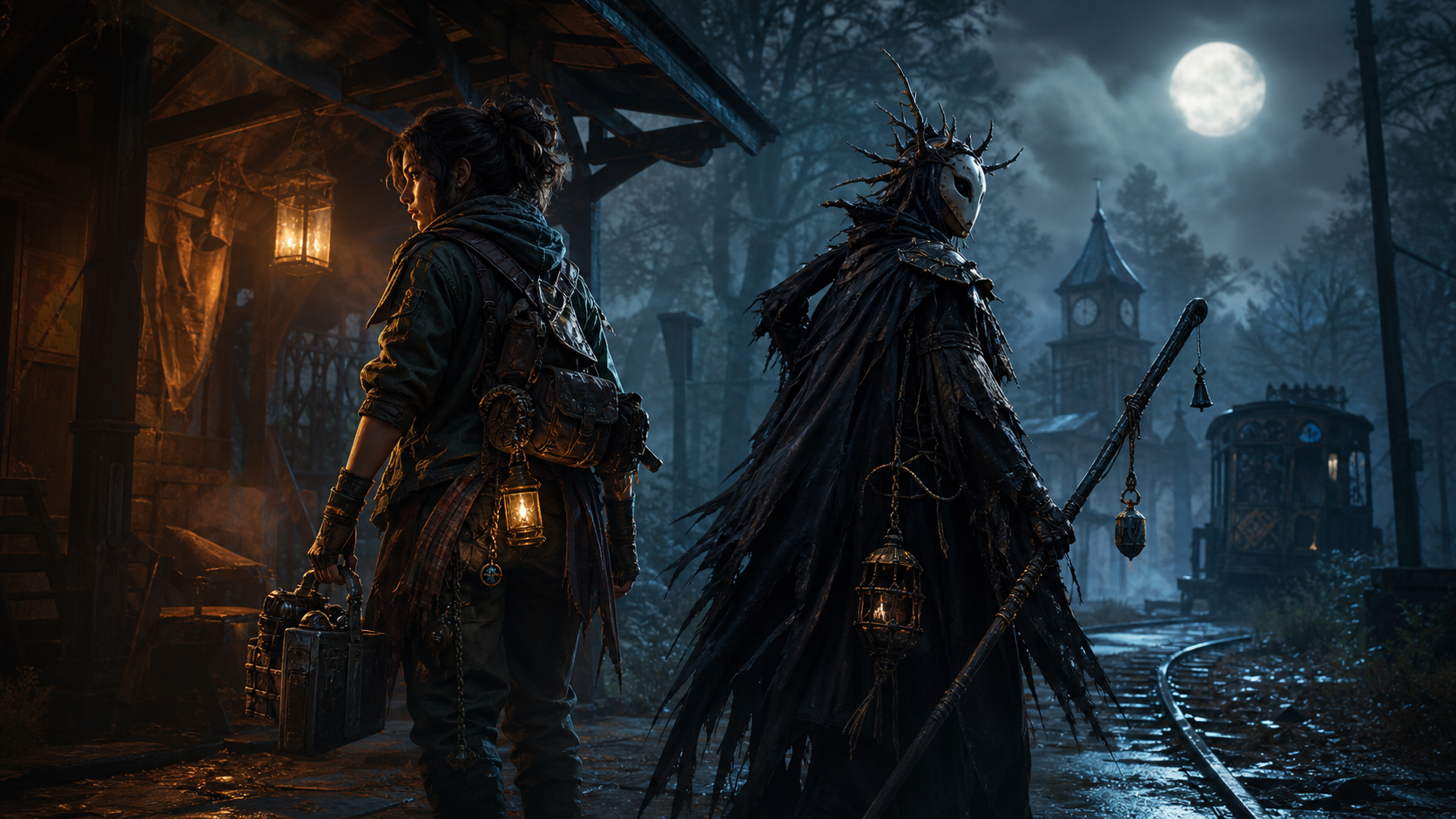
Creating a memorable Forsaken-inspired original character takes more than combining a dark outfit with a powerful ability. In an asymmetrical horror game, character design is communication. A Survivor must offer the team a useful choice without becoming mandatory. A Killer must create pressure without making escape feel arbitrary. Both sides need a recognizable silhouette, a clear gameplay loop, readable warnings, limitations, and lore that explains why these elements belong together.
This guide develops one unofficial Survivor and one unofficial Killer as working examples. They are fan concepts only. They are not affiliated with, approved by, or planned for Forsaken, Roblox, its developers, or any rights holder. Do not present them as leaked characters, official balance information, or content that can be imported into the live game.
Because live games and community rules change, check the current game page, platform standards, and creator policies before sharing your work. Keep your design original: do not trace official models, copy an existing character’s costume or abilities, reuse protected logos and interface elements, or imply endorsement.
What Makes a Strong Forsaken-Inspired OC?
A useful fan OC starts with a role, not a list of powers. Ask what the character makes players think about during a match. A Survivor might trade safety for information, spend a limited resource to protect teammates, or excel in one situation while struggling in another. A Killer might punish predictable movement, control space, or force a difficult route choice. The ability is interesting only when it creates a decision for both sides.
Use this six-part foundation:
- Identity: a short description of who the character is and what fantasy they deliver.
- Visual language: a silhouette, palette, props, and movement style that remain readable during play.
- Personality: a few consistent traits that influence posture, dialogue, and decisions.
- Ability loop: actions, costs, feedback, and recovery that produce repeatable gameplay.
- Backstory: a compact reason the character belongs in the setting without rewriting official canon.
- Counterplay: information and response windows that let opponents make meaningful choices.
If one part contradicts another, revise before generating art. A cautious technician should not have unexplained magical attacks. A methodical Killer should not communicate every action through random visual noise. Coherence is what makes an OC feel designed rather than assembled.
Step 1: Decide Between Survivor and Killer
Choose the side whose gameplay fantasy you actually want to explore. Starting with “Which one looks cooler?” often produces a costume without a role.
Choose a Survivor if you want to design teamwork
A Survivor concept should answer:
- What useful decision can this character make for the group?
- Do they provide information, protection, recovery, movement, or objective support?
- What time, position, visibility, or resource do they risk when helping?
- How can the Killer recognize and punish careless use?
- Can teammates understand what the ability did without reading a paragraph?
Survivor strength should come with a trade-off. If an ability finds danger, perhaps activating it creates sound. If it protects an objective, perhaps the character loses access to another tool while protection is active. These costs create tension and prevent the kit from solving every problem at once.
Choose a Killer if you want to design chase pressure
A Killer concept should answer:
- What specific fear or uncertainty does the character create?
- How does a chase start, intensify, and resolve?
- Which sound, animation, or shape warns Survivors that an ability is coming?
- What can an attentive Survivor do in response?
- Which limitations stop the power from controlling every map and situation?
“Invisible, silent, and unavoidable” is not a compelling threat. Horror becomes playable when a warning arrives, the player interprets it, and a risky response remains possible.
The two examples below share one original fan premise: an emergency records system became corrupted after conflicting reports were stored inside it. A maintenance worker wants to repair the archive; an entity formed from the archive wants to eliminate every contradiction. The common premise connects their visuals and mechanics without inserting either concept into official lore.
Step 2: Build a Survivor Identity — Mender
Begin with a one-sentence role fantasy:
Mender is an adult municipal maintenance technician who can inspect recent activity and temporarily protect damaged equipment.
That sentence defines both theme and function. “Maintenance technician” supports tools, repair imagery, methodical behavior, and information gathered from objects. It also suggests a support role rather than a fighter.
Visual identity
Mender needs to be recognizable at game distance, so use a few large shapes instead of many small accessories:
- a compact work jacket in muted orange;
- a square equipment pack that widens the upper silhouette;
- a pale hard hat with one permanently broken lamp;
- teal work gloves as a restrained secondary color;
- dark utility trousers; and
- a folding scanner carried close to the body.
The palette is visible enough for teammates to identify the character but worn enough to fit a horror environment. The broken lamp is a useful consistency anchor: if it changes sides, becomes functional, or disappears between images, the design sheet will feel unreliable.
Personality
Give Mender three compatible traits: patient, practical, and overly compelled to fix what others would abandon. Those traits can guide a cautious stance, economical dialogue, and the habit of checking damaged objects even when doing so creates danger.
Avoid treating personality as a collection of labels. “Helpful, sarcastic, mysterious, cheerful, ruthless, shy” gives no direction because the traits pull in too many directions. Choose a small set and show how they affect behavior.
Backstory hook
Mender once serviced emergency terminals connected to the archive. After the system failed, they remained convinced that its records could be recovered. Their refusal to leave a broken system alone explains the scanner, the support role, and the risk built into their abilities.
Keep the lore modular. It should support the fan concept without claiming that Mender participated in a confirmed event, met an official character, or changed established canon.
Step 3: Design Mender’s Ability Loop
Mender’s two abilities should compete for the same tool. That makes every use a choice between gathering information now and supporting an objective over time.
Fan ability: Trace Scan
Mender spends a brief moment scanning a nearby interactive object. On completion, a short directional trace indicates where the most recent user moved after touching it.
The ability needs firm limits:
- it works only at close range;
- the scan takes time rather than activating instantly;
- activation emits a pulse that can be heard nearby;
- the trace does not identify whether it belongs to a Survivor or Killer;
- the information covers only a short departure path; and
- a cooldown prevents constant surveillance.
This creates several decisions. Mender may obtain useful information at an intersection, but stopping to scan creates vulnerability. The Killer can hear the pulse and may intentionally interact with an object before leaving in a misleading direction. Ambiguous information is more interesting than perfect tracking because the player still has to interpret it.
Fan ability: Field Brace
Mender attaches the folding scanner to one damaged objective or obstacle. For a limited period, the device slows further deterioration. It does not repair, finish, or permanently restore the target.
While the brace is active, Mender cannot use Trace Scan because the same tool remains deployed. A visible blinking shape reveals that the device is present and gives the Killer a clue about Mender’s likely area.
The shared scanner creates the core loop:
- Scan for recent movement and keep the device available.
- Deploy it for team support and surrender information access.
- Decide when the protection is valuable enough to justify the loss.
- Reclaim the device before changing roles again.
The precise cooldown, range, and duration should remain experimental placeholders until playtesting. Never format invented numbers to resemble official statistics.
Step 4: Write Mender’s Visual-Generation Prompt
A useful character prompt describes role, silhouette, fixed details, presentation, and exclusions. It should not ask an image model to copy an official character or interface.
Unofficial fan-made asymmetrical-horror Survivor concept, clearly adult municipal maintenance technician, compact block-readable silhouette, short dark hair under a pale hard hat with one broken lamp, worn muted-orange work jacket with broad gray safety bands and no real-world logo, teal work gloves, dark utility trousers, square equipment backpack, folded handheld scanner; cautious neutral pose in an abandoned industrial service corridor, stylized low-poly game concept art, large readable shapes, original character, no existing franchise character, no official logo, no interface, no text.
Generate a neutral front view first. Once the design is stable, request front, side, and back views plus a scanner close-up and one scanning pose. Compare every result against a short lock list:
- broken lamp stays on the same side;
- jacket and glove colors do not drift;
- backpack retains its square shape;
- scanner scale remains consistent; and
- no unwanted logos or readable writing appear.
An AI image is a visual draft, not a character specification. Correct inconsistencies deliberately instead of accepting whichever variation looks most dramatic.
Step 5: Build a Killer Identity — The Index
Now define the opposing threat fantasy:
The Index is a corrupted archival entity that records repeated movement and uses a false replay to disrupt a chase.
The fear comes from bureaucracy, duplication, and being catalogued—not gore. A focused horror motif is usually stronger than stacking unrelated spikes, chains, blood, smoke, static, and glowing eyes.
Visual identity
The Index uses a narrow vertical silhouette that contrasts with Mender’s compact shape:
- an unusually tall, thin torso;
- a head resembling a sealed charcoal filing drawer;
- one horizontal amber light slit instead of a face;
- long uneven arms ending in broad stamp-like hands;
- torn blank card strips trailing from the body; and
- slow, deliberate movement that becomes abrupt only during an ability.
Keep the card strips free of legible text. The design should read through shape and motion, not a wall of labels. Avoid copying an official model, signature weapon, costume, or recognizable facial design.
Behavior and personality
Treat the Killer’s personality as an operating rule: The Index is orderly, literal, and intolerant of inconsistency. It pauses as though checking a record, then reacts sharply when a movement pattern repeats. This behavior informs its idle animation, sound design, and ability timing.
Backstory hook
The archive was instructed to preserve every emergency report. Contradictory records accumulated until the system began treating people as duplicate entries that needed correction. This hook links the filing-drawer head, repeating-path mechanic, and administrative sound palette without depending on official story events.
Step 6: Design The Index’s Chase Loop
The Killer’s kit should create uncertainty while leaving visible and audible evidence. Survivors should be able to identify a mistake after the fact and improve on the next encounter.
Fan passive: Recorded Step
When a Survivor repeats a similar vault or turn pattern within a short window, an amber marker briefly appears at the repeated position for The Index.
The marker is not continuous tracking and does not follow the Survivor. The counterplay is route variation: delay a turn, choose another obstacle, or break the repeated sequence. This passive rewards the Killer for noticing habits without eliminating stealth altogether.
Fan ability: Carbon Copy
The Index leaves a stationary replay based on part of its recent movement. The replay creates a recognizable silhouette and footsteps but cannot attack or adjust its route.
A careful Survivor can distinguish the copy through a dry paper-rustle sound and a fixed amber outline. The decoy is useful only if the Killer creates a believable situation; it should not win the chase automatically.
Fan ability: Misfile
After an obvious wind-up, The Index exchanges positions with its active replay. The swap has several restrictions:
- only one replay can exist at a time;
- the replay expires after a limited period;
- the swap has a maximum operating distance;
- a heavy drawer-closing sound plays before displacement; and
- a poorly timed swap leaves a recovery window.
Together, the abilities form a readable sequence: establish a copy, pressure the Survivor into predicting which figure is real, signal a possible swap, then commit. Survivors can listen for the cue, monitor the replay, change route, or use the recovery window. The threat is uncertainty, not an invisible attack.
Step 7: Write The Index’s Visual-Generation Prompt
Unofficial fan-made asymmetrical-horror Killer concept named The Index, original nonhuman archival entity, very tall narrow blocky silhouette, sealed charcoal filing-drawer head with one horizontal amber light slit, long uneven arms ending in broad stamp-shaped hands, torn blank index-card strips trailing behind, dark-gray body with sparse amber markers; slow neutral threatening pose in an abandoned records room, stylized low-poly game concept art, readable at distance, non-graphic horror, no existing franchise character, no official logo, no interface, no text.
Request a neutral turnaround before action imagery. Then explore an idle pose, a replay silhouette, and a swap wind-up. Check that the head does not become a realistic human face, the hands retain the stamp motif, and the design does not gain graphic violence or unrelated weapons.
DeepFake is not a Forsaken OC maker and cannot add characters to a game. If you choose to use it for visual exploration, text-to-image can help draft an original silhouette from a written brief, while image-to-image can help explore controlled variations of artwork you own or are permitted to use. Neither route verifies game balance, grants franchise rights, or makes a concept official.
Step 8: Design Visual and Audio Counterplay
Every important gameplay event needs a cue. Good cues tell the opponent what happened, what may happen next, and when a response is still possible.
For Mender, Trace Scan might use a rising electronic chirp, a teal sweep with a distinct ring shape, and one backpack flash. The Killer hears a quieter version nearby. Field Brace should display a different shape and a steady device rhythm so nobody confuses support with scanning.
For The Index, Carbon Copy uses paper rustle and a fixed amber edge. Misfile begins with the scrape of a heavy drawer, completes with a single stamp sound, and ends with the facial slit dimming during recovery. Avoid using identical static, distortion, or screen shake for every action; repeated noise hides information instead of creating fear.
Design for more than color perception. Pair amber and teal with different shapes, motion patterns, and sounds. Add captions or accessible indicators where the platform supports them. A player should not lose the ability to respond because two colors look similar or audio is unavailable.
Step 9: Test the Concepts on Paper
Before polishing art, test each ability against varied situations. Sketch a simple map and walk through at least five scenarios:
- a small room with a single practical exit;
- a long, exposed chase lane;
- a vertical or obstacle-dense route;
- several Survivors gathered around one objective; and
- a final-Survivor situation with limited information.
For every scenario, ask three questions:
- Does the ability create a decision for both sides?
- Does it become so weak that the character loses their role?
- Does it become so reliable that the opponent has no credible response?
Trace Scan may be valuable at branching paths but weak in an open lane. That can be healthy because Field Brace provides another purpose. Misfile may be strong when sightlines and corners support a convincing replay, but it should not bypass every obstacle or erase the need to chase.
Also test communication. Can a new player tell when Mender has deployed the scanner? Can a Survivor identify Carbon Copy after paying attention? Does the swap wind-up leave enough time for a response without making the ability pointless? Balance is not only damage, range, and cooldown; it includes clarity, map dependence, team coordination, and the cost of being wrong.
Record uncertain values as hypotheses. “Try a short recovery” is honest design notation. “Official recovery: 1.2 seconds” is deceptive when no such statistic exists.
Step 10: Turn the Design Into a Consistent Character Sheet
Once the paper test exposes no obvious contradiction, organize the OC into a compact reference sheet:
- fan-concept label and creator credit;
- role fantasy in one sentence;
- identity, personality, and short lore hook;
- front, side, and back visual references;
- prop or ability detail views;
- core ability loop;
- strengths and limitations;
- opponent counterplay;
- accessibility cues; and
- version date and revision notes.
Use a repeatable generation workflow:
- Write the text brief before generating images.
- Produce several silhouettes, then choose one based on readability rather than detail.
- Lock the palette, proportions, props, and unique identifiers.
- Generate a neutral turnaround.
- Create ability poses only after the neutral design is stable.
- Compare outputs side by side and correct drift.
- Run another paper-balance pass whenever an art change suggests a new mechanic.
Do not imitate an official update card so closely that viewers could mistake it for a game announcement. Put “UNOFFICIAL FAN CONCEPT” in the surrounding post or layout, not inside AI-generated art that may render the label incorrectly. Avoid clickbait such as “new leaked Killer,” and do not use official UI, badges, or developer branding to manufacture credibility.
Copyright, Platform Rules, Consent, and Originality
Fan work exists in a setting owned by other people. An original OC does not provide a license to the franchise around it. Follow the current Roblox community standards, the game’s rules, and any applicable fan-content policy. If you plan commercial use, obtain permission or independent legal advice rather than assuming that changing a name is enough.
Keep these boundaries in mind:
- Do not reuse official models, textures, map assets, music, voices, logos, or interface files.
- Do not closely reproduce an existing character’s outfit, face, signature prop, lore, or ability set.
- Do not claim that developers approved, balanced, or will release the concept.
- Do not train or guide an image edit with artwork you lack permission to use.
- Do not use a real person’s face, voice, private information, or distinctive likeness without informed consent.
- Avoid hateful imagery, harassment, sexualized minors, non-consensual content, and deceptive impersonation.
If you want to turn the idea into a commercial original game, rebuild the surrounding expression as well as the name. Create a new setting, faction structure, match rules, visual language, abilities, terminology, and lore. Inspiration can begin a design conversation; ownership requires original execution and appropriate rights.
Conclusion
A convincing Forsaken-inspired OC is not measured by how many abilities fit on a card. It is measured by how clearly identity, visuals, story, gameplay, and counterplay reinforce one another.
Start by choosing Survivor support or Killer pressure. Define one role fantasy, build a readable silhouette, give the character a small set of compatible traits, and connect the lore to the mechanic. Then add costs, warnings, response windows, and paper tests before polishing the artwork. AI can help visualize an original brief, but it cannot decide whether the design is fair, copy protected material lawfully, or make a fan character official.
The best fan concepts invite discussion because another player can imagine both using the ability and playing against it. Design that two-sided experience first; the character art will have a much stronger foundation to express.
Frequently Asked Questions
Should I design a Survivor or Killer first?
Choose a Survivor if you are most interested in teamwork, support, information, and resource trade-offs. Choose a Killer if you want to design chase rhythm, pressure, warnings, and counterplay. Either is viable, but finish one core loop before expanding to the other side.
How many abilities should a fan OC have?
Begin with one defining mechanic and one supporting ability. A compact kit is easier to explain, test, and counter. Add another element only when it creates a new decision rather than covering an existing weakness for free.
Can I upload my OC into Forsaken?
Concept art and a character sheet do not create playable content. Only the game’s developers control official characters and releases. Unless there is a current official submission process, share the work clearly as unofficial fan art or design discussion.
Can AI determine whether my OC is balanced?
AI can suggest edge cases or organize a test checklist, but it cannot reproduce the full live game, real player behavior, every map interaction, or developer intent. Use human review, paper scenarios, and actual permitted prototyping where possible. Keep all proposed values labeled as experimental.
Can I sell artwork or merchandise based on the concept?
Commercial use may involve copyright, trademark, platform-policy, and publicity-right questions. Creating a new character does not automatically grant rights to the surrounding franchise. Ask the relevant rights holder for permission or obtain qualified legal advice before selling fan-derived work.
How do I keep AI-generated character images consistent?
Lock a short list of non-negotiable details, begin with neutral views, compare every output side by side, and revise one variable at a time. For Mender, that list might include the broken lamp, square backpack, glove color, and scanner size. For The Index, it might include the drawer-shaped head, amber slit, stamp-like hands, and blank card strips.
Is it acceptable to use official art as an image-to-image reference?
Do not assume so. Use artwork you created or have explicit permission to modify, and follow the relevant service and platform rules. A safer approach is to write an original visual brief from abstract traits—such as silhouette, role, palette, and mood—without feeding protected character art into the workflow.