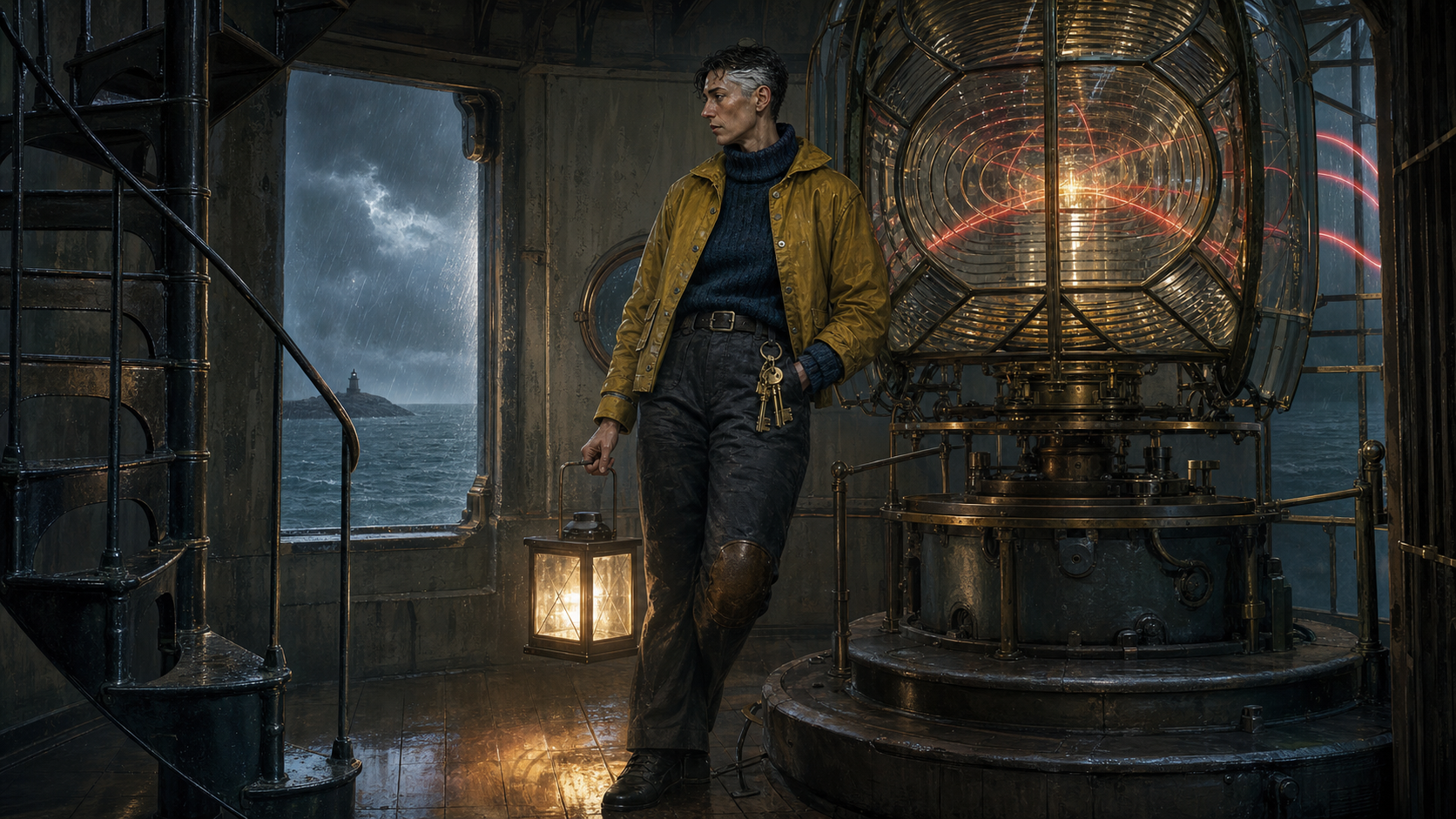
AI can answer “What might this character look like?” with many images. That is not the same as answering “Why would this person make that choice?” A story-ready original character needs a connected system of pressure, behavior, silhouette, clothing, relationships, history, ability, cost, and change.
This guide builds one character all the way through that system: Iven, a clearly adult nonbinary lighthouse keeper in their early forties. Iven has maintained a remote island light for years but has not stepped into a boat for twelve years. Their fear is not a decorative trait pasted onto a yellow coat. It determines how they stand, which keys they carry, how they speak, whom they avoid, why they train a successor, and what happens when the light fails.
Generative tools can support visual exploration, controlled variations, and presentation tests. They do not provide persistent character memory, automatic continuity, guaranteed originality, or a one-click complete OC. The creator still writes the logic, selects designs, records references, checks every output, revises inconsistencies, and decides what belongs in the character.
1. Begin With a Contradiction That Creates Scenes
Start with one sentence that places identity and behavior in tension:
Iven maintains a lighthouse on a remote island but has not stepped into a boat for twelve years.
The contradiction immediately creates story questions. How did Iven reach the island? Why stay beside the water they fear? How do supplies arrive? What happens when a replacement part can only be collected from a boat? What does Iven do if another person needs rescue?
Now define four connected parts rather than adding a list of adjectives.
Contradiction: Iven protects sailors from a tower surrounded by open water, yet refuses to travel across that water themself.
Want: Iven wants to train a capable replacement, transfer responsibility for the lighthouse, and finally leave the island.
False belief: Iven believes that feeling fear makes a person unfit to protect anyone else. They therefore hide fear, overprepare, and mistake avoidance for responsible caution.
Memory-lens limitation: During storms, the lighthouse lens amplifies a navigation memory into a visible route through fog. Iven cannot choose whose memory appears, and the keeper experiences the projected memory so intensely that past conditions temporarily overwrite their perception of the present.
These parts should collide. Training a replacement moves Iven toward the want, but the trainee will eventually see the fear Iven considers disqualifying. The lens can help guide a vessel, but using it may make Iven unable to verify present instruments. The island allows Iven to protect people without boarding a boat, but leaving requires the action they have avoided for twelve years.
Test the character engine with possible scenes:
- the supply boat cannot dock, so a transfer must happen offshore;
- the trainee discovers that Iven keeps a boat key without using it;
- calm fog returns and triggers more fear than an announced storm;
- the lens shows a route based on avoidance rather than an actual journey;
- Iven must delegate instrument checks instead of controlling every task.
If the contradiction produces only profile questions and no decisions, sharpen the want or add a deadline. Do not solve the problem by adding five unrelated tragedies. One strong pressure should be able to affect several present scenes.
2. Convert Personality Into Five Visible Behaviors
Words such as quiet, intelligent, brave, kind, anxious, or responsible are difficult to verify in a panel. Turn personality into repeated actions that another character can notice and challenge.
Iven has five visible behaviors:
- They label every tool and check it twice. The habit expresses competence, but it also reveals a need to remove uncertainty before acting.
- They speak calmly during emergencies and stammer afterward. Procedure holds fear at a distance until the danger passes.
- They refuse to stand with their back to the sea. Even inside the lighthouse, their stance angles toward a window or reflective instrument.
- They repair visitors’ belongings without asking. Care arrives through maintenance because direct comfort feels harder.
- They keep the old boat key despite refusing to use it. The key is both an occupational object and a physical contradiction.
Each behavior should have a constructive and destructive reading. Double-checking can prevent mistakes, but it can also waste time. Watching the sea maintains awareness, but it can prevent eye contact. Repairing a torn glove is generous, but doing it without permission can cross a boundary. Keeping the key preserves readiness, but it also preserves avoidance.
Use the actions selectively. If Iven labels an object in every scene, the behavior becomes a gimmick. Show it when the labeling changes the scene: the trainee notices one unlabeled key, an emergency leaves no time for the second check, or a label from twelve years ago contradicts Iven’s current explanation.
3. Give Iven Three Consistent Voice Rules
Voice is not an accent pasted onto neutral dialogue. It is a pattern in what the character notices, avoids, and says first.
Use three rules:
- Iven uses lighthouse terminology as emotional metaphor. They speak of visibility, bearings, drift, and false signals when ordinary emotional language feels too exposed.
- Iven answers personal questions with practical instructions. “Are you afraid?” becomes “Secure the lower shutter before the pressure drops.”
- Iven says “we” when discussing the light. The pronoun treats the lighthouse as a fellow keeper, responsibility, and sometimes an opponent.
A short exchange can apply all three without explaining the backstory:
Trainee: “Are you scared of the storm?”
Iven: “Storms announce themselves. Calm water gives a false bearing. Check the west latch; we lose pressure there first.”
The line gives a metaphor, redirects the personal question into work, and includes the light in “we.” The trainee can later challenge the pattern by refusing the instruction until Iven answers directly.
Read dialogue aloud. A voice rule should shape sentence priorities, not make every line ornate. Iven can still say “yes,” “stop,” or “thank you” when the scene earns directness. Growth may appear when they finally name fear without translating it into weather.
4. Build the Silhouette Around Lighthouse Work
Iven climbs narrow spiral stairs, trims a lens mechanism, cleans soot, carries oil, braces against wind, and works among hooks, gears, ladders, and railings. The silhouette should survive those activities.
The full visual brief is:
- age and identity: clearly adult nonbinary person in their early forties;
- body line: tall, narrow, and slightly stooped from years of stairs and close mechanical work;
- face: long and narrow, with heavy attention around the eyes rather than youthful softness;
- hair: close-cut dark hair with one white streak at the right temple;
- upper body: heavy slate-blue sweater beneath a short waxed yellow work coat;
- lower body: dark high-waisted trousers with room at the knees and narrow cuffs that do not catch on steps;
- right-side anchor: leather knee brace on the right leg, supporting an old work strain without preventing normal movement;
- left-side anchor: ring of labeled brass keys fixed at the left hip;
- carried anchor: square storm lantern carried low in the right hand during routine checks, then clipped to a right-side belt loop when both hands are needed.
Left and right details must be recorded, not left to chance. The white temple streak is on Iven’s right. The brace is on the right knee. Keys hang on the left hip so they do not strike the brace during stairs. The lantern normally occupies the right hand or right belt point, balancing the visual weight of the left-side keys.
The dominant silhouette is a narrow vertical figure interrupted by two compact shapes: the square lantern low on the right and the brass key cluster on the left. The short coat ends above the hip and cannot tangle around Iven’s knees. The close hair stays controlled in wind. The high waist supports the tool belt. Nothing requires ceremonial armor, a flowing scarf, oversized shoulder pieces, or a weapon unrelated to the job.
The stoop has functional logic as well. Iven leans toward gauges and stair rails, but they can straighten during an emergency. It should not become a caricature or imply frailty inconsistent with years of physical work. The brace changes weight distribution subtly; it does not immobilize the character.
Test the silhouette as a solid black shape at thumbnail size. The short coat, narrow body, square lantern, and key cluster should remain readable. If recognition depends entirely on the tiny hair streak or engraved labels, the large shapes need more clarity.
5. Use a Four-Color Narrative Palette
Color should track role and story rather than simply follow an attractive scheme.
- Slate blue: the sweater and dark environmental base suggest routine, isolation, night work, and the stable present.
- Waxed yellow: the short coat communicates visibility, maritime safety, weather protection, and lighthouse function.
- Brass: keys, fasteners, lens hardware, and tool details connect Iven to age, repair, friction, and accumulated maintenance.
- Red: a small light inside the lantern foreshadows the lens’s memory effect and provides a controlled warning accent.
The ordinary palette is mostly slate blue, waxed yellow, dark trouser tones, and small brass points. Red remains scarce until memory activates. During the ability, red combines with the existing brass warmth to create a fixed red-gold route. Do not invent purple symbols in one scene, green ghosts in another, and blue lightning in a third.
Record exact base swatches in the character reference. Scene lighting may cool, darken, or desaturate them, but the local colors remain known. The yellow coat should still read as the same garment under gray dawn, interior lamplight, and storm shadow.
6. Write the First Neutral Character Prompt
The first image should be easy to inspect. Avoid ocean spray, dramatic wind, lightning, Dutch angles, crowds, and intense expressions. Those elements can hide broken garment construction and flipped props.
Use this first prompt:
Full-body original illustrated character design of Iven, a clearly adult nonbinary lighthouse keeper in their early forties; tall narrow slightly stooped silhouette, long narrow face, close-cut dark hair with one white streak at right temple; short waxed yellow work coat over heavy slate-blue sweater, dark high-waisted work trousers, leather knee brace on right leg, labeled brass key ring at left hip, square storm lantern carried low in right hand; neutral three-quarter standing pose, practical weathered clothing, plain warm-gray background, even studio light, clear garment construction, clean restrained linework and shading, no ocean, no dramatic wind, no text, no logo, no existing character, no artist imitation.
An optional text-to-image pass can help you explore this visual brief. Treat every result as a draft, not an automatically complete character. Keep the written brief beside the outputs so visual novelty does not replace the design logic.
Make one four-option pass
Generate or sketch four options once under the same neutral conditions. Do not produce endless batches while changing the prompt each time. A controlled group lets you compare how one specification was interpreted.
Judge all four with six selection checks:
- Face: Does Iven read as the same clearly adult early-forties person, with a long narrow face rather than a generic youthful protagonist?
- Silhouette: Is the tall, slightly stooped line readable, with lantern and keys creating distinct low shapes?
- Coat construction: Is the waxed yellow coat short, practical, closable, and free of loose pieces that would catch on stairs?
- Brace side: Is the leather knee brace consistently on the right leg?
- Keys: Are labeled brass keys attached at the left hip rather than floating, duplicated, or switching sides?
- Lantern: Is the storm lantern square, functional, carried low on the right, and proportioned for actual use?
Choose the option with the strongest system, not the prettiest face. Save the rejected options with brief reasons—“brace flipped,” “coat too ceremonial,” “silhouette too wide”—so those errors do not reappear as references.
After choosing, one optional image-to-image revision can explore a controlled correction, such as shortening the coat while preserving the approved face and silhouette. Make one major change at a time. The route does not guarantee identity preservation, correct left/right details, or persistent memory of prior outputs; compare every revision with the written sheet.
7. Create Three Causal Outfit States
Outfit variants should answer changing work conditions, not advertise unrelated fashion concepts. Iven needs three states built from one base wardrobe.
State 1: Routine work
The short waxed yellow coat stays open over the slate-blue sweater during normal maintenance. Dark high-waisted trousers, right knee brace, left key ring, and square lantern remain in place. Sleeves end securely above the wrist so they do not brush lens oil. The lantern stays in the right hand during checks.
This is the defining silhouette and should appear on the main turnaround. It communicates visibility, weather protection, and the tools Iven touches every day.
State 2: Interior rest
Inside the keeper’s quarters, the yellow coat hangs by the door. Iven wears the slate-blue sweater with sleeves pushed to the forearms. The right knee brace remains because support is functional, not costume decoration. Keys hang from a dedicated wall hook on the left side of the room, and the lantern sits unlit on the table.
Removing the coat and tools makes the silhouette quieter without redesigning the person. It also creates vulnerability: the boat key can be seen on the hook, separated from Iven but still within reach.
State 3: Storm operation
The same yellow coat is fully fastened. A stored hood unfolds from the collar. Plain work gloves cover the hands, and the square lantern clips to the right-side belt point so Iven can grip the stair rail and lens controls. Keys remain secured on the left with a short keeper strap to stop them swinging into machinery.
Do not add a heroic cape, armor, glowing boots, or an entirely new costume. The storm state adapts the routine gear to greater wind, rain, and urgency.
Let wear record behavior
Weathering should be consistent and located for a reason:
- salt bleaching is strongest on the left shoulder because Iven habitually angles that side toward the sea while shielding the lantern on the right;
- both sweater elbows have repairs, but the right patch is newer from leaning into the lens housing;
- the coat cuffs show darkened wax and brass dust from repeated maintenance;
- the right trouser knee has smoother fabric around the brace straps;
- the left hip shows small rub marks from the key ring;
- one old boat key has no label, while every working lighthouse key is carefully named.
Track wear states over time. A newly torn cuff should not appear on an earlier page. An image model may turn salt bleaching into a decorative pattern or move it to both shoulders; correct that because the placement tells a story.
8. Write One Backstory Event With Present Consequences
Iven does not need a sequence of deaths, betrayals, disappearances, curses, and secret bloodlines. Use one formative event:
Twelve years ago, Iven piloted a rescue boat during sudden calm fog. The lighthouse lens projected a false navigation memory across the water. Iven followed it, and the boat struck a hidden rock. Everyone survived, but Iven stopped trusting perception at sea and took permanent responsibility for maintaining the light.
This event explains why calm water is more frightening to Iven than a visible storm. It also makes the fear specific: not simply water, but the possibility that memory and present evidence will become indistinguishable while other people depend on their judgment.
The backstory matters because it changes current behavior:
- Iven has refused to board a boat for twelve years.
- They inspect and label lighthouse mechanisms obsessively.
- They distrust calm fog and prefer announced danger with measurable signals.
- They train a replacement because they want to leave, then quietly create new reasons departure is unsafe.
- The single unlabeled key belongs to the old rescue boat.
- They resist using the memory lens unless another person can verify present instruments.
Do not add a second accident to explain the knee brace, a lost sibling to explain the white streak, or a betrayal to explain every difficult conversation. The brace can come from accumulated stair work. Hair changes can be ordinary aging. Not every visual feature requires tragedy.
Backstory should enter through current evidence: the unlabeled key, Iven closing the curtain on calm water, the supply captain refusing an excuse, or the trainee discovering the old incident log. Avoid pausing the plot for a long biography when a present choice can reveal the same information.
9. Add Three Relationships That Challenge the False Belief
A character alone can preserve the same belief forever. Relationships create different forms of pressure.
1. The trainee
The trainee is a confident sailor who treats fear as information rather than shame. They admit when a wave pattern scares them, then adjust the route. This directly contradicts Iven’s belief that fear disqualifies a protector.
The trainee needs instruction but should not exist only to admire Iven. They notice when labels replace decisions, question the unexplained boat key, and insist on learning how to verify instruments during a memory projection.
2. The supply captain
The captain is an old friend who respects Iven’s refusal to travel but will not enable avoidance forever. They keep the island supplied, remember the rescue accurately, and refuse to treat survival as proof that Iven failed everyone.
Their conflict is practical. If Iven wants to leave, a boat must be part of the plan. If Iven wants the trainee to become keeper, control must actually be transferred rather than indefinitely postponed.
3. The lighthouse
The light is not conscious, but Iven addresses it as partner and opponent. “We held the west line” shares responsibility; “you showed me the wrong water” shifts blame. The relationship externalizes Iven’s struggle with a tool that protects sailors and distorts memory.
Do not secretly make the lighthouse sentient merely to validate the conversations. Its silence is useful. Other characters can hear Iven using “we” and decide whether the habit expresses companionship, accountability, resentment, or avoidance.
Each relationship attacks the false belief differently: the trainee models fear with action, the captain challenges long-term avoidance, and the light reflects Iven’s tendency to divide responsibility.
10. Define Ability, Cost, Failure, and Counterplay
A memorable ability needs rules that generate choices. “The lighthouse makes memory paths” is only a premise. Define four parts.
Ability: During a storm, the lighthouse lens can project one nearby person’s strongest navigation memory as a visible route through fog. The route may help locate a remembered channel, shelter, landmark, or direction of travel.
Cost: The keeper experiences that memory simultaneously. For several moments, Iven may hear past weather, feel a remembered deck angle, or see an old shoreline over the current instruments. The effect makes it difficult to separate then from now.
Failure: A memory shaped by fear may display the path someone imagined, avoided, or rehearsed rather than the path they actually traveled. The strongest memory is not necessarily the most accurate route.
Counterplay: A second person must verify physical instruments, current weather, depth, and timing while the keeper reads the projection. The ability is safest as collaboration—the exact lesson Iven resists.
The rules create story decisions. Whose memory should be used? Does that person understand the risk? Is the memory relevant to the current coastline? Can the trainee maintain present readings while Iven is disoriented? What happens if Iven hides the first signs of overlap because they believe fear makes them unreliable?
Consent matters inside the fiction too. A strong memory may be private or distressing. The lens should not become an effortless interrogation device. Establish whether a person can refuse, how they are informed, and what Iven does when a route is necessary but permission is uncertain.
Keep the visual effect fixed
Every projection uses a thin red-gold path formed by light passing through aged brass lenswork. The route has narrow parallel edges, intermittent lens-shaped reflections, and fragments of past weather confined close to it. Red is strongest at unstable memory points; gold is strongest where present instruments confirm the route.
Use the same thickness, reflection grammar, and color relationship in every panel. Do not add new runes, unrelated colors, faces in the fog, or explosive magic merely to escalate. Variation should come from the memory content and present conditions, not a redesigned effect.
11. Test the Whole OC in Four Panels
A character design must work in action, not only in a neutral portrait. Create a four-panel test:
- Work: Iven labels a new lens wrench while the trainee watches, establishing the double-check habit, coat, keys, brace, and lantern.
- Fear: Calm sea fills the window; Iven closes the curtain without turning their back to the water, leaving the unlabeled boat key visible at the left hip.
- Ability: During a storm, the lens casts the fixed red-gold memory path while Iven grips the rail and the trainee reads physical instruments.
- Change: Iven hands the boat key to the trainee but keeps hold for one beat, admitting, “I’m afraid. That is not the same as useless.”
The sequence tests occupation, flaw, power, collaboration, and possible growth. It also tests visual continuity across quiet interior light, calm exterior light, and a storm effect.
Panel 1 should make tool use legible. Panel 2 tests subtle body language. Panel 3 tests left/right props and the effect rules under motion. Panel 4 tests hands, eye line, key scale, and whether dialogue sounds like a meaningful change from Iven’s established voice.
If you use an AI avatar workflow to explore a short presentation of Iven’s dialogue, treat it as a temporary visual or performance draft. Use a voice and likeness you own or have permission to use, keep the character clearly fictional, and review lip sync, identity drift, apparent age, pronouns, clothing, and props. DeepFake does not persistently remember Iven or automatically preserve the character across future sessions and scenes.
12. Build a Portable Reference Package
Do not rely on a platform history, a favorite output, or your memory. Create a local, versioned character bible that can travel between writing, image, comic, animation, and collaboration workflows.
Include:
- a one-sentence logline;
- contradiction, want, false belief, fear, and memory-lens limitation;
- five visible behaviors and three voice rules;
- pronouns, clearly adult age range, face, body line, hair, and right-temple streak;
- front, three-quarter, profile, and back views;
- left/right map for brace, keys, lantern, streak, wear, and coat closures;
- routine work, interior rest, and storm outfit states;
- slate-blue, waxed-yellow, brass, red, and fixed red-gold effect swatches;
- lantern, labeled keys, unlabeled boat key, brace, lens, controls, and tool references;
- expression and hand-pose sheets;
- ability, cost, failure, counterplay, and consent rules;
- the single twelve-year-old event and its current consequences;
- summaries of the trainee, supply captain, and lighthouse relationships;
- the four-panel story test;
- a must keep / may vary list;
- prompt versions, selected outputs, rejection reasons, and revision notes.
The must-keep list should include age, long face, narrow stooped silhouette, right temple streak, short yellow coat, slate sweater, right knee brace, left keys, square lantern, and red-gold memory route. May-vary items can include sweater knit, minor brass scratches, label handwriting, trouser seam placement, and background weather within the scene plan.
Name files by version and view. “iven_work_front_v03-approved.png” is more useful than “final_final2.png.” Record whether an image is approved reference, exploratory option, panel draft, or obsolete. A tool cannot preserve continuity if the creator supplies contradictory references.
13. Check Originality, Consent, and Rights
Originality is an active review, not a promise made by a prompt. Search the character name and compare the combined design—occupation, age, silhouette, color blocking, props, ability, and backstory—with existing characters. Revise accidental resemblance at the system level rather than changing one hair color.
Avoid protected franchise uniforms, emblems, lore vocabulary, signature weapons, or distinctive power systems when the goal is an independent commercial OC. Do not use a living artist’s name to demand imitation. Use reference images, textures, fonts, voices, and other assets you created, licensed, or have permission to use.
If a real person’s face, voice, private photograph, or identifiable likeness informs the work, obtain informed consent and suitable usage rights before processing or publishing it. Do not present Iven as a real person, impersonate someone, or attach a fictional statement to an identifiable individual without authorization.
Copyright treatment of generative material varies by jurisdiction and depends on facts such as human authorship, selection, arrangement, modification, and the nature of the inputs. Prompts alone may not establish the same protection as expressive human writing and editing. Keep records of your character logic, drafts, selections, paintovers, sheets, panels, and revisions, but do not treat documentation as a guarantee of copyright ownership.
Tool terms, model terms, licenses, and publisher requirements can also differ and change. Review the rules that apply to your intended use. For material commercial decisions or disputes, seek qualified legal advice in the relevant jurisdiction rather than relying on a general creator guide.
Disclose generative assistance when a client, platform, contest, publication, or audience context requires it. Do not claim a generated draft was entirely hand-drawn, and do not assume a generated output has automatic rights clearance.
A Final Coherence Audit
Before calling Iven ready, ask:
- Does the twelve-year boat refusal create an immediate present problem?
- Do contradiction, want, false belief, and limitation force different choices?
- Can all five behaviors appear visually without narration?
- Do the three voice rules sound consistent but flexible?
- Are the right temple streak, right brace, left keys, and right lantern fixed?
- Does every clothing state respond to work, rest, or storm conditions?
- Do wear marks have stable positions and causes?
- Does the four-color palette serve routine, safety, age, and memory?
- Did one four-option pass receive the same six selection checks?
- Is there only one formative accident, with clear current consequences?
- Do all three relationships challenge the false belief differently?
- Does the ability require its cost, failure, and collaborative counterplay?
- Is the memory route always red-gold with the same visual grammar?
- Do the four panels test work, fear, ability, and change?
- Can another creator use the reference package without guessing?
- Have originality, consent, licenses, disclosure, and intended use been reviewed?
FAQ
Should personality come before appearance?
Begin with a contradiction, want, false belief, and visible behaviors. Appearance can then communicate the character’s role and pressure. Visual exploration may happen early, but it should be revised to support the written engine rather than dictate random traits.
How much backstory does an OC need?
One formative event with present consequences is enough to begin. Iven’s rescue accident matters because it explains current avoidance, maintenance habits, distrust of calm fog, relationship conflict, and the unlabeled key. Add history only when it changes what the character does now.
Why not give every prop a tragic origin?
Because tragedy loses force when it explains everything. The knee brace can result from years of stair work, brass can age through maintenance, and a white streak can be ordinary aging. Reserve narrative emphasis for details that affect choices.
How many outfit variants should I make?
Start with one functional base and two causal states. Iven’s routine, rest, and storm versions reuse the same wardrobe and anchors. Add another state only when a new condition requires it.
Can AI write and design the entire OC in one click?
No. A model can propose text or visual options, but it does not automatically connect them into a coherent character, test the character in scenes, guarantee originality, maintain continuity, or make final authorship decisions. The creator must select, revise, document, and evaluate.
Will DeepFake remember my character forever?
No. Do not assume persistent identity memory across generations, routes, sessions, or projects. Maintain your own reference package and provide the relevant approved material for each controlled task. Review every result for drift.
How do I keep left and right details consistent?
Write them explicitly, create a turnaround, include a left/right map, avoid relying on mirrored previews, and check every draft. For Iven: white streak right, brace right, lantern right, keys left, salt bleaching left shoulder.
What makes an ability useful for story?
It should create decisions and consequences. Iven’s lens can reveal a route, but the cost confuses past and present, the failure can show avoidance, and the counterplay requires another person. The power therefore pressures the false belief instead of solving every problem.
Does editing AI output guarantee copyright ownership?
No general workflow can guarantee a legal outcome. Copyright rules vary, and protection depends on jurisdiction and the facts of human authorship and source material. Preserve records, use authorized inputs, review applicable terms, and seek legal advice when necessary.
Can I use a real person as Iven’s face or voice?
Only with informed consent and appropriate rights for the intended use. A fictional label does not make unauthorized identity use acceptable. Prefer wholly original visual and vocal direction when permission is unclear.
Make Every Choice Point Toward the Same Person
Iven works as an OC because nothing important floats alone. The twelve-year refusal to board a boat creates the contradiction. The desire to train a replacement creates forward movement. The belief that fear disqualifies a protector creates avoidance. The memory lens turns that belief into an ability with a cost, failure, and need for collaboration.
The visual system tells the same story. A narrow working silhouette fits the tower. The right brace, left keys, and right lantern support movement. Slate blue carries routine; waxed yellow carries safety; brass carries maintenance; red grows into the fixed red-gold memory route. Three clothing states adapt one wardrobe, and wear marks record repeated behavior.
Use AI to explore alternatives and controlled revisions, not to outsource coherence. Keep the reference package outside any single tool, test Iven in four actions rather than one portrait, and let the present story—not an ever-growing tragedy list—decide which details deserve to remain.