Fan-work notice: This is an unofficial creative exercise inspired by broad Gem-character ideas associated with Steven Universe. It is not affiliated with, endorsed by, or licensed by the franchise's rightsholders. Label fan work clearly and never present an OC as canonical, official merchandise, or an announced character.
A convincing Gem-inspired OC should be more than a gemstone name attached to a matching color palette. The mineral can influence how the character moves, what the silhouette emphasizes, how an ability behaves, which limitation creates conflict, and what the character misunderstands about themself.
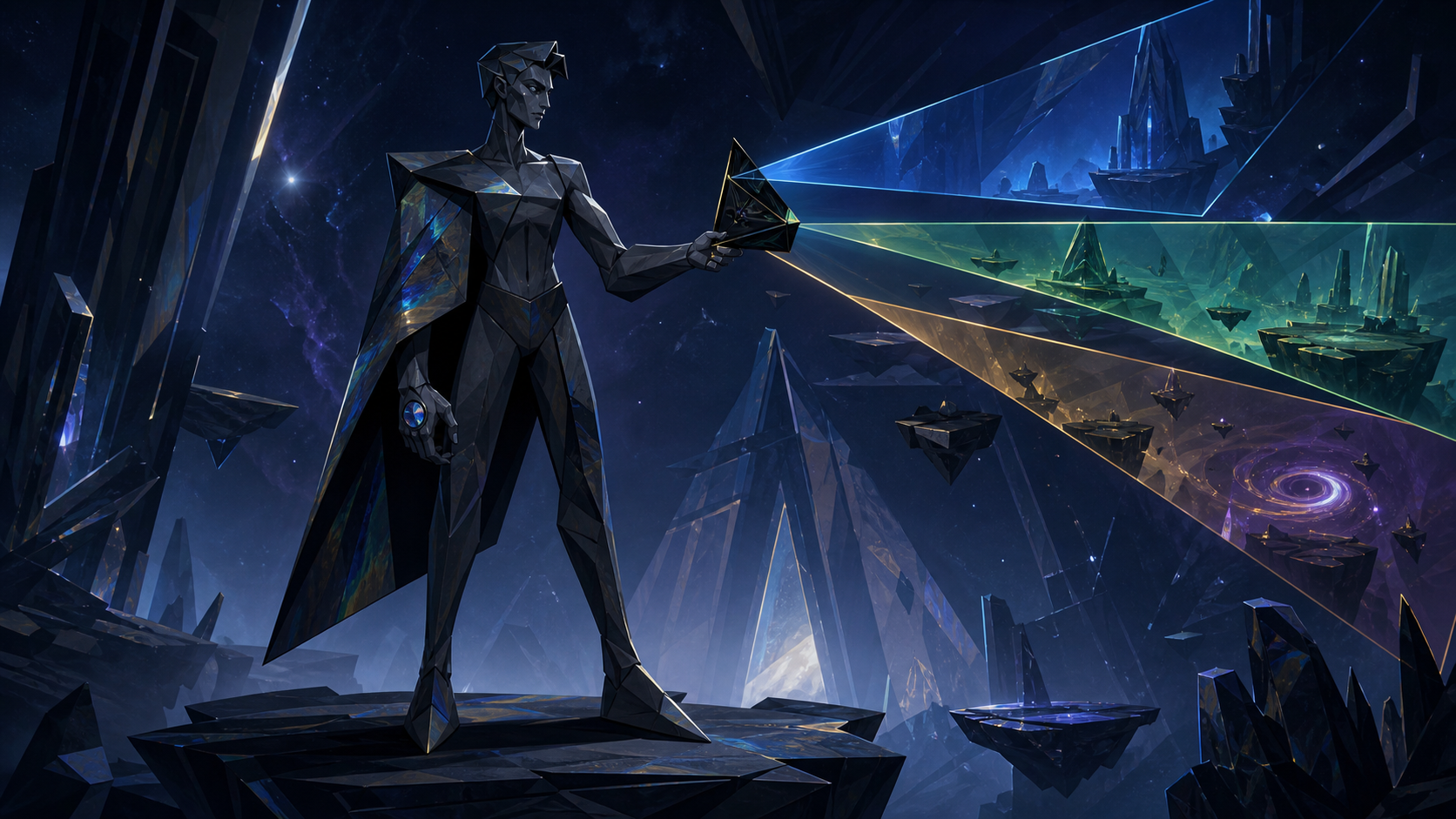
This guide builds an adult-coded fan OC named Spectrolite. The design starts with a real material property—iridescent flashes that change with the viewing angle—and turns it into a character about perspective, judgment, and the need for collaboration.
Research the mineral before inventing the person
Begin with observable material facts rather than symbolism alone. Spectrolite is a gem-quality variety of labradorite associated especially with Finland and known for vivid labradorescence: color flashes produced by its internal structure that change as the stone or viewer moves. The Slovenian Museum of Natural History's spectrolite overview provides a concise mineral reference; use geology as design input, not as franchise lore.
Those traits suggest several creative questions:
- Does the dark base cause other characters to underestimate what is present?
- Does color appear only when someone changes viewpoint?
- Is polishing a chosen discipline or an expectation imposed by others?
- Can internal planes become a visual language for possible routes?
- What happens when the character refuses to move and look again?
The central metaphor becomes:
Hidden possibilities appear when the observer changes position.
Do not force every mineral fact into the design. Select one structural property, one optical behavior, and one tension. The character should not read like a geology worksheet.
Define a role without claiming canon
Spectrolite is an original survey navigator who maps unstable light paths through dangerous space. This is a fan-made role, not a missing canonical rank or secret part of franchise history.
The role supports the material concept. A navigator must evaluate alternatives, communicate risk, and guide other people through uncertainty.
Character foundation
- Adult-coded role: survey navigator and route analyst.
- Goal: be valued for judgment rather than the beauty of projected paths.
- Strength: can reveal several plausible routes through one problem.
- Contradiction: helps others see alternatives but becomes rigid about personal decisions.
- Limitation: cannot determine the best route alone; another observer must change position and evaluate the projection.
- Emotional risk: asking for a second viewpoint feels like admitting that the first analysis failed.
This structure prevents the OC from becoming an all-knowing guide. The power creates options, while relationships create decisions.
Avoid inserting the character into every major canonical event or implying that Spectrolite secretly determined familiar history. Build an original survey site, mission, and supporting cast.
Choose gem placement and silhouette
Place the polished spectrolite cabochon on the back of the right hand. Placement should affect gesture and composition: Spectrolite must turn, tilt, and extend the hand to project routes. The stone is not a sticker added after the pose is complete.
Build the silhouette from large geometric relationships:
- tall, narrow, clearly adult-coded body;
- short faceted dark hair;
- broad angular forearms that frame the projection gesture;
- asymmetrical cape panel descending from the left shoulder;
- wedge-shaped feet designed for stable observation stances;
- right hand often held away from the body so the gem remains visible.
Test the silhouette in black. The left cape, broad forearms, narrow torso, wedge feet, and projecting hand should remain identifiable.
Do not copy an existing character's hairstyle, uniform, emblem, gem placement, weapon, or color layout. A different mineral name does not make a borrowed silhouette original.
Build a controlled palette
Spectrolite's base should remain restrained:
- charcoal gray and near-black navy across most of the body;
- muted blue along a few structural edges;
- electric blue, emerald, narrow gold, and small violet flashes only when the angle changes;
- dark polished gem surface with localized iridescence.
Do not distribute every accent evenly. If the whole character is permanently rainbow-colored, the optical shift loses its meaning. Let the color appear at selected joints, the cape edge, the eyes, the right-hand stone, and projected paths.
Record the palette hierarchy in the reference sheet. Lighting may shift the apparent hue, but the hierarchy should remain: dark body first, iridescent event second.
Design an original ability
Spectrolite projects exactly three translucent angular planes through nearby space. Each represents a plausible route based on current conditions.
The routes are not glowing ribbons. They are flat geometric surfaces with hard corners, internal facets, and small original junction symbols. Their colors change subtly as the camera or observer moves.
Ability rules
- The projection shows possibilities, not guaranteed futures.
- Exactly three routes can remain active at once.
- The routes depend on information Spectrolite can currently observe.
- Another person must move to a different viewing position and evaluate the alternatives.
- More complex terrain reduces projection duration.
- The paths can guide movement but cannot move people automatically.
Limitation and failure state
Maintaining multiple routes drains color from Spectrolite's body and reduces depth perception. The longer the projection remains open, the harder it becomes to judge distance personally.
If Spectrolite assumes what another person will choose, one route becomes brighter and begins hiding the others. The ability then reinforces the character's bias instead of correcting it.
This is more useful than a generic energy attack. It makes the power valuable for navigation, rescue, planning, and temporary traversal while preserving the need for judgment and cooperation.
Create a non-derivative summoned tool
Not every Gem-inspired OC needs a weapon. Spectrolite uses a folding survey prism: three flat dark panels joined by hinges that open into a triangular frame.
The prism:
- measures the angle and stability of projected routes;
- can hold one route plane as a temporary platform;
- folds compactly against the forearm when not in use;
- becomes awkward at close range;
- has no blade, gun mechanism, logo, or copied franchise silhouette.
Describe it precisely:
Hand-held triangular survey frame made from three hinged dark panels with thin blue-green iridescent edges; no blade, barrel, trigger, emblem, or text.Function should shape the prop. A survey tool reinforces the navigator role and prevents the character from defaulting to a familiar warrior archetype.
Write the character prompt
Use broad craft language rather than requesting the exact style of a named living artist or a television screenshot.
Unofficial fan-inspired original mineral character based on spectrolite, clearly adult-coded, with a tall narrow geometric silhouette, charcoal-gray structured body, short faceted dark hair, broad angular forearms, asymmetrical dark cape panel from the left shoulder, and wedge-shaped feet. Polished dark iridescent cabochon on the back of the right hand. Restrained blue-green-gold-violet flashes visible only along selected edges and when the viewing angle changes. Holding an original folding triangular survey prism made of three hinged dark panels, no blade or weapon mechanism. Neutral full-body three-quarter production pose on a plain background, clean rounded geometric cartoon linework. Preserve right-hand gem, left-shoulder cape, forearm proportions, prism construction, and dark palette. No existing characters, franchise emblems, copied uniforms, text, logo, or watermark.Generate a neutral reference before the routes or complex lighting. A text-to-image workflow can help explore the base concept, but each output should be reviewed for originality, right/left consistency, anatomy, and unauthorized reference material.
Approve front, side, back, and three-quarter views. Confirm the right-hand gem, left-side cape, prism hinges, feet, and color hierarchy before making scenes.
Create expressions and movement
Spectrolite should feel observant rather than emotionless. Build an expression sheet that connects analysis to vulnerability:
- neutral evaluation with the chin slightly lowered;
- restrained humor after someone finds an unexpected route;
- frustration when another person decides too quickly;
- surprise when a hidden fourth option is revealed;
- drained, low-color fatigue after holding three paths;
- visible effort before asking another person for help.
Movement should reflect the perspective theme. The right hand turns before the head. Spectrolite walks around an object instead of immediately touching it. During overload, the character becomes rigid even while the projections continue shifting. The cape catches iridescent color only when the viewpoint changes.
Use the ability in stages:
- gem turns toward the problem;
- three route planes unfold from the survey prism;
- an observer changes position;
- the color hierarchy shifts;
- Spectrolite either accepts the new reading or overemphasizes one route;
- body color fades as depth perception weakens.
Build relationships instead of a lore encyclopedia
Three original relationships can reveal more than a long chronology.
The decisive courier
This person chooses too quickly and wants Spectrolite to provide a single answer. Spectrolite must explain uncertainty without hiding behind endless analysis.
The cautious archivist
The archivist sees every risk and refuses to move. Spectrolite must learn that more options do not help unless someone commits.
The former supervisor
The supervisor praises the beautiful projection but ignores the judgment behind it. This relationship exposes Spectrolite's fear of being valued as a decorative instrument.
Each person needs something from Spectrolite and gives something in return. None should exist merely to confirm that the OC is exceptional.
Keep their shared events original. Do not claim that the OC participated in unseen canonical missions or determined an established character's past.
Test the design in a four-panel fan comic
A four-panel test can prove the ability, limitation, relationship, and theme while revealing visual consistency problems.
Panel 1: The problem
An original light bridge has collapsed over a dark void. Spectrolite and the courier stop at the edge. The right-hand gem and folded prism are visible.
Panel 2: The options
Spectrolite opens the prism and projects three angular routes. Blue, green, and narrow gold facets respond to different viewpoints.
Panel 3: The failure
The courier asks which route Spectrolite would take. The OC holds all three too long, body color fading while one favored path begins obscuring the others.
Panel 4: The change
Spectrolite asks the courier to stand in the navigator's position. From that angle, the negative space between the three projections reveals a fourth physical ledge that neither had noticed.
The scene works because the solution is not a stronger projection. It comes from sharing perspective.
When reviewing the comic, check that the right-hand gem, left cape, prism shape, body proportions, and restricted iridescence remain consistent in all panels.
Convert the concept into an original IP
Changing the name while preserving a protected species, lore system, body logic, terminology, and visual language is not enough.
To make Spectrolite independent, rebuild:
- the character's species and origin;
- the source and limits of projection technology or magic;
- body and transformation rules;
- social roles and institutions;
- terminology for the material and ability;
- visual language for characters, tools, environments, and symbols;
- relationships and story premise.
One independent version could be a human surveyor in an original science-fantasy setting who uses a mineral projection prosthesis. The perspective theme, three-route ability, depth-perception cost, cape asymmetry, and collaboration arc can remain, while protected expression is removed.
Test the result by describing the character without any franchise terms. If the sentence is still interesting, the independent foundation is getting stronger.
Fan-art and commercial boundaries
Clearly label personal or community fan work as unofficial. Do not use official logos, copied backgrounds, screenshots, music, voice performances, or false canonical claims. Interactions with existing characters remain fan fiction and should be presented as such.
Platform availability does not grant a license. An original OC inside a protected universe may still implicate copyright and trademark rights, especially in merchandise or commercial media. Obtain permission or qualified legal advice, or complete the independent-IP transformation before selling the work.
Use only references you have the right to upload. Do not request an exact imitation of a named living creator's style; describe shape language, linework, palette, shading, composition, and mood instead. This is creative guidance, not legal advice.
A repeatable Gem-inspired OC workflow
- Research a mineral's real structure and visual behavior.
- Select one material fact and one character tension.
- Define an adult-coded role, goal, contradiction, and need for collaboration.
- Let gem placement affect gesture and composition.
- Build a silhouette before choosing accent colors.
- Create one original ability with visible rules and a personal cost.
- Design a role-specific tool rather than defaulting to a weapon.
- Approve neutral references before effects and scenes.
- Test the design through expressions, relationships, and a four-panel comic.
- Label fan work clearly and rebuild protected elements before commercial use.
Frequently asked questions
Which gemstone should I choose for a Gem-inspired OC?
Choose a material property that can create conflict: cleavage, fluorescence, magnetism, inclusions, color change, layering, formation pressure, or optical shift. A familiar stone can still produce a strong character if the property affects choices rather than serving only as decoration.
Can my OC interact with canonical characters?
That can be part of clearly labeled personal fan fiction, subject to applicable rightsholder and platform rules. Do not present the interaction as canon, an official scene, or a leaked production asset.
Can I sell a Steven Universe-inspired OC?
An original character concept does not automatically grant commercial permission to use a protected setting, visual language, terminology, or marks. Obtain authorization or legal advice, or transform the work into a genuinely independent IP.
How do I keep the design consistent?
Lock the right-hand gem, left-shoulder cape, silhouette, prism construction, dark palette, and restricted iridescent accents. Save approved angle and expression references, reuse exact identity wording, and vary one scene element at a time.
How do I know whether the character is more than a franchise variant?
Describe the person without any franchise vocabulary. If the role, flaw, relationships, visual anchors, power cost, and story problem still form a compelling sentence, the OC has an independent creative core. If only “a Gem like an existing character” remains, redesign the role, silhouette, personal stakes, and world.