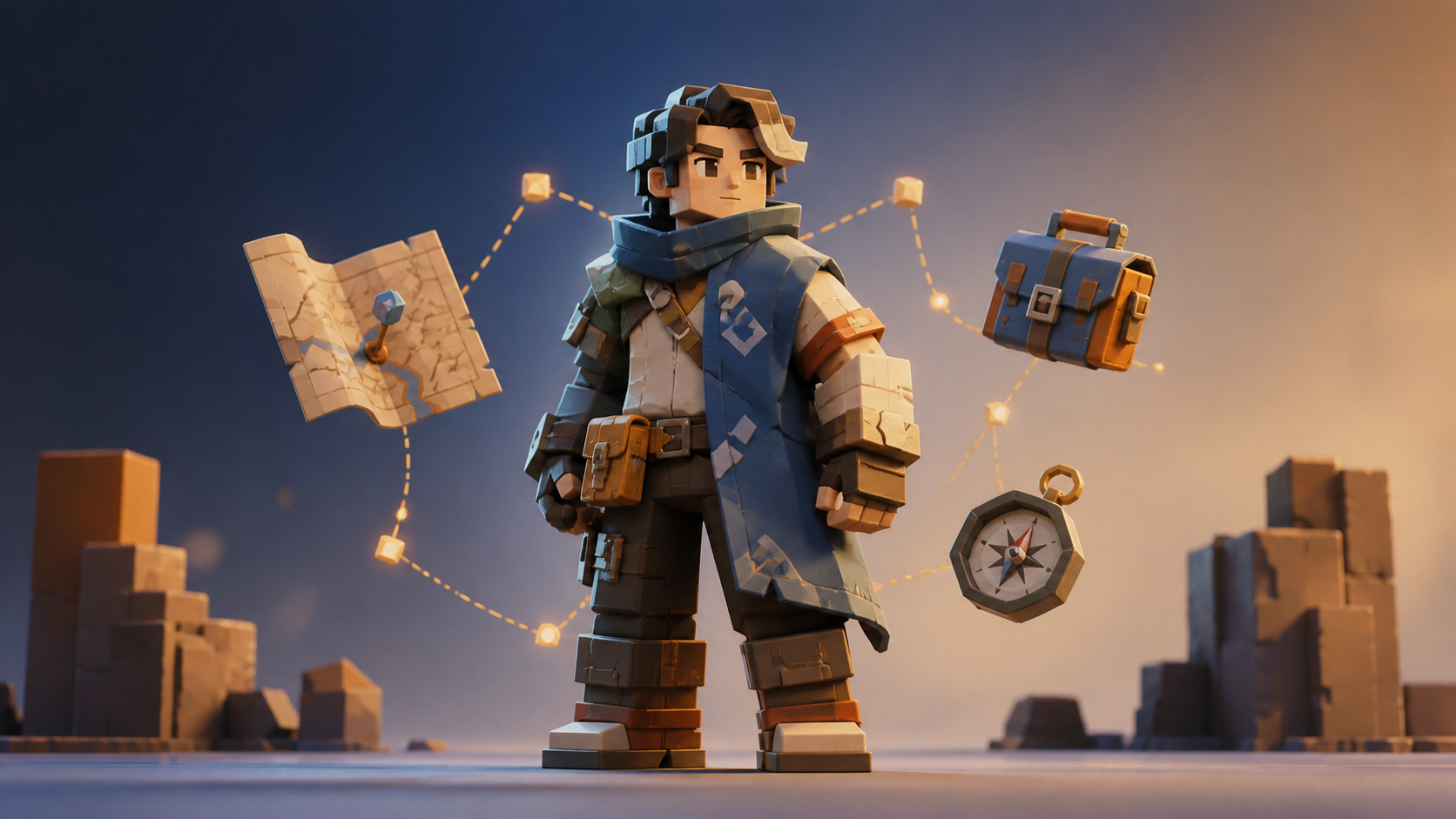
A memorable Roblox OC needs more than a crowded inventory. Players usually see characters at a small scale, in motion, and against busy environments. That means a readable silhouette, two or three dominant colors, and a few purposeful accessories do more work than dozens of unrelated details.
Story matters too. An OC—an original character—is not only an outfit. A role, current goal, limitation, and several relationship hooks give other players a reason to interact.
This guide builds an original adult-coded sky-rail courier named Tarin Quill as a worked example. AI is used for concept development, not as a promise that every pictured item exists in the Roblox catalog or can be imported directly. Roblox is a trademarked platform, and this independent guide does not imply endorsement.
Decide Whether You Are Designing an Avatar or an OC
An avatar represents the player. It can communicate your taste, mood, favorite colors, or the identity you want to use online.
An OC is a fictional person. The character has a history, motivation, habits, relationships, and a way of responding to situations. An avatar and an OC can overlap, but choosing the primary purpose makes design decisions easier.
For a personal avatar, focus on visual identity and items you genuinely enjoy. For a roleplay OC, define at least:
- a role in the world;
- a current goal;
- one useful skill;
- one meaningful limitation;
- a reason to cooperate with other characters;
- a conflict that can grow during play.
Our example begins with one sentence: Tarin Quill is an adult sky-rail courier who maps temporary routes between floating settlements after storms erase the old paths.
That premise already suggests clothing, equipment, locations, allies, and problems.
Build a Block-Readable Silhouette
Tiny details disappear at game distance. Start with three large shapes that can identify the character even when the face is barely visible.
Tarin's silhouette uses:
- a short asymmetrical shoulder cape on the left;
- a compact square route satchel on the right hip;
- a tall folded survey pole attached behind the right shoulder.
The asymmetry makes the figure easier to recognize without requiring large wings, multiple shoulder companions, and an oversized back item at the same time.
Run a simple test: take a screenshot-sized thumbnail, fill the character completely black, and zoom out. If the result resembles many generic avatars, change one major shape—the cape, bag, headwear, or stance. Do not add ten small accessories to solve a silhouette problem.
Use a Four-Color Palette
A limited palette keeps an OC readable across different lighting conditions. Choose colors by function, not merely by preference.
For Tarin:
- slate blue is the main outerwear color;
- warm sand defines the shirt and map materials;
- rust orange marks tools and route equipment;
- ivory appears in small reflective navigation accents.
Use large color blocks. Fine gradients may look polished in a full-size concept image but turn into visual noise during play. Assign one color to urgent or story-specific moments instead of scattering it everywhere.
Design Outfit Layers by Function
Every layer should answer a practical question about the character.
- The short cape protects maps without covering the satchel.
- A fitted right sleeve prevents fabric from catching on the survey pole.
- A reinforced left glove handles rail cables after storms.
- Straight dark trousers keep the upper silhouette dominant.
- Low-profile boots suggest travel without adding another competing shape.
- The satchel carries route tiles, chalk, and repair tags.
Accessories should explain what the character carries and how it is used. Keep head items compact so they do not compete with the cape and pole. Check that back items do not hide nearby players or clip through common running, sitting, and tool-use animations.
Write the AI Concept Prompt
An AI image is a design sketch, not a catalog listing. Write a prompt that locks the large decisions and clearly forbids branded or copied elements.
Original adult-coded block-style game-avatar OC, sky-rail courier named Tarin Quill; compact rectangular silhouette; short asymmetrical slate-blue shoulder cape on left; fitted right sleeve; warm-sand shirt; dark practical trousers; low-profile boots; square rust-orange route satchel on right hip; tall folded survey pole behind right shoulder; small ivory navigation accents; four-color palette; clean front three-quarter concept pose; readable large shapes; no platform logo, no text, no copied catalog item, no recognizable franchise character.Generate front, side, and back concepts when possible. Before accepting the design, check the cape side, pole height, satchel position, sleeve asymmetry, and color placement.
You can choose a supported image model from the model catalog for the first concept, then use image-to-image editing for controlled variations. Treat the results as visual references and rebuild the final avatar with legitimate platform items or assets you have the right to use.
Write a Backstory in Five Facts
Avoid writing ten pages before the first roleplay session. Five facts can establish a world while leaving room for other players to influence the story.
- Tarin grew up at a weather station suspended beneath the oldest sky rail.
- Storms now erase established routes faster than the settlements can redraw them.
- Tarin discovered that certain compass stones briefly remember paths that no longer exist.
- A powerful transit guild wants all route maps stored in one controlled archive.
- Tarin suspects the archive is quietly removing independent settlements from official charts.
Add one present goal: restore a safe route to an isolated orchard settlement before its supplies run out.
Add one limitation: reading a vanished route temporarily disrupts Tarin's sense of direction in the present.
These details create locations, mysteries, allies, and antagonists without deciding every answer in advance.
Define Roleplay Behavior
A character becomes easier to play when behavior is specific and repeatable.
Tarin:
- redraws maps while thinking;
- offers directions in exchange for a local story;
- says “one route at a time” when overwhelmed;
- distrusts official shortcuts but still checks every safety marker;
- asks permission before reading another character's compass or travel record;
- never dictates what another player's character thinks or remembers.
Include a flaw that creates scenes without making the OC unpleasant to play with. Tarin helps strangers find their way but avoids admitting when personal memories have become unreliable.
Create a Simple Ability Loop
Roleplay abilities need consent, limits, and counterplay. “I reveal your secret route automatically” takes agency from another player. “I offer to test your compass, and you choose what trace it reveals” creates collaboration.
Tarin's ability loop is:
- Survey: inspect a damaged route marker or compass stone.
- Trace: recover one brief directional impression with the owner's agreement.
- Map: place a temporary route marker that lasts for one journey.
- Cost: lose reliable orientation in the current location for a short period.
- Failure: a damaged stone may reveal an incomplete or outdated path.
The loop suggests game mechanics without pretending the character has official platform abilities. It also gives other players ways to help, refuse, negotiate, or interpret the result.
Build Three Avatar Variations
Variations should preserve the character's identity rather than redesigning everything for each scene.
Standard Courier
Slate cape, route satchel, folded survey pole, and ivory navigation tabs. This is the default readable state.
Off-Duty Tarin
Cape folded into the satchel, sand-colored overshirt visible, survey pole removed, and one rust-orange compass strap retained.
Storm Route Tarin
Cape secured across both shoulders, survey pole extended, ivory markers brighter, and a compact safety line attached to the satchel.
Create thumbnails at the same scale. The silhouette, slate-and-sand palette, and route satchel should make all three look like one person in different circumstances.
Make the OC Socially Playable
An effective roleplay concept offers other characters a way into the story.
Tarin can:
- ask a local guide to verify an unofficial route;
- trade navigation help for a story about a missing settlement;
- argue with a guild archivist who values centralized safety;
- need a partner to navigate while the route-reading limitation is active;
- discover that another character's map contradicts the official record.
These hooks create choices rather than forcing a single plot. They also let different roles—explorer, merchant, mechanic, historian, or official—participate naturally.
Originality, Catalog Safety, and Platform Caution
Search for similar names, silhouettes, and item combinations before publishing. Change accidental overlap. Do not copy another player's full outfit, custom texture, UGC design, or OC sheet.
Use official platform channels for avatar items. Avoid links offering unauthorized “free” assets, and do not upload copyrighted textures, logos, music, or character designs you do not own. Check current Roblox community standards, marketplace rules, and creator requirements directly because policies can change.
AI concept art usually cannot be imported as a compliant avatar automatically. Make an item checklist, then find the closest legitimate catalog pieces or create original assets through approved tools. Test the exact body type and animation set you plan to use; thumbnails often hide clipping that appears while running, sitting, or holding equipment.
If the OC is based on a real person, obtain permission before using their likeness or private details. Originality is not only a visual goal—it also involves consent, ownership, and respectful play.
Frequently Asked Questions
How many accessories should a Roblox OC have?
Use the fewest needed to explain the silhouette and role. Three large, readable anchors are often stronger than ten small items. Add something only when it improves identity or supports the story.
Can AI generate a Roblox avatar I can import directly?
Usually not. AI concept images are visual references, not guaranteed catalog bundles or compliant platform assets. Rebuild the idea with legitimate catalog items or properly created assets that meet current requirements.
How do I write a roleplay backstory?
Start with five facts, one current goal, one limitation, and two relationship hooks. Leave important questions unanswered so play can change the character.
Can I sell items based on my OC?
Possibly, but commercial use depends on platform marketplace rules, creator eligibility, intellectual-property rights, and ownership of every asset involved. Review the current official requirements before selling anything.
Create a Character That Can Grow
A clear silhouette makes an OC recognizable; a limited palette keeps the design readable; and purposeful accessories connect appearance to role. The backstory then turns those visual decisions into choices other players can engage with.
Keep the concept small enough to test. Build one outfit, five facts, one ability loop, and a few social hooks. The character becomes richer through play, not through piling every possible detail into the first design.