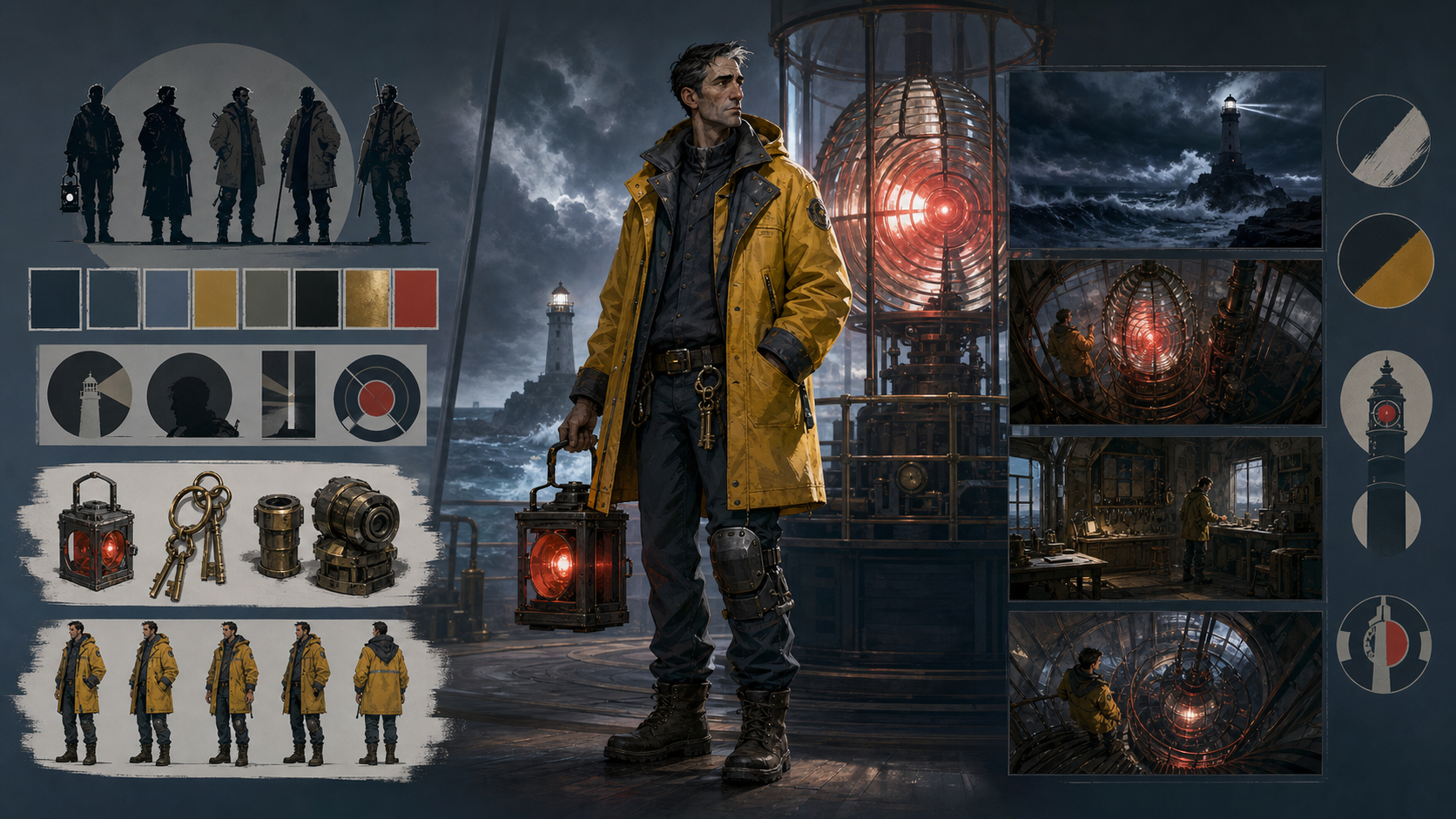
An OC maker can produce a polished-looking first image quickly, but polish is not the same as originality. Prompts built from words such as “beautiful,” “mysterious,” “powerful,” and “unique” tend to produce familiar faces, decorative outfits, and details that change from image to image.
A stronger original character begins with relationships: a role that shapes the clothes, an environment that shapes the equipment, a goal complicated by a personal limit, and a few visual anchors that remain recognizable in every scene. The prompt then becomes a production specification rather than a pile of adjectives.
This guide develops that method step by step. It uses a clearly adult lighthouse keeper as a running example, but the framework works for fantasy, science fiction, contemporary, game, comic, and animation characters.
1. Write the character sentence first
Before describing hair, clothes, or rendering style, compress the character into one sentence:
A clearly adult [role] who wants [goal] but faces [contradiction or limit].
For example:
A clearly adult lighthouse keeper and lens mechanic who wants to train a successor but is afraid of open water.
That sentence gives the design somewhere to go. “Lighthouse keeper” suggests weatherproof clothing, keys, tools, stairs, salt, and practical lighting equipment. “Train a successor” creates teaching poses and workshop scenes. “Afraid of open water” gives the character a contradiction without requiring a long biography.
Compare that with “a mysterious and attractive lighthouse hero.” The second version offers mood but almost no usable design logic.
A useful character sentence should answer three questions
- What does this person do? A specific role produces stronger visual evidence than a broad archetype.
- What are they trying to change? A goal creates action and story direction.
- What makes that difficult? A limit, fear, obligation, or contradiction prevents the character from feeling frictionless.
Make age unambiguous when it matters. “Clearly adult, early forties” is more useful than a vague word such as “young,” both for design consistency and for safer production decisions.
2. Separate visible information from invisible information
Image prompts describe what a frame can show. Character documents can hold everything else.
| Visible in an image | Better kept in a character document |
|---|---|
| Apparent age, face structure, hair, body proportions | Childhood history and complete chronology |
| Clothing, wear, tools, posture, expression | Private beliefs and secrets not affecting the moment |
| Environment, weather, lighting, action | Future plot twists and long-term character arc |
| Physical response to emotion | Abstract philosophy with no visual behavior |
Invisible traits become useful when you convert them into observable choices. Instead of writing “does not trust praise,” show the keeper looking at the repaired lens while a cheering group remains soft in the background. Instead of “cares more than he admits,” show him silently replacing a trainee's torn glove before dawn.
One visible behavior usually communicates more than several sentences of hidden lore.
3. Use an eight-block OC prompt
A stable base prompt can be organized into eight blocks. You do not need to label each block in the final prompt, but building them separately makes omissions easier to spot.
Block 1: Adult status and role
State the character's apparent age and practical function first.
Example: clearly adult, early forties, lighthouse keeper and mechanical lens technician.
The role should influence later decisions. If the clothes, props, and pose would work equally well for an unrelated character, the role is not doing enough design work.
Block 2: Structural identity
Describe relationships rather than beauty ratings:
- long or compact face;
- brow height and angle;
- eye depth and spacing;
- nose or jaw structure;
- exact hair shape and placement;
- apparent age markers;
- build and habitual posture.
“Long narrow face, low straight brows, deep-set dark eyes, close-cut black hair with one pale streak at the right temple” is reproducible. “Handsome, intense face” is not.
Block 3: Silhouette
Imagine the character as a solid black shape at thumbnail size. What remains identifiable?
For the keeper, use a tall, slightly stooped figure, a short boxy work coat, a square lantern carried low, and a subtly guarded right leg. Those large relationships matter more than buttons or fabric embroidery.
Block 4: Outfit logic
Clothing should answer the job, climate, movement, and maintenance needs:
- a waxed coat for spray and rain;
- a heavy sweater for cold night shifts;
- dark high-waisted work trousers that do not catch in machinery;
- a leather brace shaped by years on spiral stairs;
- weathered boots with reliable grip.
Avoid stacking fantasy accessories simply to make the design look “detailed.” Each major item should have a reason to exist.
Block 5: Signature props
Choose one or two props that are visually strong and useful in scenes. A square storm lantern with a red inner lens and a brass key ring at the left hip are better anchors than ten unrelated trinkets.
Record the prop's geometry and position. “Lantern” can drift into any shape; “square iron storm lantern with a circular red lens” is much easier to preserve.
Block 6: Pose and expression
Begin with a neutral production pose rather than an action shot. Ask for a full-body three-quarter stance, visible hands and feet, a clear weight distribution, and an expression that fits the role.
For this design, place most weight on the left leg, keep the lantern low in the right hand, and use a guarded, observant expression. The neutral view becomes a reference for later scenes.
Block 7: Palette and rendering
Limit the palette and establish hierarchy:
- slate blue and charcoal for the base;
- weathered yellow for the coat;
- brass for tools;
- red only for the lantern's active light.
Then choose one coherent rendering description. “Clean medium-weight linework with restrained cel shading” is clearer than mixing anime, watercolor, 3D, oil painting, photorealism, and sketch terms in one prompt.
Block 8: Production constraints
Finish with requirements that make the result usable:
- one clearly adult character;
- full body and both feet visible;
- plain or simple background;
- hands unobstructed when they matter;
- no text, watermark, or logo;
- right/left details must not swap;
- no extra tools or accessories;
- no existing franchise character.
These constraints are more actionable than “no mistakes.”
4. Assemble the complete base prompt
Here is a compact working prompt built from the eight blocks:
Original character design of a clearly adult lighthouse keeper and mechanical lens technician in his early forties. Long narrow face, low straight brows, deep-set dark eyes, close-cut black hair with one pale streak at the right temple; tall build with a slight habitual stoop. Short boxy waxed-yellow work coat over a heavy slate sweater, dark high-waisted work trousers, leather brace on the right knee, worn black boots. Square iron storm lantern with one circular red inner lens carried low in the right hand; brass key ring fixed at the left hip. Neutral full-body three-quarter stance with weight on the left leg, guarded observant expression. Limited slate, yellow, charcoal, and brass palette with red used only for the lantern. Clean medium-weight linework and restrained cel shading on a simple background. One adult character, both hands and feet readable, preserve right-temple streak, right-knee brace, lantern geometry, and left-hip keys; no text, logo, watermark, or extra accessories.Generate a small batch from the same prompt before changing anything. The best first design is usually the one with the clearest silhouette and most repeatable anchors—not the one with the most decoration.
You can use a text-to-image workflow to test the base design, then retain only outputs you have reviewed for originality, anatomy, and consistency.
5. Create originality through causal details
Originality often comes from connecting ordinary details in an unusual but believable way. For every important choice, ask “because what?”
- Why is the coat yellow? Because it must remain visible in fog.
- Why is the right knee braced? Years of climbing spiral stairs changed the keeper's gait.
- Why is the lantern square? It locks into a rectangular emergency slot in the lens machinery.
- Why are the keys always on the left? The right hand must remain free for tools and the lantern.
- Why is the red light rare? It marks a specific emergency mode rather than serving as general decoration.
The answers create story, pose, and scene opportunities. They also reduce accidental resemblance because the design grows from its own internal causes rather than a catalog of familiar genre features.
If a detail has no function, history, emotional consequence, or compositional purpose, consider removing it.
6. Lock three to five identity anchors
An identity anchor is a phrase that should remain verbatim across prompts. Three to five strong anchors are usually more reliable than a long list of tiny details.
For the lighthouse keeper, lock:
- long narrow adult face with a pale streak at the right temple;
- short boxy waxed-yellow work coat;
- leather brace on the right knee;
- square storm lantern with a circular red inner lens;
- brass keys fixed at the left hip.
Then divide the design into two lists.
Must keep: face structure, streak side, brace side, lantern shape, key location, overall silhouette.
May vary: coat open or closed, mud and rain, temporary gloves, expression, small repair tools, scene lighting.
Save approved front, side, back, and three-quarter references. A single prompt cannot define every angle, and a seed alone is not a substitute for an art-direction sheet.
7. Build new scenes modularly
Do not rewrite the whole character with synonyms every time. Keep the identity block stable and attach a new scene block.
Identity block
Same clearly adult lighthouse keeper: long narrow face, pale streak at right temple, waxed-yellow boxy coat, right-knee leather brace, square red-lens lantern, brass keys at left hip.Scene block
Inside the lens room during a storm, the keeper braces the square lantern into an empty machinery slot. Medium-wide low camera, both hands visible, rotating glass lens behind him, cold lightning through the windows and controlled red lantern light across the face.Preservation block
Preserve adult facial structure, streak side, coat silhouette, brace side, lantern geometry, and key position. No new accessories, text, logo, or watermark.This modular approach makes drift easier to diagnose. If the face changes, fix the identity reference. If the pose fails, adjust only the scene block. If the right and left details swap, strengthen the preservation block.
8. Write negative instructions as production needs
Generic negatives such as “no ugly face, no weird anatomy, no errors” do not explain what the correct result should show.
Replace them with observable requirements:
- exactly one adult character;
- both hands visible and naturally holding one lantern;
- five fingers on each visible hand;
- right knee brace and left-side keys must not swap;
- feet fully inside the frame;
- no extra belts, jewelry, weapons, text, or logos;
- background simple enough to preserve the silhouette.
Positive direction should do most of the work. Negative instructions are a final guardrail, not a substitute for composition and anatomy guidance.
9. Fix common OC prompt failures
| Failure | Likely cause | Better revision |
|---|---|---|
| Generic youthful face | Beauty adjectives and unclear age | State apparent age and structural relationships among brows, eyes, jaw, and hairline |
| Random fantasy accessories | No profession, climate, or item limit | Name the job and environment; allow only one or two functional props |
| Ability effect hides the design | Effects introduced before the base reference is stable | Approve a neutral character first; add one effect with a fixed shape, source, and color |
| Character changes across scenes | Identity block rewritten each time | Reuse exact anchor phrases and approved references; vary one scene block |
| Prompt is extremely long | Invisible biography and repeated style words | Move lore to the character document and remove duplicate descriptors |
| Left/right details reverse | Side-specific elements are weak or too numerous | Reduce asymmetry, state positions twice, and check every output before approval |
| Design is detailed but forgettable | No dominant silhouette or prop | Enlarge one structural relationship and remove competing decoration |
Treat each failure as a diagnosis. Do not add ten new phrases when one precise correction would solve it.
10. Build controlled variations
Once the base character is stable, change one axis per batch:
- test two silhouette proportions while keeping the face and outfit fixed;
- compare coat construction without changing the palette;
- compare one lantern variation at a time;
- test neutral, guarded, and relieved expressions with the same camera;
- finalize the palette only after the large shapes work in grayscale.
Keep a prompt change log. Record the exact phrase changed, the reason for the change, the selected result, and any new anchor. In a team, label fields as locked or editable so one collaborator does not accidentally redesign a decision another person is trying to preserve.
11. Check for accidental derivation
Before publishing or commercializing an OC, compare the result against well-known characters in the same genre. Search combinations of the character's name, role, silhouette, palette, and signature prop. Ask:
- Does the black silhouette strongly resemble an existing character?
- Is the color layout or costume construction immediately associated with a franchise?
- Is the signature prop too close to a protected design?
- Did the prompt request the exact style of a named living artist?
- Does the output contain an official-looking logo, uniform, or emblem?
- Do you have rights to every reference image used?
If the design is deliberate fan art, label it clearly as unofficial and follow the relevant rightsholder and platform rules. Availability in a generator does not grant a commercial license. For an independent commercial character, remove franchise terminology and rebuild any borrowed world, symbol, costume, or story convention.
Describe visual craft through broad attributes—line weight, shape language, palette, shading, and mood—rather than requesting an exact imitation of a living creator's style.
A repeatable OC production workflow
- Write the adult role-goal-contradiction sentence.
- Move invisible lore into a separate character document.
- Draft the eight prompt blocks.
- Generate a small neutral batch with no powers or dramatic scene.
- Select the most repeatable design and lock three to five anchors.
- Create approved angle, expression, and prop references.
- Add scenes through modular identity, scene, and preservation blocks.
- Test one controlled variation per batch and log every change.
- Review for accidental derivation, rights, anatomy, and misleading branding.
- Keep the prompt and reference set with the final asset so future scenes remain reproducible.
The objective is not one attractive image. It is a character system that survives new angles, actions, outfits, and story situations without losing its identity.
Frequently asked questions
How long should an OC prompt be?
A focused base prompt often lands around 80–160 words, but word count is only a heuristic. Use enough detail to define large relationships, anchors, palette, and constraints. Remove lore and repeated adjectives that do not change the image.
Should personality appear in the image prompt?
Only when it changes something visible: posture, gaze, expression, clothing care, gesture, or interaction with a prop. Keep the rest in the character document.
How many identity anchors should I use?
Three to five distinct anchors are a practical starting point. Too few can make the character generic; too many tiny anchors compete for attention and are harder for a model to preserve.
Can I reuse one prompt forever?
Reuse the stable identity block, but do not expect one prompt to define every view and context. Build an approved reference set and add modular scene instructions. Update the character specification intentionally when the design evolves.
What makes an AI character feel original?
Originality comes from connected decisions. A role causes an outfit choice; an environment shapes a tool; a physical history affects posture; a goal conflicts with a limit. When those relationships are specific, the visual design becomes harder to replace with a generic archetype.