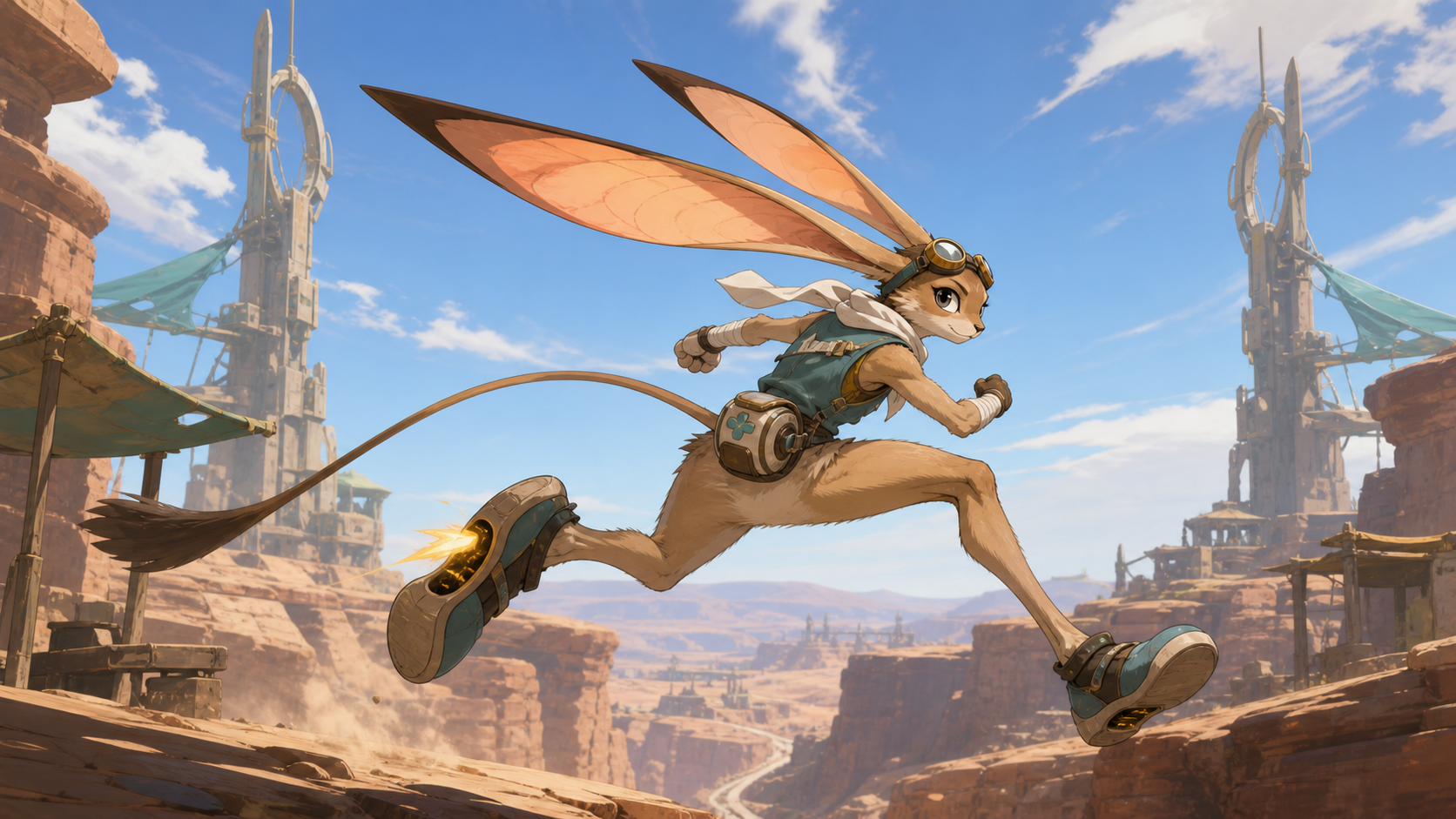
Fan-work notice: This is an unofficial character-design exercise inspired by broad ideas associated with Sonic fan OCs. It is not affiliated with, endorsed by, or licensed by Sega or other rightsholders. Do not present a fan character as canonical, playable, leaked, or officially licensed.
An action-game OC has to communicate at speed. The player may see the character at small scale, in a strong pose, for only a moment. That makes silhouette, color hierarchy, footwear, movement physics, and power limits more important than a dense outfit full of tiny details.
This guide builds those decisions around Solace, a clearly adult anthropomorphic jerboa courier. The goal is not to recolor a familiar mascot. It is to let the species determine movement, let the occupation determine equipment, and let the power's weakness create both gameplay and character growth.
Choose a species for movement, not novelty
Start by studying one or two broad traits of a real animal. Do not combine ten species simply to make the design seem original. Ask what kind of movement the animal suggests.
Jerboas are already represented in Sonic canon through Fang the Hunter, so the species alone is not an originality claim. Solace must differ through the long-jump movement system, adult medicine-courier role, tan-and-teal hierarchy, crescent-soled footwear, restrained equipment, and sunlight-limited midair correction—not through a recolor or a claim that jerboas are new to the franchise.
Jerboas are small desert rodents known for long hind legs, large ears, long balancing tails, and powerful jumps. Those traits suggest a movement vocabulary immediately:
- long, precise leaps rather than constant ground sprinting;
- a tail that steers and counters rotation in the air;
- large ears that affect the silhouette and trail during motion;
- compressed preparation followed by explosive extension;
- careful landing choices on unstable sand.
Translate the principles instead of producing a biological diagram. Solace is an adult-coded anthropomorphic character with a compact torso, very long hind legs, short forearms, upright ears, and a long tail ending in a dark brush.
Run a direct comparison before finalizing the silhouette. Remove any Fang-like hat, popgun, belt arrangement, facial shape, purple-and-white palette, or treasure-hunter cues. A species can be shared while the role, proportions, equipment, palette, movement, and story remain independently designed.
The species should answer a gameplay question. Jerboa anatomy gives Solace a distinct way to cross gaps and redirect in midair. If the character moved exactly like a familiar hedgehog-shaped runner, the species choice would be cosmetic.
Other species can work when their traits create different actions: a glider for controlled descent, a mole for burrowing, a gecko for wall adhesion, a mountain goat for landing stability, or a bat for echo-based navigation. Choose one movement advantage and one complication.
Define the role and personality
Solace is not “a fast desert hero.” The role is more specific:
A clearly adult solar-route courier who carries cooling medicine between isolated settlements during sandstorms.
The character's long-term goal is to establish a permanent shaded route so no community depends on a single courier. That goal gives speed a social purpose.
Build a small contradiction:
- Solace depends on sunlight to charge a movement ability but dislikes being watched.
- The courier helps entire settlements yet treats accepting personal help as failure.
- Solace tracks every jump when anxious, even when the counting distracts from the actual terrain.
These details create scenes that are not races. Solace can train another courier, negotiate access to shade towers, argue over route safety, fail during a night delivery, or choose between a personal record and a group evacuation.
A compact character foundation
- Species: anthropomorphic jerboa.
- Adult role: medicine courier and route surveyor.
- Goal: build a permanent network of shaded delivery paths.
- Strength: reads gaps and landing surfaces quickly.
- Flaw: mistakes self-reliance for responsibility.
- Habit: counts jumps aloud under stress.
- Emotional risk: fears becoming unnecessary after the route is complete.
The role and flaw should remain useful even if the power is removed.
Build the sunlight power with limits
Solace's translucent inner ear panels absorb sunlight and hold a limited charge. During a leap, the charge can be released through one outer heel vent as a short directional burst while the tail counterbalances the correction.
The ability does not create endless speed. It modifies a jump once.
Visible states
- Uncharged ear panels are muted peach.
- Stored energy shifts them toward bright gold.
- A small geometric gold flare appears at one outer heel vent during release.
- The tail moves opposite the correction to show counterbalance.
- Overcharge makes the ears painfully bright and the stance less stable.
Rules and weaknesses
- Charging is impossible at night or deep underground.
- The burst can be released only while airborne.
- Each leap receives one directional correction, not repeated flight.
- Wet or loose sand reduces launch quality.
- Excess charge creates light sensitivity.
- Repeated release disrupts hearing and balance.
- A poor landing cannot be erased by adding more energy.
These limits force route planning. Solace must decide where to charge, which gap deserves the burst, and whether to save energy for an emergency. A shaded path may be safer for the medicine but worse for the power.
Design the power in three frames
- Preparation: ears brighten, legs compress, tail sets the intended direction.
- Peak: one restrained heel flare redirects the airborne body.
- Recovery: ears dim, landing stance absorbs force, balance loss becomes visible after overuse.
If the recovery frame shows no cost, the limit probably exists only in text.
Design the silhouette and palette
Build the design in descending order of importance:
- extremely long upright ears;
- long hind legs and compact torso;
- sweeping tail with dark brush;
- short triangular courier jacket;
- broad crescent-soled shoes.
Convert the character to a black silhouette. The ears, leg angle, tail, and shoes should remain recognizable without interior detail.
Use a controlled color hierarchy
- sand-tan fur as the main body color;
- dark brown on ear tips and tail brush;
- muted teal for the courier jacket and shoes;
- white for a secured chest scarf panel;
- peach for uncharged inner ears;
- gold used only as the active power signal;
- one small original magenta medical mark, if needed, rather than an official emblem.
Do not spread gold across the whole outfit. If everything glows, the charged state communicates nothing. The power color should be rare enough to become information.
Make footwear part of the physics
In a movement-focused design, shoes are not decoration. Solace's footwear must explain takeoff, sand contact, and the directional burst.
Use broad crescent soles that distribute weight on loose ground, a separated heel section for the controlled vent, one strong strap, and teal-brown construction that remains distinct from familiar franchise footwear.
Avoid copying a canonical shoe outline and changing only the color. Ask:
- Where does the foot flex?
- Which surface grips sand?
- Where does energy leave the shoe?
- Can the shape be read during a jump?
- Does the landing pose look physically plausible?
The outfit follows the same logic. A short sleeveless teal jacket leaves the limbs readable. The white scarf panel is secured to the chest rather than trailing across the ears and tail. Goggles protect against sand. A compact medicine case sits at the lower back so it does not swing into the legs.
Avoid a long cape or excessive straps that blur the movement silhouette.
Write the AI generation prompt
Describe original shape language and production needs rather than requesting the exact style of a named artist or a franchise screenshot.
Create a full-body three-quarter model-sheet view of Solace, an unofficial adult jerboa courier designed for a colorful action game. Build the silhouette around jump anatomy: elongated athletic hind legs beneath a small sandy-tan upper body, abbreviated forearms, a brush-tipped steering tail, and fixed-length vertical ears. Make the ear interiors translucent peach, with deep brown reserved for the ear tips and tail end. Outfit the courier in a cropped dusty-teal sleeveless jacket, a fitted white chest wrap that cannot trail, sand goggles resting at the forehead, and a low-profile insulated medicine case secured behind the waist. Give each teal-and-brown shoe a wide crescent sole for loose ground, one pale securing strap, and a single discreet vent on the outside heel. Use a quiet light backdrop, crisp production linework, and a few large shapes that remain legible at thumbnail size. Consistency locks: ear height, leg-to-torso ratio, tail tip, jacket cut, goggle shape, case placement, sole curve, and vent side. Exclude all existing characters, franchise scenery, familiar shoe silhouettes, collectible rings, lightning trails, official marks, writing, and watermarks.Generate the neutral design without power effects first. A text-to-image tool can help test variations, but approve the anatomy and original design before treating any result as a reference.
Record the chosen ear length, leg ratio, tail brush, shoe design, jacket, goggles, and case. Then reuse the exact identity language in every action prompt.
Create a movement sheet
A single hero pose cannot prove that the design works at speed. Build a movement sheet in a controlled order:
- neutral front, side, back, and three-quarter views;
- compressed crouch before takeoff;
- unpowered long jump;
- one midair directional correction;
- stable landing on firm ground;
- unstable landing on wet sand;
- overcharge fatigue and balance loss.
Keep the ears at the same length in every panel. Decide how they trail without covering the face. Keep the medicine case fixed and the tail brush consistent.
Example action prompt
Same adult jerboa courier launches from a sand ridge in one long diagonal leap. One controlled gold burst exits the outer heel vent and redirects the body slightly toward the visible destination ridge. Fixed-length ears trail backward with dark tips visible; tail curves in the opposite direction as counterbalance. Wide side view, full body readable. Preserve tan fur, muted teal jacket, secured white chest panel, goggles, lower-back medicine case, crescent shoes, and tail brush. One burst only; no lightning trail, rings, copied speed effect, text, or logo.Test the sheet in grayscale. If the character depends entirely on color or glow, strengthen the pose and silhouette.
Write a fan-made introductory level
An original level should test species movement, occupation, power limits, and personality at the same time.
Setting
The Shadeglass Route is an original desert canyon lined with mirrored heat towers and abandoned shade stations. Settlements use the towers to signal safe landing points during sandstorms.
Objective
Solace must deliver cooling medicine before the stored dose becomes unusable.
Complication
An original maintenance machine has begun creating false bright paths. The reflections overcharge Solace's ears and hide the safe route markers.
Character conflict
A local glider offers help. Solace refuses, takes a faster solo route, and wastes charge correcting a bad jump.
Mechanical turn
Night falls before the final canyon. Solar charging stops. Solace must rely on jerboa jumping, remembered terrain, the glider's airflow knowledge, and hand-placed route markers instead of the gold burst.
Resolution
Solace finishes the delivery but abandons the personal time record. The courier begins mapping a cooperative route that works for people with different movement abilities.
The level proves the design because no single feature solves everything. Species movement remains valuable after the power fails, and the story rewards character growth rather than raw speed.
Avoid the “recolor plus power” trap
Use this originality check:
- Does the black silhouette remain distinctive?
- Does the animal species change movement and level design?
- Does the power have a visible state, limit, and recovery cost?
- Do the shoes follow original physics rather than a famous outline?
- Does the outfit support the occupation?
- Does the character want something beyond proving strength or speed?
- Can the design create humor, conflict, vulnerability, and cooperation?
- Are environments, symbols, enemies, and supporting characters original?
If the design is a familiar silhouette with a new palette and ability effect, return to the species and role. Changing the eye color will not solve a structural resemblance.
Keep fan presentation clearly unofficial
Label character sheets and mockups FAN-MADE OC. Do not fabricate game screenshots, menus, selection screens, patch notes, casting news, official statistics, voice clips, or release announcements.
Avoid official logos, music, UI, signature poses, canonical environments, and protected character assets. Do not imply that the OC will appear in a future game or that a rightsholder approved it.
For personal fan work, review the rightsholder's policies and the platform's terms. For merchandise or other commercial use, obtain permission or qualified legal advice, or rebuild the concept as a fully independent desert-courier character and world. Platform availability does not grant rights in third-party franchises, music, voices, or logos.
A practical design workflow
- Choose one animal trait that creates a movement system.
- Define a clearly adult role, goal, contradiction, and habit.
- Design one power with visible states and meaningful limits.
- Establish the large silhouette before adding accessories.
- Make footwear and clothing support movement and occupation.
- Reserve one accent color for power state information.
- Generate a neutral reference before action or effects.
- Create a movement sheet with preparation, peak, landing, and recovery.
- Test the design inside an original level that disables the easiest solution.
- Review for franchise resemblance, misleading presentation, and input rights.
Frequently asked questions
What species makes a good Sonic-inspired OC?
Choose a species with a feature that can become gameplay: gliding, burrowing, balance, climbing, jumping, echo-based navigation, or traction on a specific surface. Study broad traits respectfully and avoid assembling an arbitrary hybrid from many animals.
Does every OC need super speed?
No. A distinct rhythm is more valuable than copying speed. A character might gain height, grip walls, redirect once in midair, glide, create safe routes, sense hidden spaces, or support another character's movement.
How many colors should I use?
Begin with a body color, a darker structural color, one clothing color, one neutral, and one rare ability accent. The hierarchy matters more than an exact number. Check the design in grayscale and at thumbnail size.
Can I sell my Sonic OC?
A fan OC connected to a protected franchise may still implicate copyright and trademark rights even if you invented the character. Obtain permission or legal advice, or convert the character, terminology, world, visual language, and presentation into an independent IP before commercial use.
How do I keep the character consistent in action scenes?
Lock a small set of identity phrases, approve neutral angle references, and change one movement variable at a time. State ear length, shoe construction, tail brush, outfit, case position, burst count, and the details that must not swap or disappear.