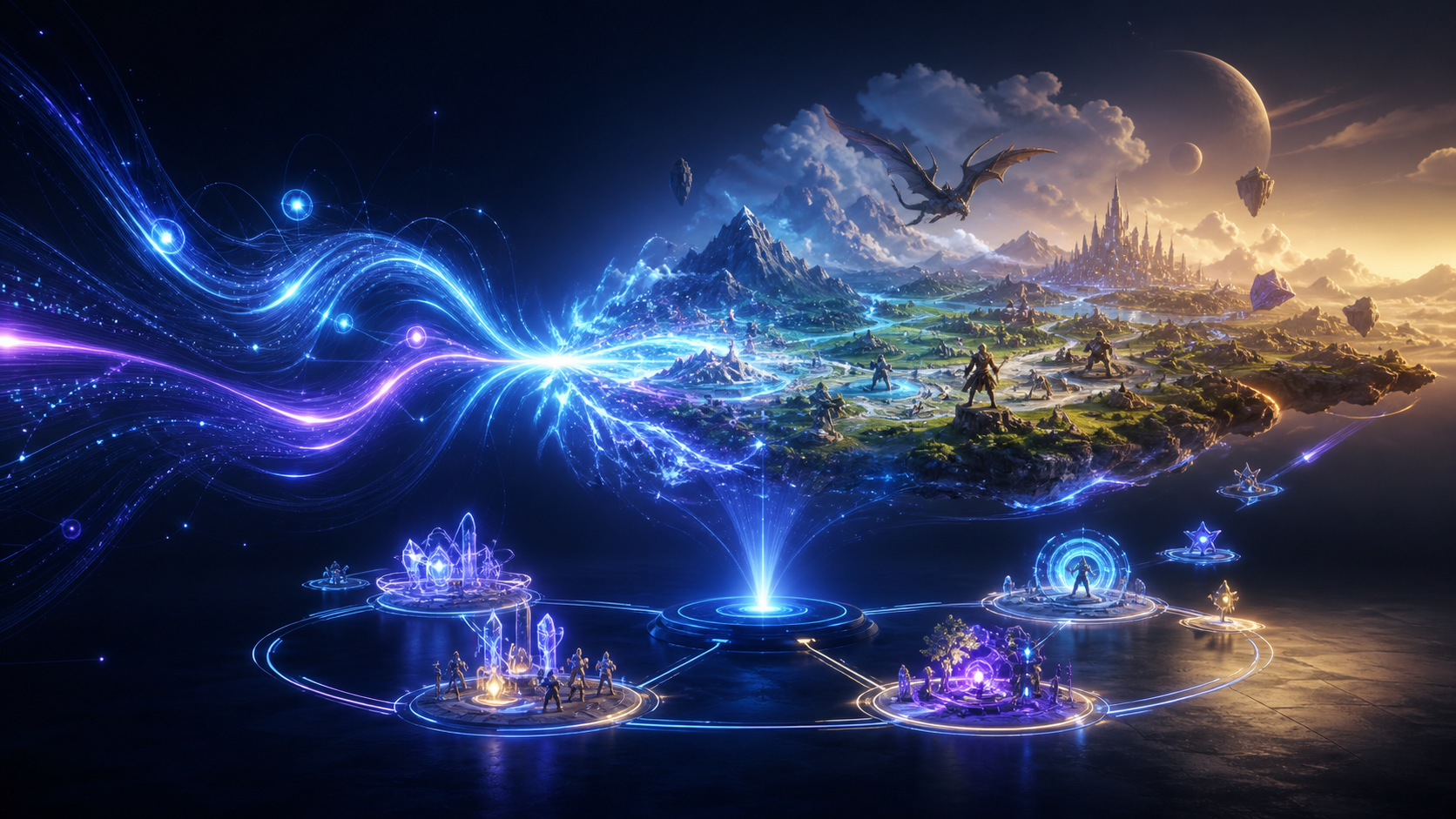
The phrase “ChatGPT moment for gaming” describes a possible change in interface, not a measured industry milestone. It refers to the point at which ordinary language becomes a practical starting place for creating interactive experiences, allowing more people to express game ideas before they master every technical tool.
ChatGPT is an OpenAI product. Neither OpenAI nor ChatGPT endorses, sponsors, or is affiliated with this article or DeepFake. Roblox, Minecraft, Fortnite Creative, their publishers and rights holders, and other game platforms mentioned here likewise do not endorse this article or DeepFake. The argument below is an editorial interpretation of emerging workflows, not a statistic, official forecast, or claim that complete game generation is already solved.
The analogy matters because conversational AI changed what many people expected from software. A user could describe a task in natural language and receive a useful draft without first learning a programming language or specialist interface. The deeper change was accessibility: advanced computation became something people could approach through a sentence.
Gaming may be moving toward a comparable entry point. A creator could begin with the experience they imagine, then use AI assistance and conventional development tools to turn that intent into a prototype. The hard part is much larger than producing text or an image, however. Games must react to players, maintain rules, create meaningful choices, and remain coherent over time. Natural language can lower the front gate; it does not eliminate the world behind it.
Every Technology Shift Changes Who Gets to Create
Many creative technologies become influential when they reduce the expertise required to begin. Personal computers expanded access to software. Smartphone cameras made photography available without dedicated equipment. Online publishing let people reach audiences without traditional media distribution.
AI has followed a similar pattern across writing, brainstorming, design exploration, and productivity. The user can state an objective before learning how every underlying system works. That is especially important in game creation because games combine several disciplines:
- Story: characters, context, pacing, dialogue, and consequences.
- Visuals: environments, readable silhouettes, animation, lighting, and interface.
- Interactions: what a player can attempt and what feedback follows.
- Systems: rules, resources, states, economies, progression, and failure.
- Player behavior: curiosity, experimentation, strategy, cooperation, and unexpected actions.
Traditional development asks teams to coordinate those layers through programming, engines, art pipelines, level design, sound, quality assurance, and production management. That complexity is not accidental overhead; it is part of what makes an interactive experience dependable.
Natural-language assistance may let a newcomer enter the process before mastering every layer. The creator can express a premise, ask for a breakdown, and reach a rough test sooner. A professional can use the same interface to compare options or communicate intent. In both cases, the result still needs human inspection and implementation.
Why Gaming Is Ready for a Different Creation Interface
Players already think beyond passive consumption. They imagine different endings, custom characters, new rules, and worlds built for their communities. The gap is between imagining those ideas and expressing them in executable form.
Even a small game may need a designer, programmer, artist, writer, and tester—or one person learning pieces of all five roles. A concept that sounds simple can hide difficult questions. How does the player move? What can change? Which states must be saved? What makes success understandable? How does difficulty evolve? What happens when the player ignores the intended route?
AI assistance could help translate a high-level idea into questions, components, placeholder content, or candidate code. The creator then has something concrete to examine. This is valuable because many game-design problems cannot be judged from prose alone. A mechanic must be played before its rhythm, friction, and edge cases become clear.
The opportunity is therefore not “any sentence instantly becomes a finished game.” It is a shorter path from sentence to testable hypothesis. That is a meaningful reduction in friction, provided the prototype is not marketed as a complete product.
Static AI Content Is Not the Same as a Game
Text, images, audio, and video are outputs a viewer can read, see, or hear. A game is a system a player can affect. The difference is not cosmetic.
A playable experience has to account for:
- player behavior: what actions are possible, including unintended ones;
- world response: how objects, characters, and rules react to those actions;
- fun or engagement: why repeating or mastering the activity is worthwhile;
- challenge: how risk, uncertainty, constraints, and skill create tension;
- progress: how the player understands change and approaches a goal; and
- evolution: how later states reflect earlier actions without breaking consistency.
An AI-generated image of a city can suggest mood. A video can show an imagined chase. Neither defines collision, navigation, inventory, clue state, non-player behavior, failure, or the consequences of a choice. Those relationships have to be expressed as logic inside an engine or another executable system.
This makes games both a harder AI problem and an interesting creative frontier. A convincing frame can hide contradictions; a player immediately finds them by turning around, revisiting a room, dropping an object, or refusing the quest. Interactivity continuously tests whether the world’s rules make sense.
From a Sentence to an Abandoned-City Mystery
Consider the prompt:
Create a mystery adventure in which I explore an abandoned city and uncover hidden secrets.
Natural language makes the intent easy to communicate, but the sentence is not a design specification. To become a prototype, it needs connected decisions.
Player role: Perhaps the player is a transit inspector searching for the last train’s route rather than an undefined explorer.
Environment: Limit the first build to a station, one street, and a locked archive. Use landmarks that help the player form a mental map.
Objective: Restore power to three signal boxes and use their timestamps to identify why the city was evacuated.
Interactions: Inspect objects, reroute electricity, compare records, and mark contradictions on a map.
Systems: Track which signals are powered, which clues have been interpreted, and which archive door states are available.
Player behavior: Allow clues to be found out of order and decide what happens if a player restores the wrong circuit first.
Feedback: Light, sound, map changes, and character notes should make each action’s result legible.
End condition: The prototype ends when the player opens the archive and chooses which of two explanations to preserve.
An AI-assisted workflow might propose variations of these components, draft placeholder dialogue, suggest a level blockout, or help scaffold code when a tool supports it. The creator must verify that the rules connect, the clues remain solvable, and the choices produce a coherent experience. “Abandoned city” supplies atmosphere; interaction design turns atmosphere into a game.
Multimodal AI: A Cautious Creative Bridge
Multimodal systems can work across more than one type of input or output, such as language and imagery. In game pre-production, that may help ideas move between formats. A creator could start with a sentence, use a sketch to clarify spatial layout, compare character silhouettes, organize an audio mood reference, and convert selected decisions into a more detailed brief.
The potential benefit is continuity of intent. Instead of manually restating every decision when moving from story notes to visual development, a system may help carry context between those stages. It might also expose contradictions: a “hidden” entrance that is visually dominant, an agile character wearing an impractical silhouette, or a calm exploration premise paired with relentless timing pressure.
But multimodal does not automatically mean world-aware, consistent, or production-ready. Different outputs may disagree. Generated art may not be animatable. A scene may look navigable while its geometry is unusable. Audio may imply an event the logic never implements. Human creators still need a source of truth, version control, and discipline-specific review.
AI Agents: Promising Assistance, Not Autonomous Design Authority
An AI agent is generally framed as a system that can pursue a multi-step task rather than answer one isolated prompt. In a game workflow, agent-like assistance could potentially:
- organize a design task into smaller steps;
- propose mechanic or level variations;
- run scripted checks against defined conditions;
- summarize playtest notes;
- flag suspicious balance patterns for investigation; or
- help maintain a list of assets and unresolved issues.
These are cautious possibilities, not proof that an agent understands fun or can independently ship a balanced game. Automated tests only cover the conditions they are given. A balance suggestion may miss player psychology, community strategy, accessibility, or an interaction across systems. An agent can produce plausible explanations for broken logic.
Keep people accountable for scope, code review, security, rights, safety, and final design decisions. Use agents to surface questions and accelerate repeatable work, not as unquestioned arbiters of quality. No agent capability described here should be read as a feature claim about DeepFake.
UGC Already Proved That Players Want to Create
The case for broader creation does not begin with AI. User-generated-content platforms have spent years demonstrating that many players also want to build.
Roblox showed the reach of an ecosystem where creators can make and distribute experiences. Minecraft demonstrated how a flexible rule set and construction system can support open-ended invention. Fortnite Creative gave communities tools to assemble and share spaces within a major game platform.
These examples do not prove that AI will reproduce their success, and the companies behind them do not endorse this comparison. They establish a narrower point: creation is itself a form of play, and players will invest in tools that let them shape experiences for others.
Existing UGC still demands platform knowledge. A creator may need scripting, logic, asset skills, level design, testing, and an understanding of discovery systems. Natural-language assistance could lower some of that learning threshold. It may let more people describe intent, get a first draft, and learn by revising a live example.
The likely result is not “developers disappear.” It is a wider gradient between player, modder, hobbyist, designer, and professional. Easier entry can create more beginners, while deeper control continues to reward expertise.
The Imagine → Create → Play → Remix Loop
A neutral way to describe an AI-assisted UGC workflow is through four recurring stages.
Imagine
Start with a character, setting, story problem, or mechanic. State the player role, main action, intended feeling, goal, and limitation. Natural language lets the creator begin with experience rather than software syntax, but the prompt remains a draft.
For the city mystery, “explore and find secrets” becomes “restore signal boxes, compare timestamps, and decide which record to preserve.” The second version is easier to test because it includes verbs and consequences.
Create
Translate the idea into executable systems using an appropriate game engine or game-building platform. AI may assist with planning, placeholder assets, code drafts, dialogue variants, or layout options where supported. Verify what the tool actually creates. A mockup or cinematic is not executable gameplay.
Play
Interact with the earliest stable build. Observe whether the goal is visible, whether actions produce predictable feedback, and whether the intended challenge appears. Give the build to someone who did not write the prompt. Their confusion is design evidence.
Remix
Revise one assumption at a time. Change the clue order, replace a mechanic, shorten the map, or alter the consequence of a wrong circuit. Save each version and the reason for the change. Remixing turns generation into an iterative design process instead of a one-shot request.
The loop matters more than the first output. Playing produces new information; that information improves the next act of imagination.
Human Direction and AI Assistance Have Different Jobs
The strongest case for AI in games is collaborative rather than substitutive.
| Human creators contribute | AI assistance can contribute |
|---|---|
| Imagination: deciding which unexplored experience matters | Speed: producing drafts or alternatives sooner |
| Emotion: understanding why a moment should affect a player | Experimentation: comparing multiple directions at lower initial cost |
| Taste: selecting, rejecting, and creating coherence | Assistance: organizing, scaffolding, or automating defined tasks |
| Originality: connecting context, lived perspective, and expressive choices | Accessibility: letting more people begin through familiar language |
These categories are not absolute. People can work quickly; models can recombine patterns in surprising ways. The practical distinction is responsibility. A human creator decides what the game is trying to say, which compromises are acceptable, and whether the result deserves release. AI can help produce options but cannot own those judgments.
Taste becomes more important when drafts are abundant. If a system offers ten mechanics, the creator must recognize which one fits the story, which can be communicated to players, and which introduces an ethical or technical problem. Selection is creative work, not a clerical step.
More Creators, Not the End of Game Developers
Lower barriers usually expand participation. Digital cameras did not make composition irrelevant; they allowed more people to practice photography. Online publishing did not remove writing or editing; it created more paths to an audience.
AI-assisted game tools could similarly give writers, educators, artists, community organizers, and curious players an earlier way to test interactive ideas. Some experiments will remain personal. Some may become mods or classroom activities. A small number may grow into commercial projects and require professional teams.
Experienced developers remain essential for architecture, performance, networking, security, accessibility, art direction, systems design, QA, live operations, moderation, and long-term maintenance. Easier prototyping can also increase demand for this expertise by creating more projects that reach the point where a specialist is needed.
The meaningful shift is not fewer creators. It is a larger creator population with more routes into the craft.
Could the Next Major Platform Be Creation-Centered?
Historically, many gaming platforms have emphasized distribution: helping players find and run games. A future platform might place creation closer to the center, making it easy to move from playing an experience to opening, adapting, and republishing a permitted version.
That is a prediction, not an established outcome. A creation-centered platform would need far more than prompt input. It would require:
- a reliable runtime and editable project format;
- rights-aware asset handling and provenance;
- versioning, attribution, and remix permissions;
- moderation and age-appropriate safety controls;
- discovery that rewards quality rather than generation volume;
- creator economics that do not encourage spam;
- scalable testing and performance systems; and
- community governance for disputes and harmful content.
If those pieces work, creation could become a continuous social activity. A player might fork a puzzle, adapt it for a classroom, or make an accessible variant with the original creator’s permission. If those pieces fail, natural-language generation may simply produce a flood of brittle, hard-to-find prototypes.
The platform opportunity therefore depends on trust, editability, and community design as much as model capability.
Where DeepFake Fits—and Does Not Fit
DeepFake can assist with visual concept communication. Text-to-image can help explore an original abandoned-city atmosphere, character silhouette, or prop from a written brief. Text-to-video can help present a short non-interactive mood study or pitch visualization.
Those outputs are static or linear media. DeepFake does not generate a complete playable world, game logic, player interactions, agent behavior, level collision, progression systems, or verified balance. A city image cannot track powered signals; a video of an archive opening cannot implement the clue logic that makes the choice meaningful.
Use original or licensed inputs, disclose synthetic media where appropriate, and obtain consent before using any real person’s face, voice, or likeness. Visual ideation belongs upstream of implementation and playtesting, not in place of them.
Frequently Asked Questions
What exactly is a “ChatGPT moment” for gaming?
In this article, it is an analogy for natural language becoming a broadly understandable entry point to game creation. It is not an official term, a market statistic, or proof that text prompts can already produce every kind of finished game.
Is ChatGPT an AI game engine?
No. ChatGPT is an OpenAI product, and this article does not claim it is a game engine. The comparison concerns the accessibility of a conversational interface, not identical product capabilities.
Can multimodal AI turn any sketch into a playable world?
Not reliably. A sketch may guide visual or spatial exploration, but executable gameplay needs geometry, rules, state, feedback, code, and testing. Capabilities differ by tool, so verify the actual output and export format.
Can an AI agent balance a game automatically?
An agent may help run defined simulations, compare variants, or flag suspicious patterns. That does not prove a game is balanced for real players. Human playtesting, expert analysis, accessibility review, and live evidence remain necessary.
Will AI replace professional game developers?
The stronger near-term case is expansion: more people can prototype, while professionals remain responsible for complex production and quality. Easier entry does not remove the expertise needed to build, secure, test, and maintain a release.
Are Roblox, Minecraft, or Fortnite Creative connected to DeepFake?
No affiliation or endorsement is claimed. They are discussed only as familiar examples of platforms or systems that demonstrated demand for user creation.
Can DeepFake create the playable abandoned-city example?
No. It can help visualize original concepts as images or linear video, but the city’s movement, clue state, interactions, rules, and ending must be implemented in appropriate game-development software.
Conclusion
Gaming’s possible “ChatGPT moment” is not the arrival of a machine that finishes every game from one sentence. It is the emergence of a more approachable front door: people can describe an interactive idea in ordinary language, receive help breaking it into components, and reach something testable with less initial friction.
Games remain uniquely demanding because players act back. Story, visuals, interactions, systems, and player behavior must survive contact with one another. Multimodal models and agents may assist parts of that work, but they do not replace coherent design, implementation, rights review, or playtesting.
UGC platforms already showed that players want to create. Natural-language tools could invite more of them to begin. The lasting opportunity is not to remove developers; it is to build a larger, more capable community that can imagine, create, play, and responsibly remix interactive experiences.