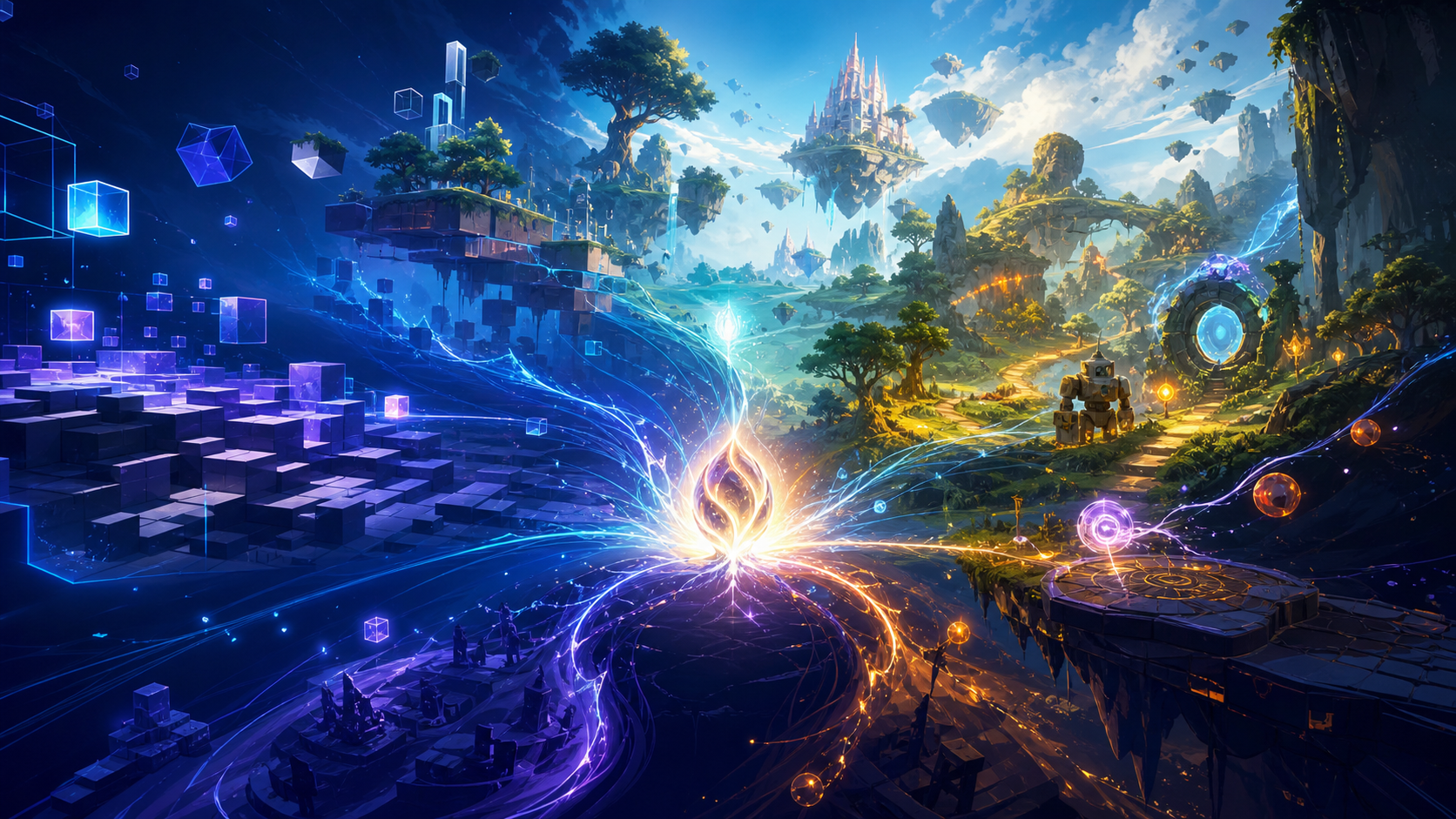
For more than a decade, user-generated games have changed the role of the player. Roblox, Minecraft, and Fortnite Creative showed that an audience does not have to remain an audience: people also want to build spaces, invent rules, customize characters, and share experiences with a community.
That shift was profound, but it did not remove the hard parts of game creation. A friendly editor is still an editor. To move from a rough idea to a working game, a creator may need to understand scripting, level design, game logic, asset production, balancing, testing, and player motivation. Existing UGC platforms lowered the threshold; they did not make it vanish.
Generative AI introduces a different possibility. Instead of making every beginner translate an idea into a sequence of unfamiliar tools, an AI-assisted system can begin with intent: a description of a place, a character, a challenge, or a feeling. The important question becomes less “Which technical workflow do I know?” and more “What experience am I trying to make?”
That does not mean a single prompt can reliably produce a polished, shippable game. It means the distance between an idea and a testable first version may become shorter. If that change continues, the next wave of UGC will not simply add more assets to familiar sandboxes. It will introduce a new creation layer between human imagination and the underlying engine.
The Evolution of User-Generated Games
Traditional game development depends on several specialized disciplines. Engineers implement systems, artists build visual assets, designers construct levels and progression, writers shape narrative, and quality teams test the many ways a player can break the intended experience. Large projects need coordination across all of them.
Creation platforms opened part of that process to a much wider public. Templates, visual editors, reusable objects, community marketplaces, and built-in distribution allowed a teenager to publish an obstacle course, a hobbyist to assemble a virtual town, or a group of friends to run a social world. A creator no longer needed to build an engine and a storefront before reaching a player.
Yet the creator still had to learn the platform’s language. Even when code was optional, producing a compelling experience required decisions about:
- what the player can do from moment to moment;
- how a level teaches its rules;
- how objectives, rewards, and failure states connect;
- which assets communicate function rather than merely decoration;
- how difficulty and pacing change over time; and
- why someone would return, share, or invite a friend.
This is the remaining gap AI is beginning to address. Earlier UGC systems made professional tools more accessible. AI-assisted systems aim to make creative intent legible to those tools.
AI Is Becoming a New Game-Creation Layer
The clearest difference between conventional UGC and AI-assisted creation is the starting point. A tools-first workflow begins with an engine, an empty scene, and a list of commands to learn. An intent-first workflow begins with a playable premise.
Imagine a creator describing a small robot exploring an abandoned planet. That sentence is not a complete design, but it contains useful seeds. An AI system could help the creator expand it into candidate environments, a character profile, an exploration objective, hazards, collectible resources, dialogue, and simple interaction rules. The creator could then accept, reject, or revise those suggestions.
For this to work well, the system must do more than illustrate the sentence. It has to convert a vague concept into connected design decisions. A practical first draft might answer questions such as:
- What is the player’s main verb: explore, repair, hide, negotiate, or fight?
- What changes in the world when the player acts?
- What creates tension, and what counts as progress?
- How does the player learn the controls and rules?
- What ends a session, and what invites another attempt?
Natural-language input is therefore an interface, not the finished product. The useful part of an AI creation layer is its ability to propose structure, expose missing decisions, and produce something that can be tested earlier. Human judgment remains responsible for whether the mechanic is enjoyable, understandable, fair, and coherent.
From Content Generation to World Generation
The first widely used generative systems made discrete media: a paragraph, an image, a song, or a video clip. Each can contribute to a game, but none is a game by itself. A playable world must respond to a player over time.
That distinction matters. An image presents a scene. A video presents a predetermined sequence. A game maintains state: a door can be locked or open, a character can trust or distrust the player, a resource can be collected or depleted, and an earlier choice can alter what happens later. The experience emerges from rules and feedback, not only from appearance.
World generation therefore requires several layers to work together:
- Space: an environment with navigable areas, meaningful landmarks, and constraints.
- Rules: consistent relationships between actions, objects, and consequences.
- Agents: characters or systems that react in understandable ways.
- Goals: reasons for the player to act, experiment, or make choices.
- Loops: a repeatable rhythm of action, feedback, learning, and progression.
Multimodal models can assist with language, visuals, audio, code, and planning, while game engines execute the resulting systems. The difficult work is integration. A beautiful generated forest is not yet an exploration game; a collection of quests is not useful if objectives conflict; a reactive character is frustrating if its behavior has no stable logic.
The emerging category is better understood as AI-assisted playable-world creation, not as ordinary content generation with a “game” label attached. Its success will depend on whether generated parts behave as one system and remain editable by the creator.
Why This Could Be Another Roblox-Scale Shift
Roblox’s significance was not only its catalog of games. It changed the relationship among platform, creator, and player. Creation tools, publishing, discovery, social participation, and remix culture existed in the same ecosystem. Players could cross the boundary into authorship and reach an audience without constructing their own distribution network.
AI could push that boundary outward again. A future creation platform may not begin by asking whether someone can script a mechanic. It may ask them to describe the game they wish existed, then help turn that description into a prototype they can inspect and change.
The comparison is not a prediction that AI will replace Roblox or every current engine. It describes a similar reduction in friction. UGC platforms reduced the cost of building and distributing inside a shared ecosystem; AI may reduce the cost of expressing an idea inside those tools. Three effects are especially important.
1. More People Can Experiment as Creators
Many potential creators think in stories, classroom activities, social rituals, puzzles, or imaginary places rather than in code. A teacher may want an interactive lesson, a writer may want readers to explore a setting, and a community may want a game based on an inside joke or local event. Their challenge is not a shortage of ideas; it is converting those ideas into systems.
AI assistance can offer a gentler entry point by turning plain-language goals into editable proposals. Someone who has never programmed may be able to explore a mechanic, compare variations, and learn design concepts through direct feedback. Technical knowledge will still increase control, but it need not be the price of admission for every early experiment.
2. Ideas Can Reach Playtesting Faster
Game ideas are hard to evaluate on paper. A mechanic that sounds clever may feel repetitive, confusing, or unfair once someone plays it. Conventional prototyping can demand enough setup that weak ideas survive too long simply because testing them is expensive.
AI can accelerate the exploratory stage by drafting layouts, placeholder assets, rules, quests, or code for review. Creators can test alternatives sooner, discard failures with less sunk cost, and spend more effort on the versions that show promise. The benefit is not “instant finished games.” It is earlier evidence.
Faster iteration also changes collaboration. A designer can bring teammates an interactive sketch rather than a long explanation. Players can react to behavior rather than imagine it from a document. That shortens the feedback loop between intention and experience, where much of good game design is actually found.
3. Play Can Become More Personal
Mass-market games are designed to serve broad audiences. An AI-assisted world could be configured around a smaller group or even one session: preferred themes, familiar characters, desired challenge, available play time, accessibility needs, or a particular social context.
A player might request a calm exploration experience featuring favorite animals, gentle music, and a magical woodland. The system could use those preferences as design constraints instead of merely recommending an existing title. In that model, discovery shifts from “Which available game is closest to what I want?” toward “How can this experience be shaped for this player?”
Personalization still needs boundaries. Challenge should not become arbitrary, generated content must be moderated, and a system should not use personal data without clear permission. The strongest version of personalized play gives the user meaningful control while preserving consistent rules.
The Create–Play–Remix Loop
The most useful way to understand an AI-native UGC playground is as a continuous loop rather than a one-click generator.
Create
Creation begins with an idea: a setting, character, story premise, or mechanic. The creator gives that idea enough structure to become testable. A concise brief might define the player’s role, primary action, objective, obstacle, mood, and intended session length. AI can help expand the brief and draft the first implementation, but the creator decides which version expresses the original intent.
Play
The prototype becomes meaningful when someone interacts with it. Playing reveals information that a prompt cannot: whether movement feels responsive, whether the goal is visible, whether the challenge produces interesting choices, and whether the world reacts as expected. Immediate access to a playable draft makes the system’s mistakes concrete and gives the next revision a clear target.
Remix
The first version is a branch point, not a final artifact. Its creator can adjust a rule, replace the setting, change the pace, or add another route. Other players may build variations if the platform supports permission, attribution, and version history. A puzzle can become cooperative; an exploration map can become a survival challenge; a short narrative can grow through community contributions.
This loop changes the unit of creation. Instead of publishing a sealed object, creators can share an evolving template whose mechanics and presentation remain open to revision. Platforms will need clear licensing, provenance, moderation, and credit systems so remixing rewards participation without erasing authorship.
AI Expands the Creator Pool; It Does Not Remove Game Developers
Prompt-based creation is sometimes framed as a replacement for professional development, but that misses the more plausible opportunity. Experienced teams will remain essential for complex systems, performance, security, art direction, narrative coherence, accessibility, multiplayer infrastructure, quality assurance, live operations, and responsible community management.
AI can instead widen the group able to participate. Independent creators can test ambitious ideas before committing resources. Educators can prototype interactive lessons. Storytellers can explore spatial narratives. Communities can make experiences for their own members. Casual players can learn design by changing something they already enjoy.
Professional and amateur creation are not mutually exclusive. A healthy future could include carefully produced studio games alongside a vast layer of smaller AI-assisted experiments. Some will be disposable personal worlds; some will become community projects; a few may grow into professional productions. The value lies in giving more people a route from imagination to evidence, while preserving the expertise required to turn promising evidence into dependable games.
What the Next Generation of UGC Platforms Must Solve
Lowering the creation barrier creates new responsibilities. If producing prototypes becomes easy, discovery and quality become harder. Players need ways to find experiences that work, creators need useful feedback, and platforms need to distinguish an unfinished generation from a stable release.
Several foundations will matter:
- Editability: creators must be able to inspect and change generated rules instead of treating the model as a black box.
- Consistency: interactions should remain predictable enough for players to form strategies.
- Safety and moderation: public worlds need controls for harmful, infringing, or age-inappropriate material.
- Attribution and rights: assets, templates, and remixes need traceable origins and clear permissions.
- Testing: generated games require automated checks and human playtesting across unusual player behavior.
- Discovery: recommendation systems should reward playable, original experiences rather than sheer generation volume.
Visual generation can support concept development without replacing this game-system work. For example, creators can use text-to-image tools to explore an art direction or text-to-video tools to communicate the mood of a pitch. Those outputs are reference media, not executable mechanics or complete playable worlds. They still need to be used with appropriate rights, and they belong upstream of engine implementation and testing.
The Future of User-Generated Games Is AI-Assisted
The next era of games will not be defined only by more detailed graphics or larger maps. Accessibility may be the more consequential advance: more people able to express an interactive idea, receive feedback from a playable draft, and refine it with others.
The central question is shifting. Instead of debating which small group has the skills and resources to make games, we can ask what new forms will appear when many more people can participate. The answers may include personal worlds made for a few friends, lessons that adapt to a classroom, stories that respond to a reader, and experimental mechanics that would never survive the cost of a traditional greenlight process.
AI will not remove the need for taste, design judgment, technical expertise, or care. It can make those qualities easier to apply earlier by giving creators something concrete to test. The most promising future is therefore neither fully automated nor limited to studios. It is a collaborative ecosystem in which ideas become prototypes more readily, prototypes improve through play, and successful creations continue evolving through responsible remixing.
Conclusion
User-generated platforms first transformed players into builders by placing creation and distribution inside the same world. AI could extend that transformation by making natural language, sketches, stories, and examples useful inputs to the creation process.
The leap is not from prompt to perfect game. It is from prompt to a first playable question: Does this mechanic work? Is this world understandable? Is this experience worth improving? When creators can answer those questions sooner, more ideas get a genuine chance to become interactive.
That is what makes AI-assisted UGC important. The future of games may still be led by skilled developers, but it could be explored, tested, and remixed by anyone with a clear idea and the curiosity to play the first draft.
Frequently Asked Questions
Can AI generate a complete game from one prompt?
Some emerging systems can produce limited prototypes or assemble several game elements, but a polished release still requires design decisions, integration, testing, performance work, moderation, and human review. A prompt is best treated as the beginning of iteration, not a guarantee of a finished game.
Will AI game makers replace Roblox or traditional engines?
They are more likely to become a new interface or creation layer within a broader ecosystem. Shared platforms still provide execution, social features, distribution, safety systems, and communities. AI can reduce the friction of expressing an idea, while engines and platforms make that idea reliably playable.
Do creators still need to learn game design or coding?
Beginners may be able to start without code, but design knowledge remains valuable. Understanding feedback, objectives, pacing, balance, and player behavior helps creators judge AI suggestions. Coding can also provide deeper control when a generated system needs custom behavior or debugging.
What makes world generation different from image or video generation?
A generated image or clip is a fixed media output. A generated world must maintain state, apply rules, respond to actions, and support a repeatable game loop. Visual assets may be part of the world, but interactivity and consistent consequences are what make it playable.
Why is remixing central to AI-assisted UGC?
Remixing turns one prototype into a foundation for many experiments. Players can adjust mechanics, themes, difficulty, or narrative and quickly test the consequences. For that culture to remain healthy, platforms also need permissions, version history, attribution, and moderation.