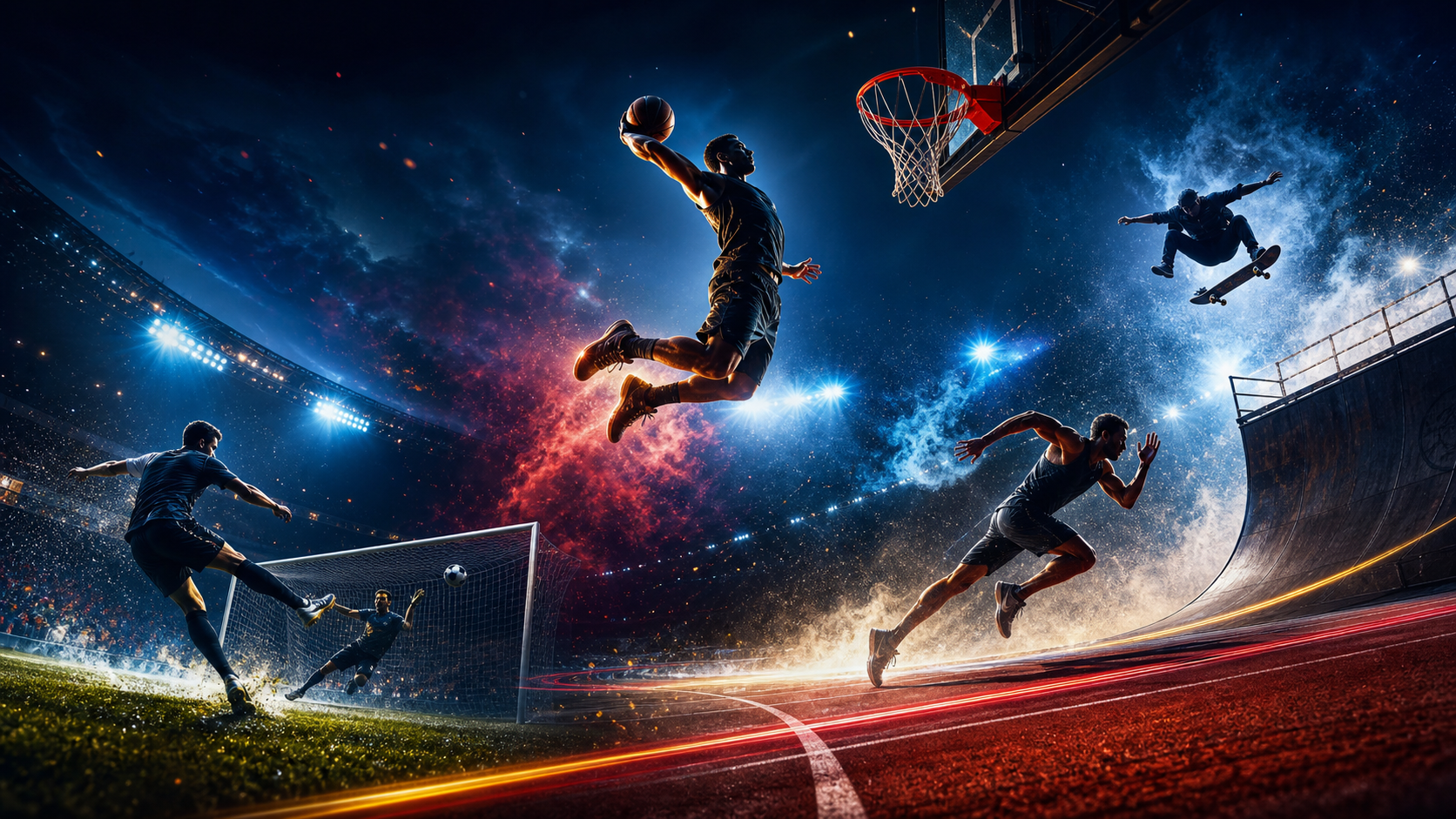
Sports highlights compress a story into anticipation, decisive action, reaction, and release. AI video can help create fictional athletic sequences, concept ads, explainers, and stylized social packages—but fast movement, ball physics, limbs, crowds, and recurring athletes remain difficult. Treat every generation as a shot candidate that requires review, not as verified footage of a real event.
Plan the highlight arc
A 60–90 second package might include:
- one or two venue and pre-game establishing shots;
- three to five action clips;
- one or two athlete or crowd reactions;
- one decisive slow-motion moment;
- one resolving wide shot.
Generate each beat separately. The story should build from atmosphere through escalating action to a peak and aftermath.
Use a four-part sports prompt
Write:
[fictional athlete and visual identity] + [one precise athletic action] +
[camera angle and movement] + [venue, lighting, atmosphere, and sound]
For example:
A fictional basketball forward in a plain red jersey drives to the basket and completes one powerful right-handed dunk. Slow tracking shot at rim level, packed generic indoor arena, hard overhead lights, polished floor reflections, rising crowd reaction and synchronized net sound. No logos, no real team, no visible jersey text.One action per clip makes biomechanics, camera, and timing easier to evaluate. Generate two or three variations of each key moment, changing only the camera, starting phase, crowd density, weather, or timing focus.
Basketball prompts
Dunk
Fictional player in a plain white jersey takes two steps through the lane and completes a two-handed dunk. Low court-level camera tracks the jump; slow motion begins only near the apex. Generic sold-out arena, bright spotlights, sneaker squeak, clean ball-and-rim impact, no branding.Three-point shot
Fictional guard in a dark blue uniform catches in the corner, plants, and releases one high-arcing jump shot. Elevated medium broadcast-style camera follows the ball to the basket; defender arrives late; crowd holds briefly, then reacts. Stable hardwood and arena lighting.Fast break
Two fictional players in yellow uniforms run a two-on-one break. The ball handler makes one bounce pass to the cutter for a layup. Wide lateral tracking camera moves at constant speed; preserve player identity, court lines, and ball trajectory throughout.Use contrasting uniform colors, a specific court surface, and one movement phase. Never request official leagues, team logos, or a famous athlete's likeness without appropriate rights.
Soccer prompts
Scoring moment
Fictional striker in a generic red-and-white kit receives a through ball, takes one controlling touch, and shoots low into the far corner. Slow side-on camera follows the ball path; goalkeeper dives late; net moves at impact. Night stadium with stable floodlights and synchronized crowd reaction.Set piece
Fictional midfielder in a plain yellow kit takes a direct free kick outside the penalty area. Broadcast camera looks through a defensive wall as the ball rises and bends toward the upper corner. Hold the crowd quiet before the kick, then release the reaction after the net moves.Goalkeeper save
Fictional goalkeeper in green dives fully to the right and redirects one hard shot around the post. Ultra-slow camera behind the goal captures fingertip contact and the landing. Wet grass under floodlights, controlled spray, plausible body position.Large pitches and multiple players invite drift. Keep the decisive action readable and avoid one prompt that tries to simulate a whole match.
Running and athletics prompts
Sprint finish
Eight fictional sprinters drive through the final meters. Low tracking camera runs parallel from the inside lane, then cut to a front view as two athletes lean at the finish. Late-afternoon light, stable lane geometry, synchronized footfalls, no country logos or timing-board text.Marathon
One fictional runner in bright orange moves through a city course with spectators on both sides. Smooth elevated tracking camera leads slightly ahead; rhythmic stride, consistent outfit, broad daylight, restrained crowd sound, generic city skyline.High jump
Fictional high jumper completes a curved approach and one Fosbury-flop clearance. Side-on slow tracking camera holds the bar, takeoff point, and landing mat in stable geometry. Clear evening, crowd reaction only after the bar settles.Extreme-sports prompts
Skateboarding
Fictional skater approaches a concrete stair set, performs one clean kickflip, and rolls away. Low side-tracking camera; slow motion only at the board's apex; golden-hour urban setting, sharp concrete texture, no logos.Snowboarding
Fictional snowboarder in red gear completes one controlled aerial above a mountain halfpipe and lands. Drone follows from slightly above and behind; deep blue sky, realistic snow spray, stable board and body proportions.Climbing
Fictional competition climber makes one dynamic move between holds and stabilizes. Upward camera from below the overhang captures hand contact and chalk dust. Generic indoor wall, accurate safety environment, focused crowd reaction.Do not depict unsafe behavior as instruction. For high-risk sports, keep protective equipment and venue context appropriate.
Choose the camera for the emotion
- Slow motion: isolate the instant of ball contact, takeoff, landing, or victory; do not slow an entire long action.
- Tracking: move alongside a runner, ball, cyclist, or skater to convey speed.
- Broadcast: elevated medium and wide coverage makes the action legible and authoritative.
- Ground level: emphasizes scale, impact, and speed.
- Aerial: reveals formation, venue, route, and environment.
- First person: creates immersion but increases motion and continuity risk.
State both camera position and relationship to the subject. “Low camera moving parallel to the runner” is more controllable than “epic camera.”
Build believable atmosphere
Connect reaction to the moment:
The crowd remains still and quiet during the run-up, rises together as the ball reaches the goal, and reacts only after it crosses the line.Specify venue size, attendance, weather, light, and energy. Use establishing shots—aerial stadium night, indoor warmups, or arrivals at golden hour—to make the decisive action feel situated rather than generic.
Edit the highlight
- Organize clips into establishing, action, reaction, and slow-motion folders.
- Rate them as use, backup, or discard.
- Select music before final timing; verify its license.
- Build intensity toward the strongest decisive moment.
- Cut after discrete actions: basket, landing, save, or finish.
- Use roughly 2–3 second action cuts for fast team sports and longer holds for continuous endurance motion.
- Add simple captions in the editor, not generated inside the footage.
- Match color, crowd sound, athlete description, venue, and lighting across clips.
Use DeepFake's text-to-video workflow for fully fictional shots or image-to-video when you own an approved athlete reference. Review hands, limbs, equipment, court or field geometry, ball trajectory, sound timing, and crowd behavior frame by frame.
Ethical and rights checklist
- Do not present synthetic action as footage of a real competition.
- Do not imitate a famous athlete, official uniform, league, sponsor, or broadcast package without rights.
- Obtain consent for any real person's face, voice, or body reference.
- Label fictional or AI-generated sports material when viewers could mistake it for fact.
- Do not fabricate records, injuries, scores, endorsements, or documentary evidence.
Final workflow
Define the arc, prompt one action per shot, generate controlled variations, keep only physically and visually credible clips, and finish them with deliberate sound and editing. Consistency comes from repeating the same fictional athlete, venue, light, and visual language—not from asking one generation to create an entire match.
Explore DeepFake's available video models and run a short fictional three-shot test before committing to a full highlight package.