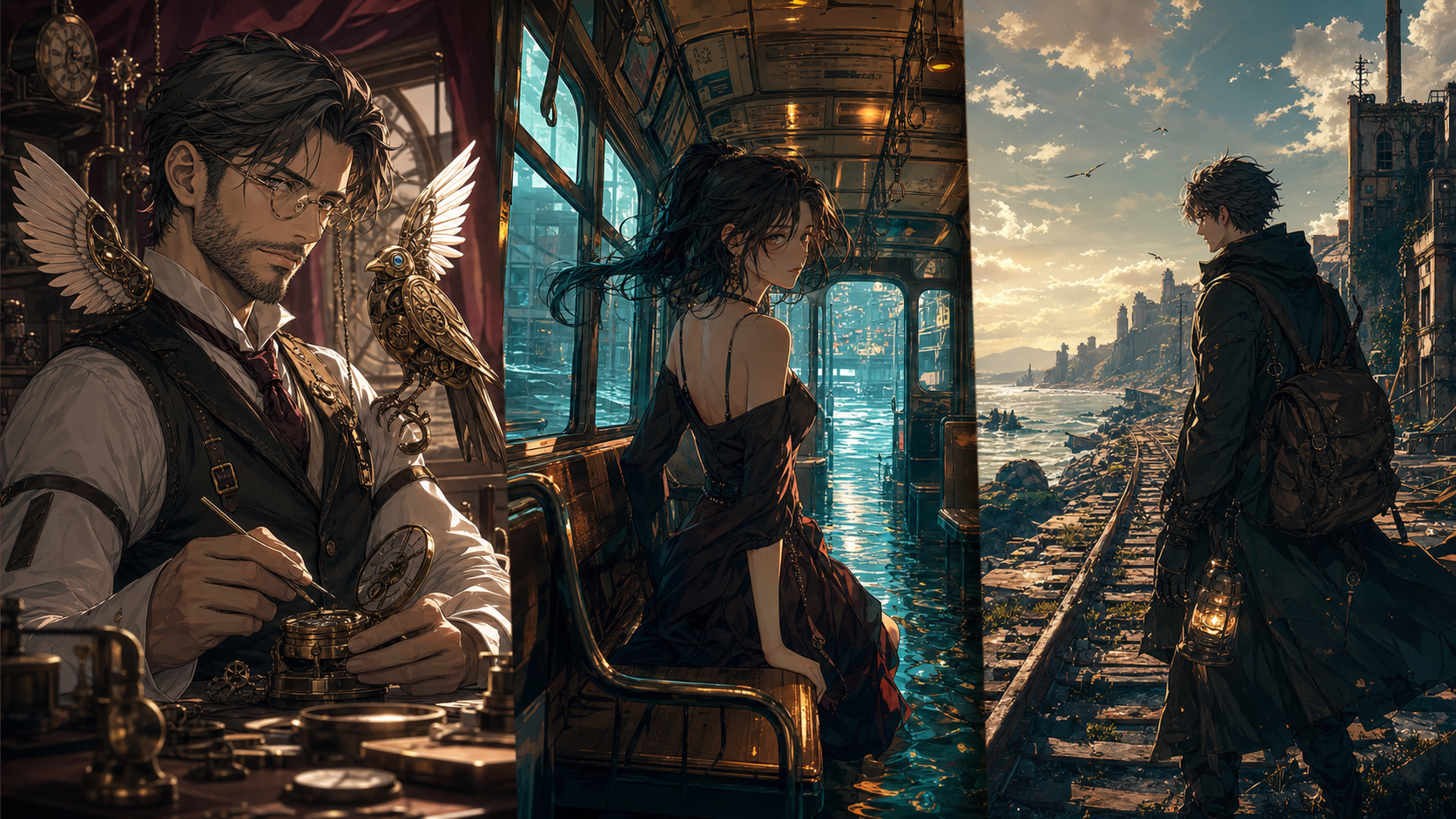
Great anime prompts do not flatter the model. They direct the image.
“Masterpiece, beautiful, ultra-detailed” says almost nothing about who is present, what is happening, where the camera sits, or why the viewer should care. A useful prompt behaves like a compact production note: subject, identity, action, environment, shot, light, and the details that must remain.
The ten prompt patterns below are designed to be taken apart. Replace the character and setting, keep the information order, and change one category at a time. They can be tested in DeepFake’s text-to-image workflow or another generator, although each model may interpret the same language differently.
Every human character in these examples is explicitly adult to reduce age ambiguity.
1. A prompt formula worth memorizing
Adult subject and role; stable identity anchors; visible action; environment; camera and composition; key light and palette; rendering language; continuity or exclusion note.
Not every prompt needs every detail. The formula forces you to decide what the image is for.
2. A clean original-character portrait
Clearly adult clockmaker, early thirties, long rectangular face, copper-brown skin, close-cropped silver curls, dark teal eyes, narrow burgundy waistcoat with one brass chain; adjusting a tiny mechanical bird on the workbench; medium close-up at eye level, hands and bird visible, uncluttered dark workshop behind; warm window light from camera left with a cool blue fill; crisp anime linework, restrained two-tone cel shading, limited burgundy-teal-brass palette; preserve face shape, curls, eye color, waistcoat construction, and chain.
Why it works: the prompt protects structural identity and gives the hands a clear task. The limited palette reduces random color changes.
3. A full-body character sheet
Full-body production design for a clearly adult desert courier, athletic build, shaved sides with a long black braid, sand-colored hooded coat ending above the knee, indigo sash, red ankle wraps, compact water canister worn on the left hip; neutral three-quarter standing pose with arms relaxed and feet visible; plain warm-gray background, even studio light, no dramatic perspective; clean modern anime model-sheet rendering, readable garment seams, no text, no extra weapons, no duplicate accessories.
Why it works: the prompt removes dramatic storytelling so the design can be inspected. Feet, seams, and placement are deliberately visible.
4. A cinematic night scene with readable light
Clearly adult tram conductor in a navy uniform and amber scarf, standing alone inside the last carriage as it crosses a flooded city; medium-wide interior shot, conductor placed on the right third, empty seats leading toward the rear window; warm overhead carriage lights reflected in shallow water on the floor, cool cyan storm light outside, one red signal in the distance; dramatic but readable anime lighting, controlled reflections, softly painted background, face not silhouetted, no neon overload.
Why it works: “cinematic” is supported by specific sources, colors, and placement. The face remains readable because the prompt says how contrast should behave.
5. A background without a character
Abandoned coastal railway station reclaimed by tall summer grass, weathered green roof, two wooden benches, rusted signal tower beyond the platform, ocean visible between concrete pillars; wide establishing shot from platform height, strong foreground grass, clear middle-ground station, distant sea and pale cliffs; late-afternoon sun from camera right, salt haze, muted green-rust-blue palette; hand-painted anime background, large readable shapes, detailed focal areas only, no people, no text, no train.
Why it works: removing characters lets the generator spend attention on geography. The foreground-middle-background instruction creates depth.
6. A dynamic action shot that preserves identity
Clearly adult rooftop courier with short cobalt bob, one long left hair strand, gray-green eyes, brass compass pin, navy flight jacket with one red cuff, charcoal messenger bag worn high; leaping across a narrow gap between rain-dark buildings while protecting a glowing parcel against the chest; wide low-angle tracking composition, full silhouette and landing roof visible, diagonal motion from lower left to upper right; blue-hour rain with warm parcel light on the face; crisp action-anime linework, restrained speed accents, readable anatomy; preserve face, hair silhouette, pin, cuff, bag, and parcel, no extra limbs, no costume redesign.
Why it works: action direction, destination, and protected prop are specified. The warm parcel light keeps the face from disappearing.
7. A comedic reaction
Clearly adult kitchen mage, broad round silhouette, cropped purple hair, cream apron over a black robe, three green repair patches on the left sleeve; opening the pantry and discovering that every spoon is floating in a perfect circle; wide eye-level kitchen shot, mage on the left, spoon circle on the right, clear visual gap between them; exaggerated but adult facial reaction, bright morning window light, cheerful cream-purple-green palette; clean graphic anime comedy style, simple readable props, no captions, keep exactly three sleeve patches.
Why it works: the joke is spatial. A stable wide shot lets the audience see setup and surprise at once.
8. An emotional close-up without melodrama
Close-up of a clearly adult airship pilot, angular brown face, short wind-tossed white hair, pale scar through the left eyebrow, dark flight collar; watching a damaged airship rise beyond the window, eyes wet but not crying, jaw beginning to relax; camera at eye level, face on the left third, blurred sunrise vessel reflected faintly in the glass on the right; soft gold backlight with neutral skin tones, shallow depth, restrained anime film rendering; preserve scar side, age, hair shape, and reflection logic, no tears streaming, no exaggerated smile.
Why it works: it describes physical signs of emotion instead of asking for “sad but hopeful.” Restraint gives the model less room for a generic dramatic face.
9. A fantasy environment with one governing idea
Library grown inside a colossal hollow tree where forgotten memories become small glowing moths; spiral wooden walkways, reading alcoves carved into living bark, glass jars containing blue-gold memory moths, one central shaft of daylight from far above; vertical wide interior looking upward, tiny clearly adult librarian at the lower center for scale; cool shadowed wood with concentrated blue-gold lights, atmospheric depth; richly painted anime fantasy background, coherent architecture, repeated moth motif, no random magical symbols, no readable text.
Why it works: the environment has a rule, and every major detail supports it. Scale comes from one small figure rather than a crowd.
10. A final shot built for animation
Clearly adult mechanic with wrapped dark hair, teal rectangular glasses, rust-orange work jacket, blue cloth around the right wrist; standing outside a bicycle shop before sunrise as an old streetlight plays visible gold-blue rings of sound; medium-wide locked composition, mechanic and streetlight separated cleanly, shop interior softly glowing behind, open negative space above; pre-dawn blue ambience with warm accent light; clean anime linework and stable simple shapes; design the image for subtle animation: one head turn, one pulse of light, slight jacket-hem movement; preserve face, glasses, wrist cloth, jacket, and streetlight structure.
Why it works: The prompt anticipates motion. Clean separation and limited effects give image-to-video tools fewer ambiguous edges. One head turn, one pulse, and slight fabric movement are easier to review than a scene where the character runs, speaks, and changes pose while the camera rotates.
How to adapt the prompts without breaking them
Change nouns before changing structure. Replace “clockmaker” with “marine cartographer,” the mechanical bird with a tide gauge, and the palette with sea-green, charcoal, and copper. Keep the subject-action-environment-camera-light order.
Use this controlled loop:
- Generate four options with the same prompt.
- Judge composition at thumbnail size.
- Choose the strongest structure.
- Identify one problem.
- Revise only that problem while naming what must remain unchanged.
- Save the accepted prompt and reference asset before moving to the next scene.
Keep three to five recognition anchors for recurring characters. Too many accessories make consistency harder. Keep style language stable across a sequence and change pose, camera, weather, or emotion only when the story requires it.
Negative prompts: use them sparingly
Negative instructions help when they protect production needs: no lettering, no cropped hands, no duplicate accessories, no extra characters. A giant list of anatomy failures may consume attention without defining the desired image.
State the positive target first. “Both natural hands visible, each holding one side of the map” is more actionable than “no bad hands.” “Locked camera” is clearer than “no camera movement.” The positive instruction tells the model what success looks like.
Rights and responsible prompting
Use original characters and references you have the right to upload. Do not use a real person’s likeness without informed permission. Avoid deceptive, abusive, intimate, or otherwise harmful identity edits.
Avoid requests for the exact signature style of a living artist. Describe line, color, material, period, light, and composition instead. Fan-inspired work should be labeled unofficial; do not copy logos, key art, or signature costume details and claim an original commercial property.
Frequently asked questions
Should I include “masterpiece” or quality tags?
You can test them, but they do not replace visual direction. Subject, action, camera, light, and identity anchors usually have a clearer effect on usefulness.
Why does a long prompt sometimes produce a worse image?
Length can introduce contradictions and flatten priority. Remove decorative synonyms and keep only instructions that affect the finished asset.
Can I reuse these prompts for comics and video?
Yes. For comics, reserve space for dialogue, keep lettering editable, and preserve screen direction. For video, begin with clean shapes and add a motion sentence describing one primary action.
Conclusion
Better AI anime prompts are not spells. They are briefs. Tell the generator who is present, what must stay recognizable, what happens now, where the camera sits, how the light behaves, and what the image must accomplish.
Keep the language stable across related scenes and revise one variable at a time. When you are ready to turn these patterns into your own controlled batch, explore DeepFake with one original character and one clearly defined deliverable.