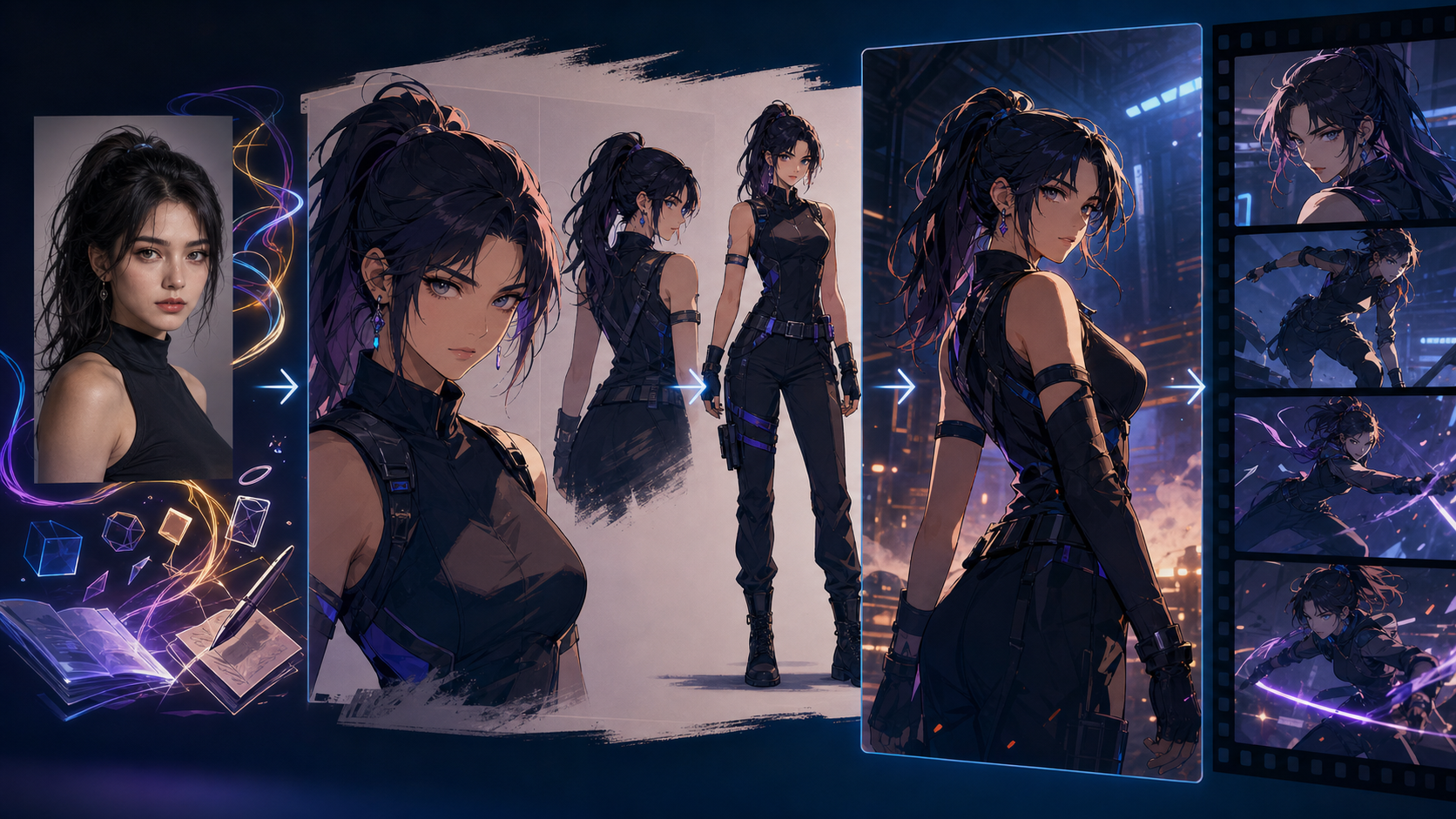
The phrase “best AI anime generator” hides at least four different jobs. One creator wants a striking avatar from a permitted selfie. Another needs an original character who looks the same across twenty comic panels. A third needs polished background art. A fourth plans to animate the result and add dialogue.
Generating an anime-looking image is no longer the hardest part in 2026. The hard part is control: preserving a face, directing the camera, keeping a costume consistent, revising without starting over, and understanding whether you have the right to publish the result. This comparison treats “best” as a workflow decision, not a universal crown.
The fastest way to choose: define the finished asset
Before comparing products, write down what you need to deliver:
- A profile image needs a readable face and a clean crop.
- A character sheet needs neutral poses, multiple views, and stable design details.
- A comic needs recurring identities, panel composition, and editable lettering.
- A visual story needs backgrounds, continuity, and shot planning.
- A short video needs stable motion, timing, audio, and an editing path.
This distinction prevents an expensive mistake. Image galleries reward the most spectacular one-off result, while production rewards repeatability. The generator that makes your favorite portrait may still be the wrong choice for a serialized story.
Use a scorecard instead of a beauty contest. Rate each tool on input options, character reuse, camera and aspect-ratio control, local revision, export quality, privacy terms, commercial terms, time per accepted output, and the next stage in your pipeline.
Best for an image-to-motion workflow: DeepFake
DeepFake is the relevant choice here when your approved anime still is meant to become a motion clip. Its public workflow includes text-to-image, image-to-image, and image-to-video routes, so a creator can move from an original prompt or permitted reference into visual iteration and then motion.
That does not mean one service automatically replaces comic lettering, page layout, detailed paint-over, sound design, or final editing. Use a dedicated editor when it gives you more precise control. DeepFake is strongest in this comparison when still-image generation and motion belong to the same project and you want a direct handoff between those stages.
Best for design and compositing integration: Adobe Firefly
Adobe Firefly is relevant when anime-style art must enter a broader professional design workflow. As verified against Adobe’s official Firefly help in July 2026, its text-to-image interface offers Adobe and partner models, aspect-ratio controls, composition and style references, and paths into further editing.
Its practical appeal is not anime specialization. It is integration: designers can generate, edit, composite, add typography, and prepare deliverables in a familiar creative environment. Adobe makes commercial-safety claims for its own Firefly models, but those claims do not transfer automatically to every partner model, uploaded reference, protected character, or project. Confirm the selected model, current license, plan terms, and your rights to every input.
Best for adding motion to approved artwork: Runway
Runway remains a relevant specialist option after you already have a strong anime still. Its official image-to-video guidance, checked in July 2026, says the input image provides composition, subject, lighting, and style, while the text prompt should focus on motion, camera work, and temporal progression.
The important phrase is “after you already have a strong still.” Image-to-video systems inherit both the strengths and ambiguities of the source. A clean character with readable eyes, separated limbs, and a simple background is easier to animate than a crowded illustration with overlapping hands and hair. Visual artifacts in the source can become more obvious in motion.
Comparison at a glance
| Workflow priority | Strong candidate to test | What to verify |
|---|---|---|
| Generate and iterate stills, then animate them | DeepFake | Character continuity, accepted-shot cost, local cleanup needs |
| Create a design asset inside a wider editing workflow | Adobe Firefly | Selected model, reference controls, license, handoff to editor |
| Add directed motion to an approved still | Runway | Source-image quality, motion adherence, temporal artifacts |
| Produce recurring comic characters | Any tool with reusable references | Face, costume, props, lettering workflow, panel continuity |
No table can replace a test. Give every candidate the same adult original character, three camera angles, one location change, and one motion shot. Record retries and cleanup time.
How to turn a text prompt into better anime art
Weak prompts describe taste: “beautiful, detailed anime girl, cinematic masterpiece.” Strong prompts describe a production decision. Build yours from:
- Character: role and apparent adult age.
- Identity anchors: details that must not change.
- Action: a visible verb.
- Environment: location and meaningful props.
- Camera: shot size, angle, and composition.
- Lighting: direction, color, and focal hierarchy.
- Rendering: broad visual properties rather than a named artist.
For example:
Clearly adult rooftop botanist, early thirties, short silver curls, amber safety glasses, moss-green utility coat with a triangular brass clasp, kneeling beside a luminous night-blooming plant, rain-dark greenhouse roof, medium low-angle shot, cool city rim light and warm plant glow, clean cel shading with a softly painted background; preserve curls, glasses, clasp, and coat construction.
Generate a controlled batch without changing the prompt. Choose the strongest composition, then revise one problem at a time. Do not add a dozen conflicting style adjectives after every weak result.
How to turn a photo into anime without losing the person
Photo-to-anime generation adds a responsibility that pure text prompting does not: you are handling someone’s likeness. Use a photo only if you own it or have clear permission to transform it. A public social-media photo is not automatically licensed for your use.
Start with a sharp, evenly lit image in which the face is unobstructed. Decide which features must survive—face proportions, hairstyle, glasses, expression, clothing, or pose—and state them explicitly. Increase stylization gradually. If the first pass is too strong, identity can collapse into a generic anime face.
Avoid private, intimate, medical, or highly identifying images unless you fully understand the service’s data practices and have a legitimate, consensual purpose. Never make abusive, deceptive, humiliating, or non-consensual likeness edits.
The consistency test every buyer should run
Create one adult original character with five non-negotiable features. Then request:
- neutral portrait;
- full-body three-quarter view;
- seated medium shot;
- low-angle action shot;
- the same character in a new location;
- one short image-to-video test.
Do not change the style language during the test. Reuse the same approved reference when supported. Score face shape, hair silhouette, eye color, costume construction, signature prop, apparent age, rendering, and cleanup time. A beautiful failure is still a failure if it cannot join the sequence.
Copyright, artist style, and commercial use
Avoid asking for the exact signature style of a living artist, especially for commercial work. Describe visual properties instead: limited cel shading, delicate ink weight, watercolor environment, a 1990s science-fiction palette, or theatrical rim light. Broad visual language gives you more control and produces a less derivative result.
Fan art should be labeled unofficial and should not be marketed as an authorized product. Avoid copied logos, official key art, traced poses, and claims that a fan-made character is canon. If you plan to sell the work, transform franchise-specific elements into an original world or seek permission and qualified legal advice.
Commercial use depends on platform terms, selected models, input rights, intellectual property, human authorship, and local law. Keep source files and a record of your creative edits.
Frequently asked questions
What is the best AI anime generator for beginners?
Choose the tool whose path matches your first deliverable. DeepFake is worth testing when still generation and animation belong to one project. Firefly may suit a creator who prioritizes design and compositing integration. Runway is relevant when the main challenge is adding directed motion to an approved image.
Which AI anime generator is best for consistent characters?
Choose a tool that supports reusable references or saved assets, then test it across camera angles and locations. Consistency depends on reference discipline, prompts, and review as much as the underlying model.
Can I turn any photo into anime?
Many tools accept photos, but you should upload only images you own or have permission to transform. Avoid sensitive material and never make abusive or non-consensual likeness edits.
Can I sell AI-generated anime art?
It depends on platform terms, reference rights, intellectual property, human authorship, and local law. Read the current license and avoid unlicensed franchise, logo, or celebrity content.
Conclusion
The best AI anime generator in 2026 is the one that fits the asset you intend to finish. Select candidates by workflow, run the same consistency test, count usable outputs and cleanup time, and inspect rights before committing to a platform.
Choose DeepFake when prompt or image generation needs a direct path into motion. Consider Firefly when the work must flow into a broader design environment. Consider Runway when the key challenge is motion direction from an approved still. Then let your own results—not a gallery—decide.