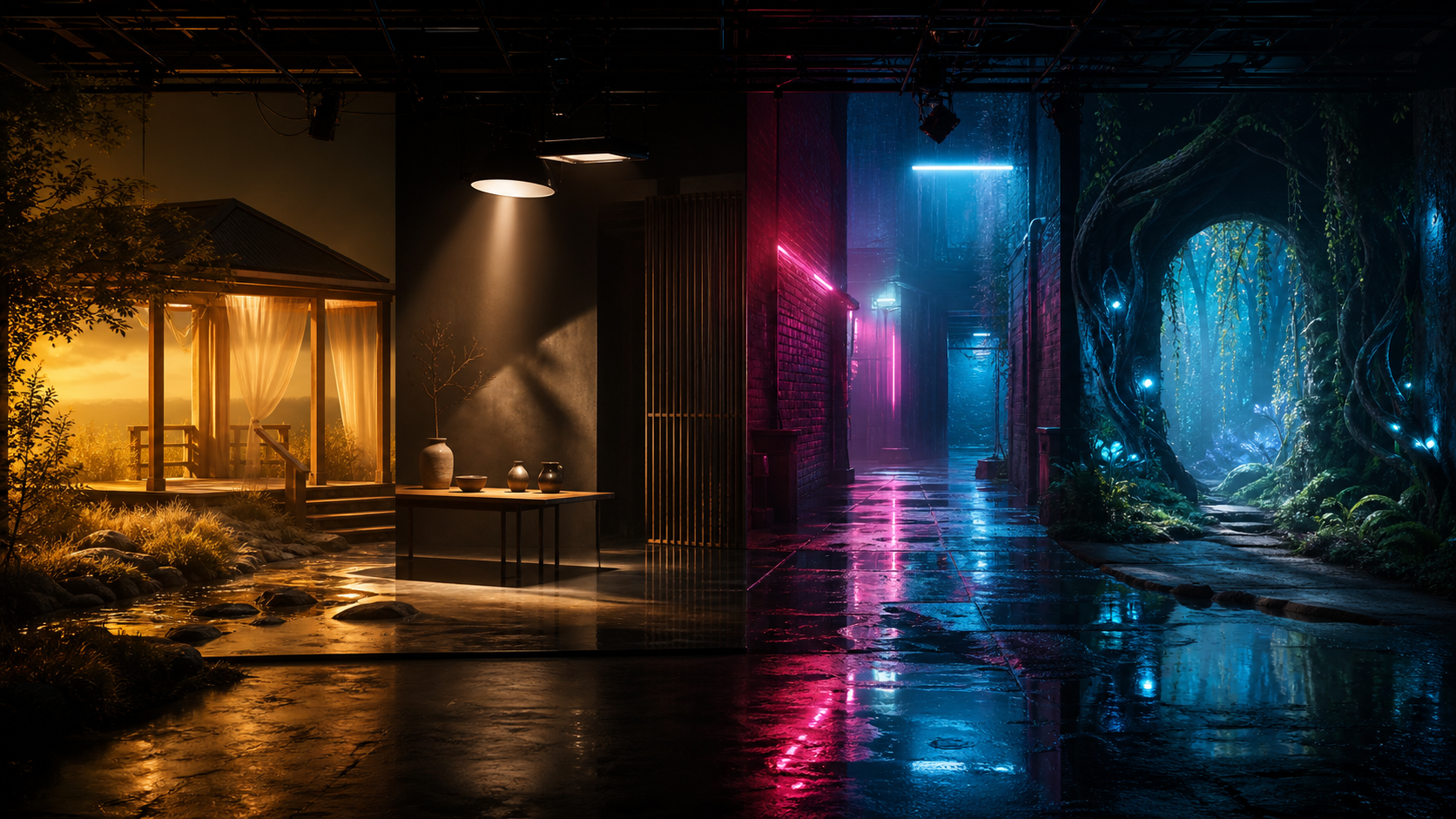
Lighting is not a cosmetic layer added after a scene. It directs attention, defines depth, establishes mood, and tells viewers how to interpret a subject. AI video models respond much more consistently when a prompt describes light with cinematography language instead of vague adjectives such as “beautiful” or “dramatic.”
A useful lighting brief controls five dimensions:
- Source: sun, window, bulb, neon, fire, monitor, or another motivated emitter.
- Quality: hard or soft, direct or diffused.
- Direction: overhead, side-lit, front-lit, backlit, or motivated from a visible source.
- Color temperature: warm tungsten, neutral daylight, cool blue, or mixed practical colors.
- Contrast: the relationship between highlights, midtones, and deepest shadows.
Each prompt below combines at least three dimensions. Replace the fictional subject and location with your own, then change one lighting variable at a time.
Natural-light prompts
1. Golden-hour portrait
Close portrait of an original fictional traveler in an open meadow at golden hour. Low amber sun enters from camera left, creating a soft rim around the subject and long shadows across the grass. Rich warm skin tones, shallow depth of field, sunlit bokeh, restrained anamorphic flare, cinematic 24 fps, wide 2.39:1 frame.Use it for emotional portraits, travel, romance, or premium product mood. The low source, warm color, and rim direction separate the subject without adding an artificial fill.
2. Overcast forest softness
A lone hiker pauses on a forest path beneath a fully overcast sky. Cool blue-gray light wraps evenly around the figure and foliage with no hard shadows. Rich natural greens, faint mist between midground trees, lifted black levels, subtle handheld breathing movement.An overcast sky behaves like a giant softbox. This setup suits introspection, nature, and environmental stories where texture should remain readable without aggressive contrast.
3. Harsh midday desert
Wide establishing view of a figure crossing a cracked salt flat under brutal overhead midday sun. Hard bleached light, minimal cast shadow, dark distant mountains, heat shimmer above the ground, bone-dry palette. Begin from a high descending camera and settle near eye level.Midday light can feel oppressive and isolating when used deliberately. It works for survival, dystopia, and psychological pressure.
4. Blue-hour city
Wide city intersection during blue hour. Deep indigo ambient sky balances warm amber street lamps as storefront lights begin to glow. Wet pavement reflects cool and warm sources; one distant figure crosses the empty street. Locked tripod, crisp cinematic detail.Blue hour naturally creates cool-warm color contrast. Use it for transitions, urban mood, and metropolitan product imagery.
5. Backlit silhouette and translucency
A dancer moves along a shoreline at sunset, camera facing directly toward the sun. The body forms a detailed silhouette with a bright golden corona; translucent fabric glows where backlight passes through it. Glittering sea highlights, horizontal flare, slow motion, epic wide scale.Backlight turns edges and thin materials into the visual subject. It is effective for movement, fashion, and emotional climaxes.
Studio and dramatic-lighting prompts
6. Rembrandt character light
Medium close-up of an older fictional craftsperson at a wooden table. One warm key light sits high at 45 degrees camera-left, forming a small triangular highlight on the shadow-side cheek. Deep chiaroscuro, detailed skin texture, background falling nearly to black.The cheek triangle and controlled shadow ratio give this classic setup psychological depth. Use it for interviews, period scenes, and character drama.
7. Hard overhead interrogation light
An empty chair in a bare concrete room beneath one exposed overhead bulb. Hard vertical shadows fall from every surface; the seat alternates between overexposed highlights and deep black. A second chair remains barely visible beyond the light radius. Tense film-noir atmosphere, 4:3 frame.This point source creates immediate pressure and institutional severity without relying on dialogue.
8. Butterfly beauty light
Beauty close-up of a fictional cosmetics model. A large soft source is centered above the lens and angled down 45 degrees, creating the small symmetrical shadow beneath the nose. Even cheek illumination, subtle reflector below the chin, luminous skin, clean background, 85 mm portrait compression.Butterfly or Paramount lighting emphasizes symmetry and smooth facial modeling. Use it for beauty, fashion, and polished lifestyle work.
9. Split light for conflict
Tight portrait with the face divided precisely along the bridge of the nose. One half receives hard amber side light; the other falls into near-black with almost no ambient fill. Razor-clean light boundary, minimal background, restrained music-video mood.Split light communicates duality, conflict, or a hidden side. Its effectiveness depends on explicit source direction and very limited fill.
10. Motivated candlelight
An intimate dinner table lit only by several visible candles. Warm flickering pools fade rapidly into a dark room; nearby flames provide gentle uplight across faces and tableware. Rich corner shadows, subtle film grain, romantic and timeless atmosphere.Because the visible practical source explains the illumination, the scene feels coherent. Specify flicker, falloff, and the below-face direction.
Neon and urban-night prompts
11. Rain-slicked neon noir
A fictional figure walks through a rain-soaked alley before dawn. Magenta and cyan signs cast broken reflections across wet stone; puddles mirror the sources. Steam creates halos, deep darkness separates each pool of light, and the subject moves in and out of visibility. Wide anamorphic frame with restrained horizontal flare.Reflections multiply the sources, haze makes light volumetric, and alternating bright-dark zones create noir rhythm.
12. Dense mixed-practical street
Elevated view down a busy night street with layered practical sources: cool LEDs, warm lanterns, fluorescent storefronts, vehicle headlights, and saturated colored signs. Preserve the competing color temperatures rather than averaging them. Pedestrians pass through changing light directions; humid haze adds depth.Use this for energetic travel, urban documentary, and street-fashion sequences. Mixed sources should remain visibly distinct.
13. Liminal roadside station
A solitary roadside fuel station on an empty desert highway at night. Blue-white canopy lights form a stark island of illumination with an abrupt boundary against the black landscape. Fluorescent tubes bloom slightly; the surrounding distance remains unknowable and still.The central contrast is industrial light against total darkness. It suits road stories, solitude, and threshold moments.
14. Club strobe and colored wash
Underground dance floor alternating between deep red and electric-blue washes. Periodic white strobes freeze motion while haze reveals laser lines and moving-head beams. Motion blur appears between flashes; each strobe reveals a different phase of movement.This is a temporal-lighting test. Keep the color cycle, flash behavior, haze, and subject action clearly separated.
15. Sodium-vapor overpass
Night action beneath a concrete overpass, illuminated by distant sodium-vapor lamps. A nearly monochrome amber wash desaturates the environment; hard architectural shadows cross the frame. A skater enters one orange pool of light, performs one trick, and exits. Raw handheld documentary texture.The restricted palette and graphic infrastructure shadows create a gritty, location-specific look.
Science-fiction and fantasy prompts
16. Bioluminescent forest
A figure moves slowly through an ancient night forest where plants, fungi, and insects emit soft blue-teal light. Illumination is distributed through the environment rather than coming from one direction. Surfaces glow from nearby life; no moon or external lamp. Ethereal slow push-in.The key instruction is a distributed, self-emitting environment. It prevents the model from defaulting to an ordinary directional key.
17. Portal backlight
A lone explorer faces a vast circular portal emitting white-gold light. The portal is the only source, creating a strong silhouette and brilliant rim. Volumetric rays spill through atmospheric particles; animated patterns of overflow light move across the floor. Low heroic camera angle.A single overwhelming motivated source creates readable science-fiction scale.
18. Clinical laboratory thriller
A scientist works alone in a dark laboratory. Blue-white monitors provide hard frontal and side light; a narrow 6500K LED task light isolates equipment on the bench. The remaining room stays in deep shadow with sparse green and amber indicators. Begin close, then reveal the wider isolation.Layer monitor glow with a separate task source so the shot does not collapse into one flat blue wash.
19. Dynamic fantasy fire
A vast stone chamber illuminated entirely by shifting orange-red fire. Near-white flame cores reflect from polished black pillars; deep shadows flicker between them. Embers rise through the beams while moving warm highlights travel across an armored fictional figure. Extreme contrast, epic scale.Fire changes through time. Explicitly request moving illumination and reflection so it behaves as a dynamic source rather than a static orange grade.
20. Soft holographic glow
A character interacts with translucent cyan planes floating in a dark space. The hologram emits soft diffused light that illuminates the face and hands from nearby angles. The environment remains mostly black; the display is visible from several viewpoints without becoming a solid screen. Clean futuristic medium shot.The hologram must illuminate nearby surfaces to feel physically present. Keep its glow soft enough to preserve facial detail.
Combine lighting with camera movement
Static camera, dynamic light
Lock the frame and let changing illumination supply the energy:
Locked camera. A figure walks away through a corridor of independently flickering fluorescent tubes, alternating between full illumination and darkness. The camera never moves.Moving camera, static light
Move through a stable lighting environment to reveal depth:
Slow dolly into a candlelit room. Warm amber light grows more enveloping as the lens crosses the threshold and gradually reveals the subject.Camera and light changing together
This is the hardest option because the model must preserve subject, camera path, and lighting continuity:
One controlled orbit around a central subject while the environment changes from golden sunset to blue hour and then neon night. Complete the lighting transition at the end of the orbit; keep facial exposure readable throughout.Use a video transition workflow to plan the endpoints before attempting the combined move.
Make camera direction part of the lighting brief
- Camera facing the source produces backlight or silhouette.
- Camera opposite the source gives frontal key light.
- Camera 90 degrees from the source creates side or split light.
- Camera below a high source emphasizes theatrical downlight or uplight relationships.
Whenever possible, state where the source sits relative to both subject and lens.
Six rules for repeatable results
- Lead with the named setup—Rembrandt, butterfly, split, backlit—then describe its geometry.
- Add a color temperature such as 2700K tungsten warmth or 5500K daylight when precision helps.
- Describe where shadows fall, how dark they become, and whether their edges are hard or gradual.
- State light quality explicitly: hard and defined, or soft and wrapped.
- Use genre language as a broad reference, but avoid copying a living artist's signature style or a protected franchise.
- Test one variable at a time so you know which change improved the shot.
If a prompt includes a real person's identity, use their likeness only with informed consent and appropriate rights. Lighting direction should never become a pretext for deceptive impersonation.
Build the scene from light outward
Start with a prompt as written, replace the subject and location, and then adjust one source, color, shadow, or camera relationship at a time. Save successful variants as reusable lighting blocks.
You can apply these blocks in DeepFake's text-to-video workflow or pair an approved reference frame with image-to-video. Precision about source, quality, direction, temperature, contrast, and camera position gives the model a visual system—not just a mood word.