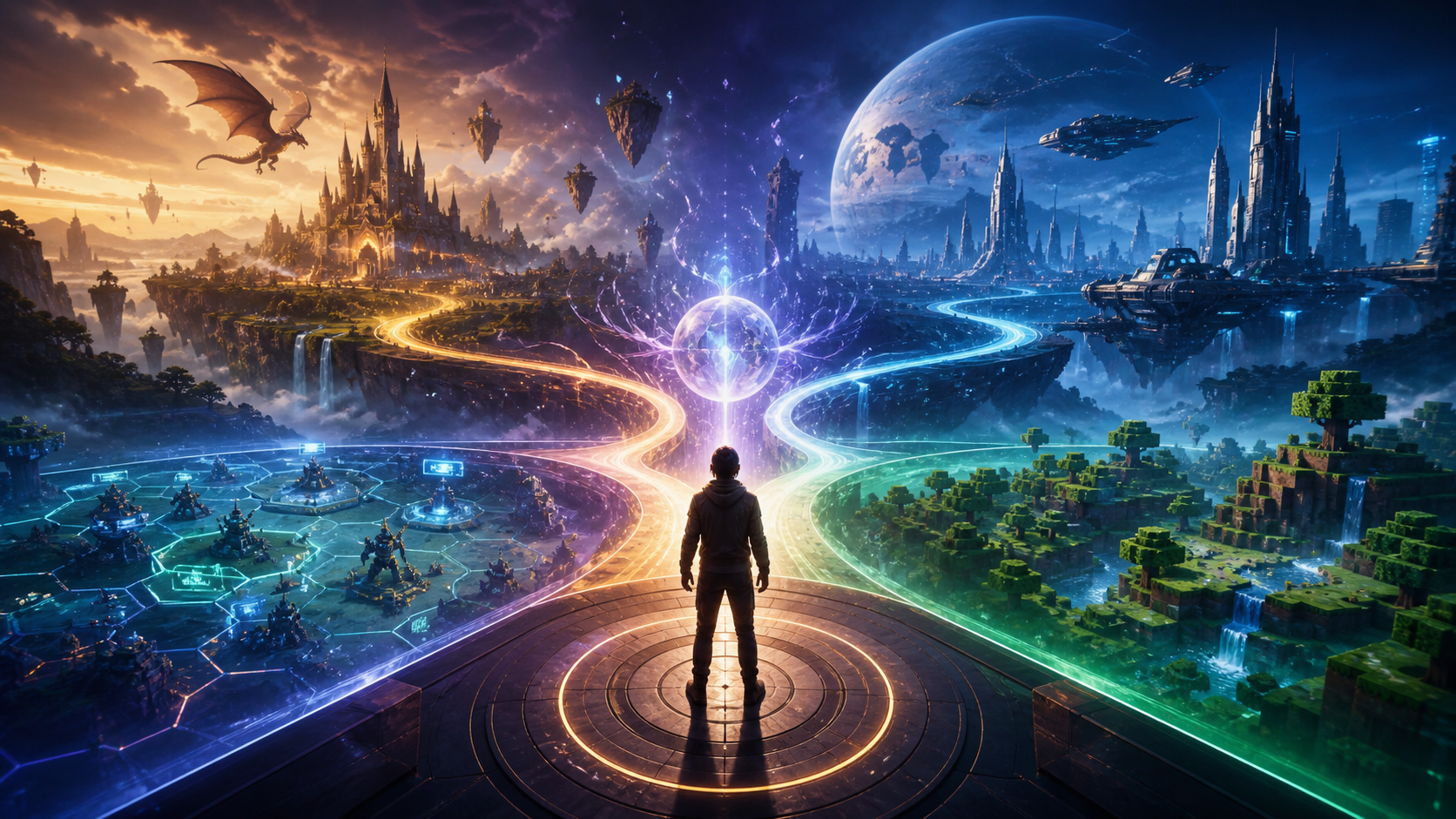
AI games are moving beyond the familiar idea of computer-controlled opponents. The most interesting online experiences in 2026 use AI to interpret a player's intent, adjust characters and situations, and help turn an idea into something playable.
That does not make every game with an AI feature worth your time. Good AI games still need coherent rules, meaningful choices, satisfying feedback, and a reason to return. This guide explains what is genuinely different about AI-powered play, which categories are worth exploring, and how to tell a flexible experience from a shallow novelty.
What Makes an AI Game Different From a Traditional Game?
Most traditional games are built from content and rules prepared before the player arrives. Developers write dialogue branches, design missions, place environments, and decide how enemies or companions respond. Players may have many options, but those options usually stay inside a defined possibility space.
An AI-powered game can make parts of that space more responsive. Instead of selecting only a scripted response, a player might describe an intention in ordinary language: help a village, question its leader, and investigate quietly before choosing a side. A capable system can interpret the goal behind that instruction and adapt the next interaction.
The difference is not simply “more content.” It is a change in the relationship between player and game. Rules, characters, missions, or outcomes can respond to ideas that were not written as exact menu choices.
AI alone, however, is not game design. Generated dialogue that goes nowhere or endless worlds without consequences quickly feel empty. The strongest experiences combine AI flexibility with deliberate objectives, constraints, progression, and feedback.
Why AI Games Feel More Capable in 2026
Several improvements are pushing online AI games forward at the same time.
Better Context Understanding
Newer systems can follow longer instructions and keep more of an interaction in view. This matters in a game because a character should remember an earlier promise, a story should respect an established rule, and a mission should not reset its logic every few turns.
Natural-language input also gives players more expressive control. Rather than searching for the closest predefined action, they can state a plan, tone, or motivation and let the game translate it into an event.
More Dynamic Characters
AI characters are most convincing when their behavior changes for a reason. They can react to how the player treats them, carry information from earlier encounters, and pursue goals that sometimes conflict with the player's plan.
The aim is not unlimited conversation for its own sake. It is the feeling that characters belong to a living system. A strong character response should reveal information, create a consequence, open a possibility, or force a decision.
Faster World Experimentation
Detailed game environments traditionally require substantial art, writing, and engineering work. AI-assisted creation can help teams and individual creators test maps, quests, dialogue, objects, and variations earlier in production.
That lowers the cost of trying an unusual premise. It does not remove the need for review: generated locations still need visual logic, adventures need pacing, and mechanics need to remain fair. The practical benefit is a shorter path from an idea to a testable experience.
The Best Types of AI Games to Play Online
There is no single format that defines an AI game. The most promising experiences currently fall into several overlapping categories.
AI Playable-World Platforms
Best for: players who want to explore, create, and remix.
Playable-world platforms treat AI as part of a broader creation loop. A player can begin with an idea—perhaps a floating-island civilization populated by friendly robots and hidden treasure—and develop it into an interactive setting rather than leaving it as a written prompt.
These platforms blur the line between player and developer. Their value depends on how well they support iteration: Can you revise the premise? Do rules remain consistent? Can other people discover, understand, and build on what you made?
AI Roleplay Adventures
Best for: character interaction and collaborative storytelling.
Roleplay experiences let players speak and act more freely than a dialogue tree permits. The attraction is not merely chatting with a character; it is seeing relationships, conflicts, and situations change as a result of the player's behavior.
Look for clear character motivations and durable memory. Without them, roleplay becomes a sequence of agreeable but disconnected replies. With them, conversation can create genuine dramatic pressure.
AI Dungeon-Style Story Games
Best for: open-ended narrative experimentation.
Text-led adventure games introduced many players to generated stories. They work especially well when imagination matters more than fast reflexes: a detective can investigate a city where memories are traded, or an explorer can negotiate with a culture invented during play.
The strongest story games balance freedom with continuity. They keep track of important facts, establish stakes, and make choices alter later events. Unlimited prose is less valuable than a story that remembers what the player has done.
AI Sandbox Worlds
Best for: creative players who enjoy building and discovery.
Sandboxes have always invited experimentation. AI can expand that promise by helping generate locations, quests, objects, characters, or local rules in response to a player's idea.
Quality depends on whether those pieces interact. A generated building is decoration; a building that affects trade, attracts characters, or changes a settlement becomes part of a game. Favor sandboxes where creation has visible systemic consequences.
AI Simulation and Strategy Experiences
Best for: players interested in systems and decisions.
Strategy games already rely on interacting economies, factions, populations, and opponents. AI can make those systems less predictable by allowing rivals to react to unusual tactics or by generating scenarios around a player's decisions.
Unpredictability needs boundaries. If the system changes rules without explanation, strategy stops feeling fair. Useful AI variation should create new problems while preserving information the player needs to reason about them.
AI Adventure Games With Dynamic Worlds
Best for: exploration, discovery, and replayable journeys.
Adventure games depend on places, characters, obstacles, and consequences, which makes them a natural match for adaptive systems. AI can vary encounters or respond to a player's chosen route without reducing the experience to random events.
The key test is causality. A dynamic world should change because of what the player did, not merely because a generator produced something different.
Free AI Games vs. AI Game Platforms
A free AI game usually offers one contained experience. That is ideal when you want to try a concept quickly and learn whether AI-driven interaction appeals to you.
An AI game platform is broader. It may let players create worlds, modify scenarios, publish experiences, or remix work made by a community. The distinction matters because AI gaming is increasingly participatory: people want to shape the experience, not only consume a finished one.
Before paying for a platform, examine what the free level actually demonstrates. Check whether creations can be exported or shared, which rights apply to your inputs and outputs, how personal data is handled, and whether the platform clearly explains content moderation and ownership.
How to Choose an AI Game Worth Playing
Use four practical questions to separate a compelling game from an AI demo.
Does AI Improve the Gameplay?
The AI should enable a meaningful action, response, or creative possibility that would be difficult to deliver with a fixed script. If removing the AI would barely change the experience, the label may be doing more work than the technology.
Do Your Choices Matter?
Test whether the game remembers earlier decisions and produces understandable consequences. Good adaptive play is not simply different on every attempt; it is responsive in a way the player can recognize.
Is It Actually Fun?
Technical novelty fades quickly. The experience still needs satisfying goals, pacing, challenge, surprise, or creative expression. A game should give you a reason to continue after the first impressive response.
Can You Create or Customize?
The biggest opportunity in AI gaming is participation. Tools for changing a world, character, scenario, or rule can give an experience lasting value—provided the controls are understandable and the results remain coherent.
Why AI Games Are More Than a Short-Term Trend
Major shifts in gaming have repeatedly expanded what players can do. Arcades made electronic play accessible, online multiplayer connected communities, and user-generated platforms turned audiences into creators. AI extends that progression by making game systems more responsive to language and ideas.
The future is unlikely to belong to one format. Roleplay, strategy, sandbox creation, simulation, and authored adventures will continue to overlap. The most durable platforms will understand that players want both freedom and structure: room to influence a world, plus enough design to make that influence meaningful.
The Future of Online AI Gaming
Expect more worlds to be assembled or adapted close to the moment of play. Characters may maintain longer histories, creators may prototype interactive concepts without a full studio, and communities may exchange playable ideas as easily as they now share videos or images.
Human direction will remain essential. Someone still has to define the premise, establish boundaries, evaluate generated material, and decide what makes the experience enjoyable. AI can shorten the distance between imagination and play, but taste and game design determine whether the destination is worth visiting.
If you are prototyping the visual side of an interactive concept, you can explore the creative models available through DeepFake. Keep licensed inputs, review every generated asset, and respect the rights and privacy of real people whose identity or likeness could otherwise be involved.
Frequently Asked Questions
What is an AI game?
An AI game uses artificial intelligence as part of the player experience—for example, interpreting natural-language intent, adapting characters, generating situations, or helping players create worlds. A game that only uses AI during development is not necessarily an AI-powered game from the player's perspective.
Are online AI games free?
Some offer free trials or limited free play, while platforms may charge for additional generations, storage, publishing, or advanced creation features. Review the current terms before committing time or payment.
What makes an AI game good?
Strong AI games connect flexible responses to coherent rules and meaningful consequences. Context retention, character consistency, player agency, clear feedback, and ordinary game-design fundamentals matter more than the amount of generated content.
Can I create my own AI game without coding?
Some playable-world and user-generated platforms reduce the technical barrier, but their capabilities vary. Start with a small premise, test whether rules and characters stay consistent, and verify ownership and publishing terms before building a larger project.