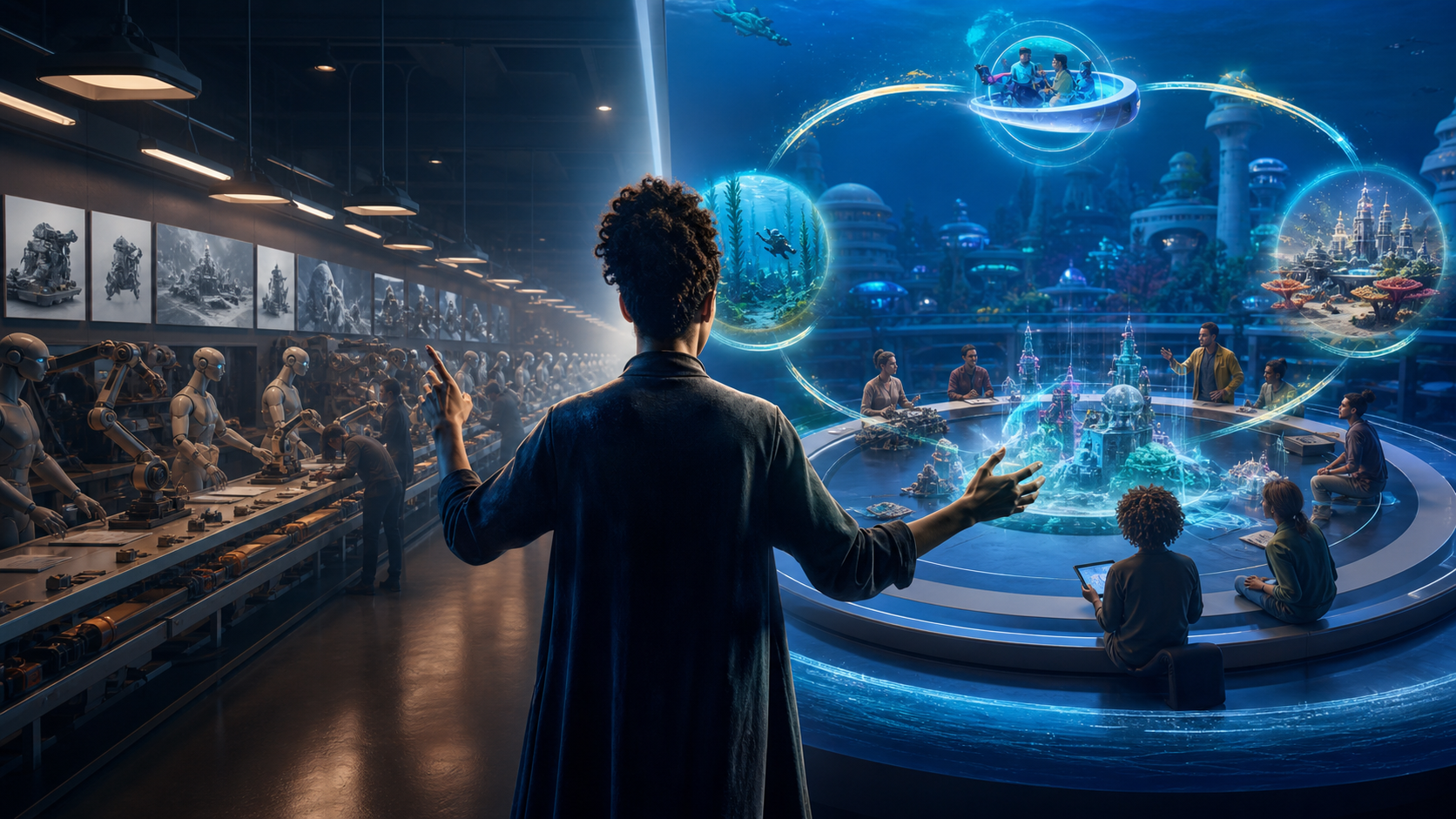
Every game begins as an imagined experience: a rule the player has not tried, a world that does not yet exist, or a feeling the designer wants to produce through action. The difficult part has always been turning that intent into something playable soon enough to learn whether it works.
The established production sequence is familiar:
Idea → Design Document → Prototype → Development → Testing → Launch
Each stage serves a real purpose, and a shipped game still needs engineering, art production, quality assurance, accessibility work, platform compliance, operations, and many other disciplines. But the first useful playtest may arrive only after several layers of translation between the designer’s idea and the running build.
AI-assisted experimentation introduces a shorter loop at the front of that process:
Prompt → AI Generation → Play → Feedback → Remix
This second loop does not replace the first. It changes how creators explore uncertain ideas before committing to full production. A natural-language description becomes a design input; generated drafts or assembled prototypes become test material; play exposes assumptions; feedback reshapes the prompt, rules, assets, or scope; and the cycle repeats.
That is the practical meaning of “prompt to play.” It is less about generating a finished game with one sentence and more about reducing the distance between a design hypothesis and an experience someone can evaluate.
1. From Tool-Based Creation to Idea-Based Direction
Traditional game-making often begins with a tool decision. A creator opens an engine, selects a template, creates a scene, imports assets, writes components, and learns what that stack makes convenient or difficult. This is tool-based creation: the idea is repeatedly translated into engine objects, scripts, animation states, data tables, UI hierarchies, and build settings.
Those skills remain essential for production. The shift is that early exploration can become more idea-based. Instead of first asking which component to create, the designer can describe the experience:
- a world with a particular mood and navigational logic;
- a player role with a meaningful limitation;
- a mechanic that creates a specific decision;
- a story situation expressed through interaction;
- a test question that play should answer.
The description is not the design itself. It is the beginning of a conversation that must turn ambiguous language into explicit rules. “Make it tense” could mean limited information, time pressure, costly movement, an unreliable map, or a threatening soundscape. Each interpretation produces a different game.
As the entry point changes, the designer’s emphasis may shift from component builder toward experience director. A component builder asks, “Which systems and assets must I construct?” An experience director also asks, “What should the player notice, decide, feel, and remember, and how will I know whether that happened?”
The best workflow uses both perspectives. Experience direction without implementation discipline produces attractive descriptions that cannot be tested. Component construction without a clear experiential question produces systems that work but have no reason to exist.
2. What “Prompt to Play” Actually Means
Prompt to play is a design workflow in which natural language starts a rapid path toward a playable hypothesis, followed by observation, feedback, and revision. The output of the prompt is not presumed correct. It is material for a test.
Compare two starting statements:
“I need a programmer to build a survival mechanic.”
“Create a survival experience in which the player explores an abandoned underwater city.”
The second statement communicates a fantasy, but it is still too broad. “Survival” might mean oxygen management, pressure damage, food scarcity, shelter construction, navigation, social isolation, or avoiding predators. “Explore” might mean free roaming, route planning, puzzle solving, archival investigation, or rescuing trapped residents. The abandoned city could feel mournful, frightening, serene, or wondrous.
The prompt-to-play process makes those uncertainties visible early. Before producing anything, turn the idea into a design hypothesis:
Hypothesis: Limited oxygen and changing water pressure will make navigation through a flooded civic district feel tense without requiring constant combat.
Then define the smallest playable question:
Can a player read three kinds of environmental warning, choose between a short dangerous corridor and a long safe route, and understand why the decision mattered?
Now the first prototype needs only a compact district, two routes, an oxygen rule, a pressure warning, a clear destination, and feedback after the choice. It does not need a complete city, crafting tree, cinematic prologue, twenty enemies, or final art.
The sequence becomes:
- describe the intended experience;
- expose ambiguous terms;
- choose one player decision;
- define an observable question;
- create the smallest testable form;
- play it rather than judge it from a document;
- revise the rule, feedback, level, or premise;
- decide whether to expand, redirect, or discard it.
“Prompt to play” therefore describes a feedback architecture, not a magic export button.
3. Use Language Models to Interrogate Creative Intent
Large language models are useful in early design when they turn vague intent into questions, contrasts, edge cases, and alternative formulations. The designer should treat their responses as proposals, not facts or final creative authority.
Consider the prompt:
“I want a relaxing exploration game.”
The most valuable response is not a pile of features. It is a structured inquiry:
What kind of world supports relaxation?
Is the player wandering through a quiet archipelago, an overgrown orbital station, a miniature city built inside an old library, or a desert crossed by slow-moving shade? Is the space safe, or does it contain mild risk? Does the landscape change while the player is away? How dense is visual information?
What motivates the player to continue?
Are they collecting observations, restoring pathways, learning local stories, photographing wildlife, delivering letters, or simply reaching viewpoints? Does progression unlock access, understanding, expression, or efficiency? A relaxation goal does not eliminate motivation; it changes the pressure around it.
What actions create enjoyment?
Is pleasure found in walking, gliding, arranging objects, listening, mapping, gardening, talking, or noticing small changes? How often does the player need to make a decision? What happens when they do nothing? If movement itself is the appeal, does the control scheme feel satisfying before content is added?
What makes the experience memorable?
Is there one place the player sees from several perspectives, a companion with a changing routine, a sound that reveals hidden paths, or a ritual at the end of each day? “Relaxing” is a desired emotional quality; a memorable design needs specific actions and images that produce it.
This questioning transforms a mood word into a testable design. A simple prototype might ask whether following changes in bird calls is enough to guide the player through a garden without a map. Playtesters can then report where they felt curious, lost, hurried, or bored.
Language models may also help create contrasting versions of the same hypothesis. One version could remove rewards to protect aimless exploration. Another could add a gentle collection goal. A third could make the environment respond to how long the player stays in one place. The designer selects which difference is worth testing and owns the conclusion.
4. Multimodal Systems Can Bridge Design Artifacts
Game ideas move between formats. A sentence becomes a sketch; a sketch becomes a level blockout; a movement test changes the animation brief; a sound changes how a corridor feels; a playtest video reveals that the intended focal point was missed. Multimodal systems may reduce friction between these artifacts by helping creators translate intent across text, images, audio, video, and interactive representations.
The value is not that every format becomes a finished asset automatically. The value is a faster shared vocabulary. For example:
- a written description may produce several composition drafts for a drowned plaza;
- a selected image may clarify scale, color, sightlines, and landmark placement for a blockout;
- a short motion concept may reveal whether drifting debris communicates current direction;
- a spoken playtest note may be organized beside the exact scene where confusion occurred;
- screenshots from successive builds may help a team compare whether the landmark became easier to read.
Every bridge needs review. A beautiful concept image can imply architecture that does not support navigation. A cinematic motion preview can hide a mechanic behind camera movement. Generated audio may carry licensing or provenance concerns. A text summary may miss sarcasm or disagreement in a playtest.
Treat each artifact as evidence in a design conversation. Record what it is supposed to communicate, which decisions it informed, what changed afterward, and whether it is approved for reference or merely exploratory.
5. AI Agents May Assist With Multi-Step Design Tasks
Agentic workflows are often discussed as if they were autonomous design teams. A more responsible framing is conditional: agents could or may assist with bounded tasks, while human designers define the goal, constraints, permissions, evaluation criteria, and final decisions.
In a controlled development environment:
- an agent could propose balance variations for an existing mechanic, provided the designer defines the target experience and valid parameter range;
- an agent may generate structured variants of encounter layouts for comparison, without deciding which one is enjoyable;
- an agent could run repeatable mechanical tests and collect results when the build exposes safe test hooks;
- an agent may identify obvious edge cases or suggest improvements for human review;
- an agent could compare observed outcomes with stated acceptance criteria, while leaving interpretation to the team.
None of these possibilities guarantees balanced gameplay, meaningful novelty, reliable code, or accurate player simulation. Automated test behavior is not a substitute for human play. A simulated agent may optimize a route while missing confusion, delight, fatigue, social meaning, accessibility, or the pleasure of learning.
Bound the work. Give an agent a versioned build, a small parameter space, a test protocol, and a place to record results. Review changes before integrating them. Keep security, licensing, privacy, and repository permissions appropriate to the task.
6. Faster Prototyping Changes Which Questions Arrive First
A prototype exists to answer a question, not to resemble a trailer. If AI assistance reduces the effort needed to draft assets, outline interactions, or assemble test material, teams can reach certain questions earlier:
- Is the core decision legible?
- Does the mechanic create the intended emotion?
- Can players predict cause and effect?
- Is the level asking for attention in the right place?
- Does repetition create mastery or boredom?
- Is the fantasy still interesting after direct control begins?
This is faster prototyping in the useful sense: earlier contact with player behavior. It does not mean that every prototype takes a fixed amount of time. A reference to work once taking “weeks” or “months” is an illustration of production friction, not a benchmark, measured speedup, or guarantee. Scope, team skills, tools, fidelity, platform, and integration demands vary enormously.
Earlier prototypes can make cancellation cheaper. That is a feature. If the underwater-city test reveals that oxygen pressure discourages exploration rather than making it tense, the team can replace oxygen with route instability, change the desired emotion, or stop. The goal is not to preserve the first prompt; it is to learn before the project accumulates expensive dependencies.
Use placeholder visuals, rough audio, minimal UI, and explicit debug feedback when they help isolate the question. Polish only what affects the test. If players cannot read the current direction because the placeholder particles point both ways, improve that signal. Do not build the entire skyline to solve it.
7. Creative Exploration Becomes a Deliberate Search
Lower-cost drafts can expand the number of concepts a designer considers, but volume alone is not exploration. Generating one hundred variants with no comparison rule produces a crowded folder, not knowledge.
Define dimensions before making alternatives. For the underwater city, a creative exploration matrix might vary:
- primary pressure: oxygen, visibility, current, structural instability;
- navigation cue: lights, debris, sound, marine life;
- player verb: swim, tether, redirect flow, deploy beacons;
- emotional target: dread, solitude, wonder, responsibility;
- failure consequence: lost time, changed route, damaged tool, missed story.
Choose a few combinations that make genuinely different promises. Prototype the smallest contrast. A sound-guided route and a light-guided route may reveal more than ten differently colored versions of the same corridor.
Creative exploration also benefits from negative prompts in the design sense: state what the experience should avoid. The relaxing exploration game may avoid countdowns, inventory overload, mandatory combat, and noisy reward bursts. Those boundaries help tools and collaborators generate alternatives that remain relevant.
Unusual combinations deserve testing, not automatic celebration. A poetic concept can still be unreadable. The designer’s taste appears in what is selected, removed, combined, and refined.
8. Personalization Must Preserve Authored Intent
AI-assisted systems create possibilities for personalized experiences based on player choices, preferred difficulty, themes, or interests. Personalization can be valuable when it improves accessibility, pacing, relevance, or expression. It can also weaken a game if every challenge bends until decisions lose consequence.
Start by defining what may change and what must remain authored:
- difficulty assistance may change timing windows while preserving the decision;
- optional guidance may clarify a route without moving the goal;
- cosmetic themes may vary while critical readability colors remain protected;
- side stories may respond to prior choices while the central arc retains its designed structure;
- encounter order may adapt while required teaching beats remain intact.
Make adaptation visible enough to evaluate. Log which variable changed and why. Let players control or decline personalization where appropriate. Avoid inferring sensitive traits from behavior without informed consent. Do not disguise monetization pressure or engagement manipulation as personalization.
A personalized system still needs authored boundaries, accessibility review, privacy decisions, abuse testing, and human playtests across different player profiles.
9. Turn the Prompt Loop Into a Design Sprint
A disciplined prompt-to-play sprint can fit inside the larger production process.
Step 1: State the experience
Write one sentence about the player’s role, repeated action, pressure, and desired feeling. For example: “The player navigates a drowned civic district by reading currents, choosing between safe detours and unstable shortcuts, to feel cautious curiosity.”
Step 2: Name the unknown
Choose one question the prototype should answer. Do current cues help players make an informed choice without an arrow? Avoid asking whether the whole game is good.
Step 3: Define observable evidence
Decide what you will watch: hesitation at a junction, ability to predict the shortcut risk, route choice, explanation afterward, or emotional language during an interview. Separate behavior from interpretation.
Step 4: Create only the necessary artifacts
Make a blockout, two routes, one current visualization, a destination, and a reset. Use concept drafts only where they clarify scale or mood. Do not turn the prototype into a marketing scene.
Step 5: Play and record
Let the designer play first to catch obvious failures, then observe other people without coaching them through the intended answer. Ask what they believed would happen before explaining the rule.
Step 6: Diagnose the result
Was the design hypothesis wrong, or was the feedback unclear? Did players understand the current but choose the safe route because the reward was weak? Distinguish comprehension, motivation, execution, and preference.
Step 7: Remix one variable
Change the signal, route cost, control, or emotional framing—not all four at once. Preserve version notes so a better result can be connected to a decision.
Step 8: Decide the next commitment
Expand, repeat, pivot, archive, or stop. If the idea survives, it returns to the broader production sequence with better evidence: design documentation, implementation plans, art direction, testing strategy, and launch work still matter.
This is where the two workflows connect. The prompt loop explores and validates; the production pipeline turns selected learning into a reliable product.
10. A Broader Pattern: Idea, Experience, Playing, Remix
The industry pattern behind prompt-based design can be described without tying it to one platform:
- Start with an idea: a character, world, story, mechanic, player role, or emotional goal.
- Transform the idea into a playable experience: reduce it to rules, feedback, spaces, and decisions someone can interact with.
- Improve through playing: observe what people actually do, not what the design document predicts.
- Remix and expand: revise the mechanic, build a different version, combine discoveries, or let communities extend systems under clear permissions.
The word “experience” matters. Producing content is not the same as designing interaction. A generated environment may be visually impressive but provide no meaningful route choice. A generated character biography may be rich but never affect a verb. A generated mechanic list may be extensive but create conflicting incentives.
Playing is the reality check. It reveals whether instructions are clear, whether feedback arrives at the right time, whether the intended choice is genuinely available, and whether the emotional rhythm survives contact with player agency.
Remix should preserve provenance and permission. Teams need to know which assets, code, prompts, and references may be reused; community creators need understandable rules; and designers need version control so an interesting branch does not disappear into a collection of unnamed exports.
11. Human Judgment and AI Assistance Have Different Jobs
The productive division is not “humans have ideas, AI finishes them.” Design remains an authored practice.
Human creators provide:
- vision: what experience is worth making and for whom;
- taste: which option is coherent, distinctive, and appropriate;
- creativity: how rules, stories, spaces, and culture produce new meaning;
- empathy: how a player may feel, interpret, struggle, cooperate, or be excluded;
- responsibility: what should be built, tested, disclosed, licensed, protected, or rejected.
AI assistance may provide:
- speed: reducing friction in certain drafts or comparisons;
- assistance: organizing questions, references, variants, or observations;
- experimentation: making some alternatives cheaper to examine.
Speed is not direction. Assistance is not accountability. Experimentation is not evidence until someone defines and observes a test. A system cannot decide why a story matters to a particular community or guarantee which moment a player will remember.
Human review is also required for correctness, safety, bias, accessibility, licensing, privacy, security, and cultural context. The designer remains responsible for what enters the build and what reaches players.
12. The Future Designer’s Core Skills
Technical fluency will continue to matter, but the highest-leverage skills may increasingly include:
- describing an intended player experience precisely;
- turning mood words into observable actions and feedback;
- asking useful questions instead of requesting feature piles;
- scoping the smallest prototype that can disprove an idea;
- directing several tools without losing design coherence;
- evaluating outputs rather than accepting the first plausible result;
- understanding players through ethical research and playtesting;
- documenting provenance, decisions, versions, and permissions;
- knowing when manual craft, specialist expertise, or a custom system is necessary.
The central question can move from:
“Can this be built?”
to:
“Is it fun?”
That shift is valuable only when “fun” is investigated seriously. Which player? What behavior indicates engagement? Is confusion intentional? Does the experience remain accessible? What tradeoff created the emotion? Can a second test reproduce the result?
Designers do not become less important when prototypes become easier to make. More possible drafts create more need for taste, clarity, ethics, synthesis, and the courage to discard work.
13. Use DeepFake Only for Concept Previsualization
DeepFake is not a game generator. It does not turn a prompt into a playable build, implement mechanics, write engine code, manage game state, balance systems, run gameplay QA, or launch a game.
Within a real development workflow, DeepFake’s text-to-image route may help draft visual directions for a location, prop, creature, or mood board. Its text-to-video route may help previsualize a short camera, atmosphere, or motion idea before a team builds it properly. These are concept artifacts, not interactive environments or production-ready game assets.
Review generated media for continuity, anatomy, readability, unintended text, copied marks, identifiable likenesses, and usage rights. Do not use a cinematic concept clip as proof that a mechanic works. A player cannot make a meaningful decision inside a noninteractive preview.
Keep the boundary visible in project notes: concept image, motion previsualization, engine prototype, playtest build, and shipping asset are different states. Confusing them creates false confidence and weak production estimates.
FAQ
Does prompt to play mean one prompt creates a finished game?
No. It means natural language can begin a shorter experiment loop that moves toward something playable, then uses feedback and remixing. A finished release still requires deliberate design, engineering, art, audio, QA, accessibility, security, legal review, distribution, and support appropriate to its scope.
Does the prompt loop replace the traditional pipeline?
No. It can sit inside the early design and prototyping stages. Successful learning then enters the larger sequence of documentation, development, testing, and launch. Failed ideas can be revised or retired before they create larger dependencies.
Are AI prototypes guaranteed to be faster?
No. Complexity, integration, tool fit, team experience, target fidelity, and review requirements vary. References to work taking weeks or months are illustrative descriptions of traditional friction, not benchmarks or promised reductions.
What should the first prompt contain?
State the player role, repeated action, relevant pressure, desired emotion, and test question. Avoid asking for an entire genre at once. “Can players use current direction to choose between a safe detour and an unstable shortcut?” is more useful than “make a great underwater survival game.”
How should designers evaluate generated variants?
Choose comparison dimensions before generation, change one major variable at a time, put the variants into an appropriate test, and record observations. Selection should follow the experience goal rather than surface polish alone.
Could agents replace human playtesters?
No. Agents may assist with bounded mechanical checks or structured comparisons, but human players reveal interpretation, emotion, accessibility needs, social behavior, fatigue, surprise, and delight that automated behavior does not reliably represent.
Can DeepFake create a playable game?
No. DeepFake is not a game generator. It can support text-to-image concept drafts and text-to-video motion previsualization, while playable mechanics, implementation, testing, iteration, and shipping happen in appropriate game-development tools under human direction.
From Building Components to Directing Experiences
Prompt-based game design changes the order in which questions become affordable. A designer can begin with intent, turn ambiguity into a small hypothesis, reach a playable test, observe what happens, and remix one variable before committing to full production. Multimodal artifacts can bridge conversations, and bounded agent workflows could assist with carefully defined comparisons, but neither replaces human play or judgment.
The durable opportunity is not automatic game creation. It is a tighter relationship between imagining and testing. Faster prototyping can expose weak ideas earlier. Deliberate creative exploration can compare genuinely different mechanics. Thoughtful personalization can adapt selected variables without dissolving authored meaning.
Human vision, taste, creativity, empathy, and responsibility decide what experience should exist. AI may contribute speed, assistance, and experimentation. When those roles remain clear, the practical design question can move sooner from “Can this be built?” to “Is it fun?”—and the answer still comes from playing.