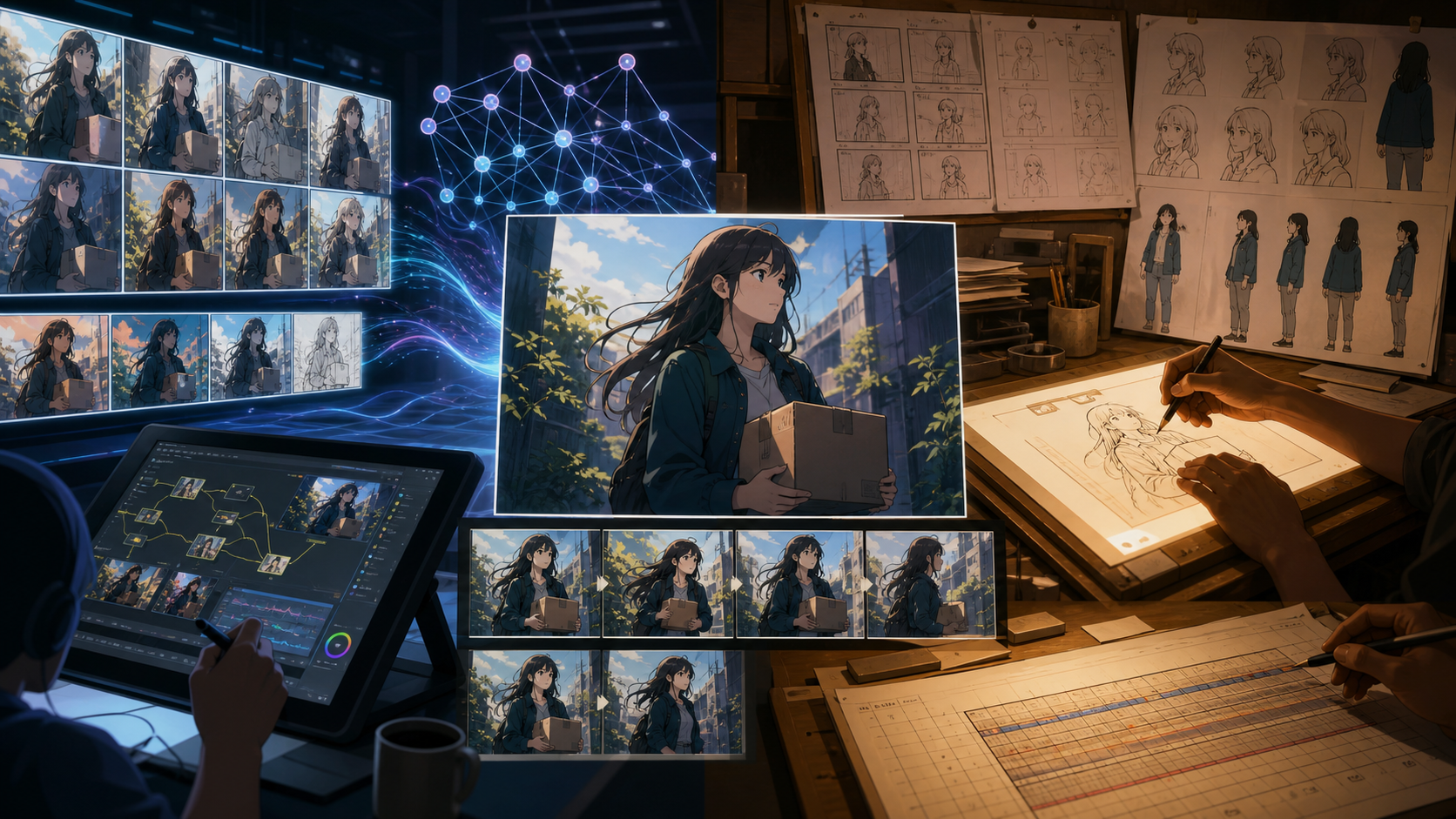
An AI system can generate an anime shot in minutes. Traditional animation may spend days on the same few seconds. That comparison is both true and misleading.
The generated shot may need six retries, character repair, continuity matching, sound, editing, and a rights review. The traditional shot may be slower to draw but easier to direct precisely and revise predictably. “Time to first output” and “time to approved scene” are not the same measurement.
This stage-by-stage comparison shows where AI genuinely compresses work, where traditional craft keeps an advantage, and why a hybrid pipeline is often the fastest route to something worth publishing.
Define the two workflows
For a fair comparison, imagine a 30-second original anime scene with one clearly adult character, one interior location, six shots, brief dialogue, music, and sound effects.
A traditional small-team pipeline might include:
- script and visual development;
- character research, model sheet, and expression sheet;
- location design and color script;
- storyboard and timing;
- key animation, in-betweens, cleanup, and color;
- background art and compositing;
- voice, effects, music, mix, edit, and delivery.
An AI-assisted pipeline may compress several exploration and generation stages through text-to-image, image iteration, image-to-video, generated audio, and automatic variations. The creator still needs to define the story, approve continuity, repair failures, edit the sequence, and decide whether the result meets the acceptance criteria.
The comparison assumes both workflows receive real review. A “one-click film” with no quality control is faster only because approval has been removed from the definition.
Script development: AI wins speed, humans retain judgment
A writer can draft a 30-second scene quickly without AI. The larger time saving appears during variation. AI can propose ten premises, three endings, shorter dialogue, or alternate tones almost instantly.
That makes AI useful for exploration and compression. A creator can paste a rough idea, request a six-shot structure, and obtain a workable starting point. The risk is generic cause and effect: familiar reveals, sentimental endings, or dialogue that explains what the image already shows.
The human advantage is judgment. A writer decides what the scene is about, which contradiction makes the character interesting, and what should remain unsaid. Use AI for options, then rewrite the premise, emotional turn, and dialogue in your own voice.
Character design: AI compresses exploration
Traditional character design involves research, thumbnails, silhouettes, costume studies, turnarounds, expressions, and revisions. An experienced artist makes these decisions efficiently, but each usable option still requires drawing time.
AI dramatically shortens visual exploration. A creator can test broad silhouettes, palettes, professions, and costume directions in minutes through a text-to-image workflow. That is valuable before the design is locked.
The trade-off appears in consistency and intent. A generated turnaround may change jacket construction between views or hide an impractical prop. Traditional drawing exposes those decisions early. In an AI workflow, approve a model sheet, name five identity anchors, and test the character at different angles before making final scenes.
Storyboards: speed depends on how specific the director is
A storyboard artist translates a script into staging, camera, screen direction, performance, and timing. Rough drawings can be fast because they only need to communicate.
AI can generate polished-looking boards quickly, but polish is not the purpose. A beautiful panel with the wrong eyeline or geography creates more work later. If the creator has not already decided the shot, prompting becomes a slower form of directing.
For each board, decide shot size, camera angle, screen direction, visible action, duration, dialogue or sound, and continuity notes. Use rough output until the sequence reads. Save finish work for approved shots.
Final images and backgrounds: AI has the largest raw advantage
This is where the clock difference becomes dramatic. A detailed traditional anime background or polished character illustration may require hours or days. AI can propose completed frames in minutes.
For a one-off concept, that is an enormous advantage. For six connected shots, the saving is moderated by consistency. The character must keep the same face and outfit; furniture must remain in place; light should come from the same window; props cannot change shape.
Measure accepted frames, not raw generations. If a six-shot sequence needs thirty generations, four paint-overs, and a continuity pass, include all of that time. Even then, the AI path can be dramatically faster for concept art and proofs of concept—but the number should be real.
Animation: instant motion is not controlled animation
Traditional animation exposes timing and drawing decisions. An animator can choose the exact anticipation, arc, spacing, expression, and frame on which a hand touches a prop. That control takes labor.
AI image-to-video can add movement rapidly, but the output is probabilistic. A head turn may reshape the jaw; fingers may merge during contact; an earring may disappear behind the hair and return differently. Complex action increases both generation and review time.
Use an approved still as the input to image-to-video, request one primary change, and keep the camera locked unless camera motion is essential. A slow push-in, a blink, and a curtain moving in the wind are safer than running, speaking, grabbing a parcel, and rotating the camera in one clip.
Traditional animation is slower when exact drawings and timing must be produced from scratch. It may be faster to revise when the director asks for a specific contact frame or two-beat timing change, because the relevant drawings and keyframes are explicit.
Voice, music, and sound: integration saves coordination time
Audio work is often underestimated in visual comparisons. A short scene needs recorded or generated dialogue, cleanup, timing, ambience, effects, and music that does not compete with speech.
DeepFake includes routes for generated audio and music, which can reduce searching and help a solo creator build a complete audio sketch quickly. Temporary sound is useful even when a later production replaces it with performed dialogue, licensed music, or a dedicated mix.
Generated voices and music still need rights review, level balancing, timing, and editorial judgment. Do not clone a real voice without authorization, and do not treat generated audio as automatically cleared for every commercial use.
Revisions reveal the true cost
AI appears fastest before the first review. The real comparison begins when someone says:
Keep the acting, but make the hand touch the parcel two beats earlier, preserve the exact face, move the camera slightly left, and change nothing else.
Traditional tools can isolate each request: adjust keyframes, camera, or drawings. A generative pass may alter the face, lighting, costume, and performance while fixing the hand. That uncertainty is the hidden revision tax.
Preserve intermediate files and separate stages. Keep the approved character, clean background, motion clip, dialogue, music, and effects as independent assets. A flattened all-in-one output is fast until someone asks to change one part.
A realistic hybrid workflow
For the 30-second scene, a fast quality-focused pipeline might be:
- A human writes the premise, emotional turn, and acceptance criteria.
- AI proposes alternate beats and dialogue; the human rewrites and selects.
- AI explores silhouettes, palettes, and location directions.
- A human approves a model sheet, floor plan, prop list, and color script.
- Rough boards establish shot logic and timing.
- AI generates selected stills and backgrounds from stable references.
- A human repairs continuity, anatomy, and composition.
- Image-to-video produces simple motion where probabilistic output is acceptable.
- Traditional keyframing or manual animation handles precise contact, acting, and timing.
- Generated audio provides a sketch; final audio is edited, mixed, and rights-checked.
- A human reviews the complete sequence and records changes.
The fastest hybrid assigns probability to exploration and precision to the shots where viewers will notice it.
How to run your own speed test
Choose a six-shot script and produce it twice. Keep the resolution, duration, and acceptance criteria identical. Track:
- planning time;
- number of generated or drawn alternatives;
- time to first complete sequence;
- time to approved sequence;
- repair and cleanup time;
- number of continuity errors;
- audio and export time;
- which decisions remain editable;
- time required for one realistic revision request.
Do not compare the AI rough to the traditional final. Compare outputs at the same approval level. Also record creative fatigue: a workflow that is technically faster but impossible to direct consistently may not be faster for your team.
Frequently asked questions
Is DeepFake faster than traditional anime production?
For ideation, character exploration, first-pass images, backgrounds, and simple motion, it often can be. The final advantage depends on consistency requirements, revision precision, quality standards, and the number of accepted outputs.
Can DeepFake replace an animation studio?
It can help individuals and small teams produce proofs of concept and short projects that might otherwise be inaccessible. It does not reproduce every specialist role, frame-level control, or collaborative judgment of a professional studio.
Which workflow is better for a serialized project?
A hybrid workflow is usually strongest. Use AI to accelerate exploration and selected production tasks, but establish human-controlled model sheets, continuity systems, editing, and quality review.
Conclusion
DeepFake is faster when the job rewards rapid variation: exploring concepts, discovering visual directions, building first-pass images, or adding simple motion and audio. Traditional anime tools are faster when the job demands exact, local, repeatable control.
The useful question is not “AI or traditional?” It is “Which stage benefits from probability, and which stage requires precision?” Test both against the same approved scene, then choose the workflow that reaches approval fastest—not the one that produces the first frame first.