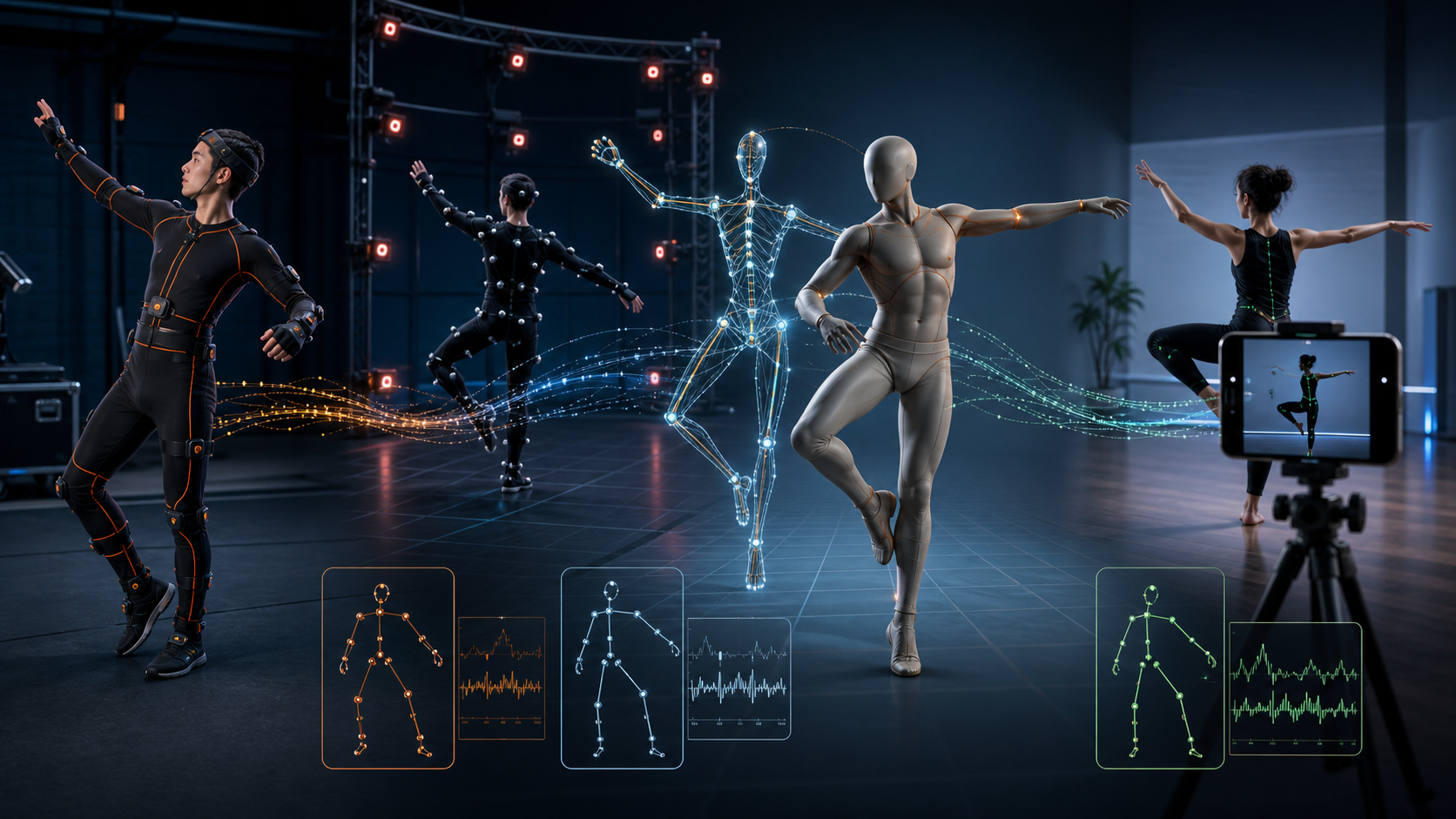
A motion-capture suit looks like the serious option: a fitted garment covered in sensors or markers, like the hardware shown in behind-the-scenes footage from games and films. It is also the first thing many creators assume they need to capture believable movement.
That assumption is often wrong. Suits and camera stages are impressive tools, and the right production can justify every dollar. But the real cost includes calibration, accessories, space, operators, subscriptions, cleanup, and retargeting—not just the hardware. For prototypes, stylized games, ads, and short creator projects, markerless motion capture from ordinary video may be enough.
What is a motion-capture suit?
A mocap suit is a wearable garment that keeps sensors or reflective markers in repeatable positions on the performer. The capture system samples those points many times per second and reconstructs the measurements as a moving digital skeleton.
The basic pipeline is:
- The performer wears sensors or markers.
- A tracking system records orientation or position.
- Solving software estimates the body pose.
- The result becomes animation on a skeleton.
- An artist cleans the take and retargets it to a character.
The suit does not create the finished character. It produces motion data that must match—or be mapped to—the destination rig.
How inertial mocap suits work
Inertial suits place small inertial measurement units, or IMUs, on body segments. An IMU usually combines gyroscopes and accelerometers; some systems also use magnetometers or external aids. Each unit estimates its orientation or motion, and a biomechanical model connects those segment measurements into a whole-body pose.
The advantages are portability and freedom from a fixed camera volume. A performer can move in a normal room, turn away from the operator, or capture outdoors if the system permits it.
The trade-offs are drift, magnetic interference, soft-tissue movement, sensor placement, and indirect position estimation. Feet may slide, global position may wander, and long takes can need recalibration or contact correction. Higher-end systems reduce these problems but do not abolish cleanup.
How optical motion capture works
Optical systems place reflective or active markers on the performer and observe them with several synchronized cameras. After the capture volume is calibrated, software triangulates each visible marker in three-dimensional space and fits those trajectories to a skeleton.
Optical capture can provide accurate global positions and detailed trajectories inside the stage. It is widely used where contact, subtle performance, repeatability, and multi-performer capture matter.
Its challenges are the capture volume, line of sight, marker swaps, reflective contamination, camera calibration, lighting, and occlusion. A hand hidden behind the torso or two performers embracing can obscure markers. Skilled operators and cleanup artists are part of the system.
Inertial vs optical vs markerless
| Factor | Inertial suit | Optical stage | Markerless video |
|---|---|---|---|
| Hardware | Body-worn IMUs | Multiple cameras and markers | One or more ordinary cameras |
| Capture space | Portable | Calibrated volume | Depends on camera framing |
| Global position | Can drift or need aids | Directly reconstructed in stage | Estimated from pixels |
| Occlusion | Not dependent on camera view | Markers can be hidden | Body parts can be hidden |
| Setup | Fit and calibrate sensors | Calibrate stage and place markers | Frame, light, and record clearly |
| Live use | Strong in supported systems | Strong with stage infrastructure | Possible, but latency and stability vary |
| Best fit | Portable repeated capture | High-precision studio work | Prototypes and accessible capture |
There is no universally superior method. The correct tool is the cheapest workflow that repeatedly reaches your animation acceptance criteria.
How much does a mocap suit really cost?
The source article illustrates a market ranging from entry-level inertial hardware under $500 to mid-range systems in the low thousands, higher-end inertial packages above that, and professional optical stages reaching tens of thousands. Those are broad July 2026 examples, not vendor quotes.
Budget for total cost of ownership:
- hand and finger capture;
- face capture;
- software licenses or subscriptions;
- receivers, networking, synchronization, and computers;
- extra cameras, lenses, mounts, and calibration tools;
- capture space, lighting control, and safety;
- suit sizing, maintenance, replacement markers, and batteries;
- operators, performers, rehearsal, and cleanup;
- rigging and retargeting support.
A low sticker price may still produce a high cost per approved minute if setup is slow or cleanup is extensive. Get current quotes and run a representative paid test before buying.
What setup actually involves
A suit is not plug-and-play merely because it is wearable.
- Fit: sensors or markers must remain aligned with the body.
- Calibration: the performer holds known reference poses so the solver can estimate body proportions and sensor offsets.
- Synchronization: sensors, cameras, face capture, audio, and timecode must agree.
- Volume preparation: optical systems need calibrated cameras and a clean stage.
- Rehearsal: movement must stay inside capture and safety limits.
- Recalibration: inertial drift or moved sensors may require another reference pose.
- Cleanup: gaps, jitter, foot sliding, contacts, penetrations, and retargeting errors still need correction.
For a ten-second take, setup can take longer than the performance. That is acceptable when a team captures hundreds of clips; it is inefficient for an occasional prototype.
Who actually needs capture hardware?
Hardware earns its price when a production needs:
- high-end film, VFX, or AAA game performance;
- large volumes of animation captured repeatedly;
- multi-performer physical interaction;
- reliable real-time virtual production;
- detailed hand, face, and body synchronization;
- measurement-grade biomechanics, research, or medical data;
- a repeatable studio process with trained operators.
For scientific, clinical, or safety-critical use, do not substitute a consumer markerless tool for a validated measurement system without appropriate evidence and review.
Why you may not need a suit
Start with markerless capture when most of these are true:
- you are prototyping;
- the animation style is exaggerated or forgiving;
- you capture only occasionally;
- one performer is clearly visible;
- the movement has limited self-occlusion and floor contact;
- you work solo or in a small team;
- the final shot is short;
- budget matters more than measurement accuracy;
- manual cleanup is acceptable.
The fastest way to decide is a bake-off. Capture the hardest representative movement with an ordinary camera, process it through the markerless system, retarget it to the real character, and count cleanup time. Compare that with a rental or vendor test—not a marketing demo.
How markerless AI motion capture works
A markerless system detects body evidence in one or more video frames, estimates a three-dimensional pose over time, applies temporal smoothing and physical assumptions, and solves the motion onto a skeleton.
It removes the suit and stage, but not every problem. Depth is ambiguous from one camera. Fast limbs blur. Loose clothing hides joints. Body parts can leave frame. Contacts and feet can slide. Results depend on the model’s training data and on how well the performance is recorded.
To improve a single-camera capture:
- keep the whole body visible with margin;
- use a stable camera and short shutter time;
- provide even light and visible limb separation;
- avoid long coats, mirrors, crowds, and severe occlusion;
- keep feet and contact surfaces in frame;
- capture a clean reference pose;
- perform several short takes rather than one long take;
- review the retargeted character, not only the skeleton preview.
Frequently asked questions
How much does a motion-capture suit cost?
From hundreds for entry-level inertial hardware to tens of thousands for professional multi-camera systems, before accessories, software, space, labor, and cleanup. Obtain current vendor quotes for the complete system.
What is the difference between inertial and optical capture?
Inertial capture measures body-segment motion with worn sensors and works without external cameras. Optical capture triangulates markers with synchronized cameras inside a calibrated space.
Do you need a suit for motion capture?
No. Markerless systems estimate motion from ordinary video. Hardware remains valuable when precision, coverage, volume, live performance, or validated measurement justifies it.
Do mocap suits drift?
Inertial systems can accumulate error and need correction. Optical systems avoid IMU integration drift but face occlusion, marker swaps, calibration, and line-of-sight problems.
How long does setup take?
It varies by system and session. Fitting, calibration, synchronization, stage checks, rehearsal, and recalibration can exceed the duration of a short take.
Conclusion
Mocap suits are remarkable hardware, and high-volume or precision-sensitive productions still need them. But most prototypes and creator projects should test markerless video capture before buying.
Judge the total workflow: setup, approved-animation quality, cleanup, retargeting, revision, and cost per usable minute. The professional choice is not the most impressive capture rig—it is the method that reliably meets the project’s actual requirements.
After the cleaned motion has been retargeted and rendered, DeepFake Video to Video can support a separate style-exploration pass; keep that creative step downstream from capture so it does not obscure tracking or retargeting problems.