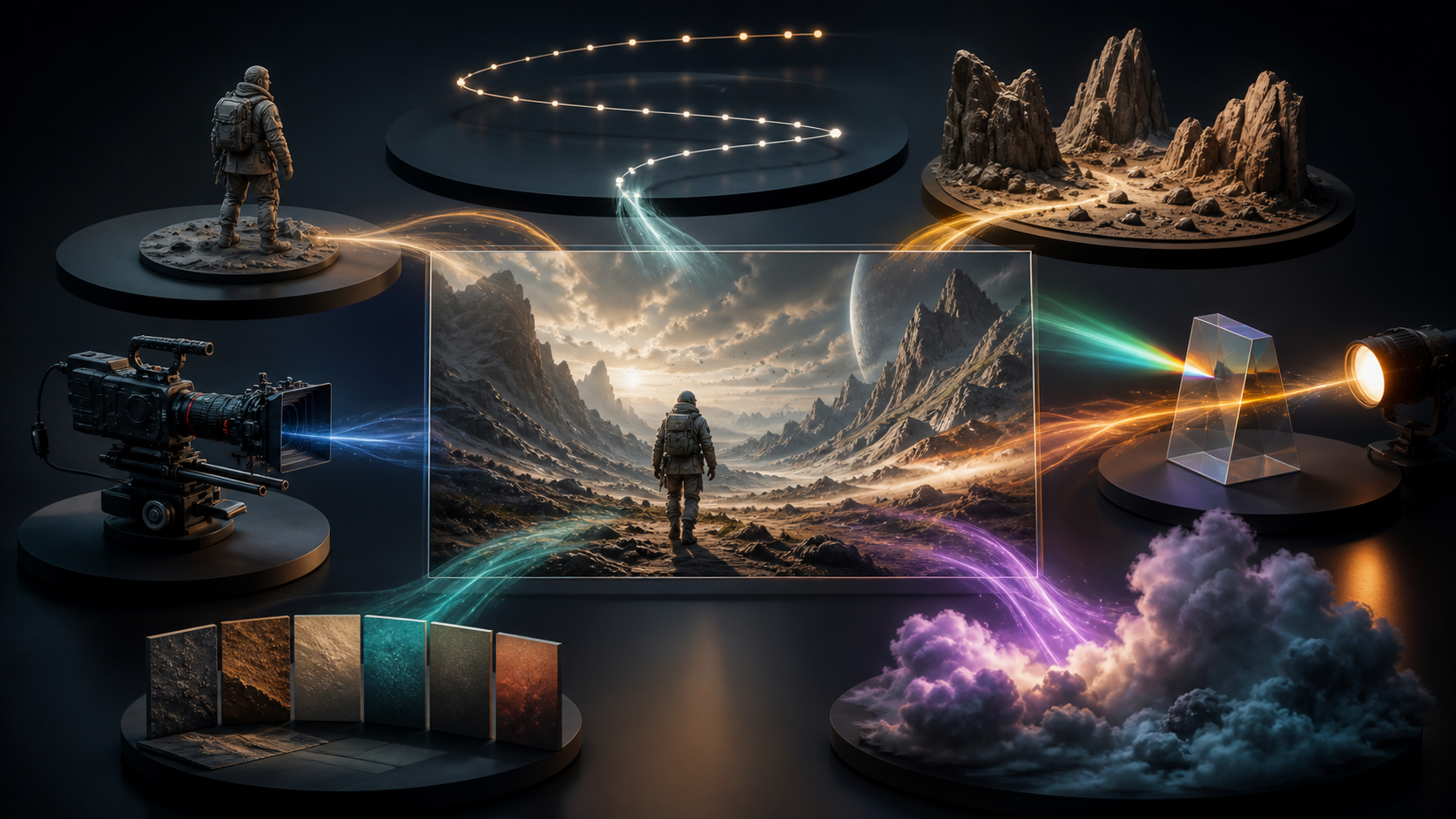
The difference between a vague Kling AI prompt and a useful one is creative direction. A string of keywords may communicate a genre, but it does not tell a video model what should move, how the camera should behave, or which visual decision matters most.
A reliable starting structure is:
Subject + Action + Environment + Camera + Lighting + Visual Treatment + Mood
This guide explains how to use that structure, then provides 25 original prompts grouped by cinematic use case. Model behavior, controls, duration, and access can change, so treat every prompt as a tested creative brief to adapt—not a guarantee of a particular output.
Why Most Kling AI Prompts Fail
Weak prompts usually fail for one of five reasons.
They Describe a Still Image
“Beautiful astronaut, alien planet, cinematic” names a subject and setting but not an event. Video needs a readable action and a change over time.
They Ask for Too Many Events
A five-second shot cannot clearly stage a character entering a room, arguing, running, finding an object, transforming, and escaping. Choose one main action with a beginning and end.
They Use Conflicting Camera Directions
“Static handheld orbiting drone close-up” combines incompatible ideas. Select one framing and one camera move.
They Replace Direction With Quality Words
Terms such as “masterpiece,” “8K,” and “ultra detailed” do not establish composition, motion, or story. Concrete physical and visual instructions are more useful.
They Omit Invariants
When a character or product must remain consistent, say what cannot change. In image-to-video, the approved reference and preserve instructions are as important as the motion request.
The Seven-Part Cinematic Prompt Structure
1. Subject
Identify the main visual focus. Include only the traits required for this shot: “an original adult desert cartographer in a teal coat” is more controllable than a paragraph of biography.
2. Action
Use a physical verb and define the progression: opens, turns, steps, catches, unfolds, looks up. Add a clear end state when timing matters.
3. Environment
Describe the space and one or two elements that can respond to motion: wind through grass, rain on glass, dust under footsteps, curtains moving from an open door.
4. Camera
Choose framing and movement: locked wide shot, slow dolly in, lateral tracking, gentle crane down, overhead push, or handheld follow. Avoid stacking several moves into a short clip.
5. Lighting
Name the light source and behavior: low sunset backlight, soft window light, flickering practical lamps, moonlight through clouds, or cool overhead fluorescents.
6. Visual Treatment
Describe lens, palette, texture, and rendering language. Use original characteristics rather than a living artist or protected franchise: restrained cel shading, fine ink contours, desaturated film texture, tactile stop-motion-inspired materials.
7. Mood
End with the emotional intention: cautious wonder, restrained grief, playful tension, quiet triumph, or uncanny calm.
Add Preserve and Avoid Instructions When Needed
For image-to-video, append:
Preserve the subject's identity, clothing, proportions, color palette, environment layout, and all visible objects. No new characters, no text, no logo, no face change, no extra limbs, no camera shake, and no scene cut.Use only constraints relevant to the shot. A long negative list can compete with the core action.
25 Cinematic Kling AI Prompts
The examples below use fictional adults and original worlds. Adjust duration, aspect ratio, and reference handling in the product interface rather than stuffing unsupported parameters into the prose prompt.
Cinematic Worlds and Exploration
1. Rain Observatory Reveal
An original adult astronomer in a weathered indigo coat pushes open the brass doors of an abandoned hilltop observatory; rain blows past as the dormant telescope slowly rotates toward a break in the clouds; begin in a medium rear shot and dolly forward through the doorway; cold moonlight meets warm amber interior lamps; realistic cinematic materials with restrained blue-and-gold color grading and subtle film grain; mood of cautious discovery; preserve the astronomer's face, coat, telescope shape, and observatory layout; no text, logo, or new character.2. Floating Orchard Arrival
An adult sky courier steps from a small cable car onto a floating orchard platform while wind moves silver leaves and suspension ropes; wide establishing shot with a slow crane down to reveal waterfalls beneath the island; soft sunrise backlight and mist; polished fantasy editorial realism with pale green, ivory, and coral palette; mood of serene wonder; stable horizon, coherent cable motion, no camera spin.3. Desert Signal
An adult desert cartographer kneels beside a buried navigation beacon and brushes sand from its glass surface as a faint light activates; low medium shot with a slow semicircle move of less than thirty degrees; late-afternoon sun, long shadows, airborne dust catching the light; grounded science-fiction realism with muted ochre and teal; mood of patient suspense; preserve hands, beacon geometry, scarf, and footprints.4. Underwater Archive
An adult marine archivist swims through a flooded library and gently frees one sealed book from swaying chains; side-profile tracking shot that matches the swimmer's slow movement; shafts of turquoise light pass through surface water and floating particles; dreamlike but physically coherent underwater cinematography; mood of reverence and mystery; stable face and suit, natural fabric drift, no bubbles obscuring the subject.5. First Step on a Living Valley
An original adult explorer descends from a compact lander onto a dark alien valley; with the first bootstep, thin bioluminescent plants awaken in a wave toward distant rock spires; start behind the explorer in a wide shot and perform a slow push forward; low planetary sunrise with cyan ground light; premium grounded science-fiction cinema, charcoal and turquoise palette; mood of awe with a hint of uncertainty; one continuous shot, stable terrain, no spacecraft redesign.Action and Physical Motion
6. Rooftop Parcel Chase
An adult bicycle courier runs across a rain-slick rooftop and catches a sliding parcel just before it reaches the edge; lateral tracking camera at waist height, ending in a stable medium shot as the courier stops; blue-hour city light with warm window reflections; graphic cinematic realism with crisp silhouettes; mood of urgent relief; preserve parcel size, clothing, roof geometry, and direction of travel; no fall or collision.7. Workshop Chain Reaction
An adult inventor turns one brass crank, sending a clear mechanical sequence through gears, a rolling marble, and a small bell; locked three-quarter wide shot so every cause and effect remains visible; warm window light and focused task lamps; tactile stop-motion-inspired materials with precise mechanical motion; playful anticipatory mood; no new machinery, no disappearing parts, one continuous chain reaction.8. Wind Sail Rescue
An adult cliff ranger anchors a bright rescue sail as a strong gust pulls it open above a narrow canyon path; low wide camera with a gentle forward move, fabric filling the upper frame while the ranger stays grounded; storm light breaks through clouds behind the sail; realistic adventure cinema with amber-and-slate palette; mood of controlled danger; accurate rope tension, stable body proportions, no camera rotation.9. Train Platform Catch
An adult traveler reaches for a paper ticket lifted by a passing train's wind and catches it against a station pillar; medium shot with subtle handheld follow, ending on the hand and ticket; warm afternoon light alternating with moving train shadows; nostalgic film texture and restrained colors; mood of small comic triumph; preserve platform layout, hand anatomy, and ticket shape; no readable text.10. Rain Alley Sparring Drill
Two original adult martial artists perform one clearly choreographed training exchange in a rain-covered courtyard: block, step, controlled turn, and separated ending stance; stable wide camera with a brief slow push; overhead lanterns reflect in puddles; elegant action cinema with high-contrast ink-like edges; focused respectful mood; no injury, no weapon, no extra people, preserve both identities and left-right positions.Transformations and Transitions
11. Paper City Unfolding
An adult architect places a folded paper model on a table; the model opens in one continuous motion into a miniature city while the architect's hands withdraw; overhead camera slowly lowering toward the table; soft studio skylight with warm edge light; tactile paper-craft realism, cream, coral, and cobalt palette; mood of inventive delight; preserve the architect's hands and table, no text or logo, no full-size buildings.12. Seasonal Doorway
An adult gardener opens a greenhouse door from a snowy courtyard into a lush summer interior; camera tracks behind at walking speed and crosses the threshold once; cool diffuse snow light transitions naturally into warm humid sunlight; painterly realistic botanical cinema; mood of restorative calm; keep the same person and door geometry, transformation confined to environment, no scene cut.13. Coat Becomes Wingsuit
An original adult aerial surveyor stands on a high platform as panels of a long technical coat unfold mechanically into a compact gliding suit; medium full-body shot with a slow orbit under twenty degrees; sunrise rim light and cool city haze; grounded near-future design with clean fabric mechanics; mood of ready determination; preserve face, body, and colors; no feathers, no superhero logo, no launch during this shot.14. Ink Drawing to Living Street
A blank sketchbook page shows an original ink drawing of a quiet market street; watercolor spreads through the lines, depth rises from the page, and the camera moves gently into the now-living street; seamless forward push from overhead macro to eye level; soft morning light develops with the color; handcrafted ink-and-watercolor treatment with visible paper texture; mood of gentle imagination; no writing, no human face close-up, no abrupt cut.15. Mirror Weather Shift
An adult traveler wipes condensation from a station mirror; the reflection reveals the same platform in bright spring sunlight while the real platform remains under winter rain; locked medium shot with a very slow push toward the mirror; cool practical light outside the reflection and warm sunlight within it; elegant magical realism; mood of longing and possibility; preserve the traveler's identity in both views, no duplicate body outside the mirror.Experimental and Social-First Concepts
16. Frozen Market Walk
An adult street photographer walks slowly through a market where people, falling fruit, steam, and fabric are frozen in midair; stabilized first-person-follow camera moves beside the photographer; late-day sun creates suspended volumetric dust; grounded surreal realism with rich natural color; mood of quiet curiosity; only the photographer and camera move, no distorted frozen faces, no collision.17. Five Rooms, One Continuous Step
An original adult dancer takes five measured steps, and with each completed step the surrounding room changes seamlessly from rehearsal studio to greenhouse, observatory, seaside hall, and empty theater; locked full-body framing with smooth lateral track; lighting changes logically with each environment; polished editorial fantasy with one consistent costume; playful transformative mood; preserve dancer identity and movement rhythm, no split screen, no hard cuts.18. Gravity Turns Sideways
An adult museum guard notices a loose paper rise from a desk as gravity slowly rotates ninety degrees; the guard braces against the desk while small lightweight objects drift toward the wall; stable wide shot with a gentle tilt matching the gravity change; quiet overnight gallery lighting; clean surreal cinema with controlled physical detail; mood of restrained astonishment; no falling person, no broken artwork, coherent object motion.19. Memory Lanterns
An adult traveler releases three small paper lanterns in a dark room; each lantern briefly illuminates a different original landscape inside its paper surface as it rises; slow circular camera move around the traveler, less than half an orbit; warm lantern light against deep blue shadows; poetic cinematic realism with delicate paper texture; reflective mood; no text, no identifiable real location, stable face and lantern count.20. Clay World Repair
An adult craftsperson presses a cracked clay hill together in a miniature landscape; trees straighten, a river resumes flowing, and tiny lights return to the village in a single visible sequence; macro side angle with slow rack focus from hands to village; warm workshop lamps and cool miniature moonlight; tactile clay-animation-inspired materials; hopeful mood; preserve finger anatomy, miniature scale, and village layout.Emotional and Story-Driven Shots
21. Last Light at the Bus Stop
An adult musician sits alone at a rural bus stop and closes an instrument case as the final bus passes without stopping; static medium-wide composition with the bus crossing foreground and revealing the musician again; fading dusk with one soft shelter lamp; restrained naturalistic cinema, muted blue and amber; mood of disappointment turning into resolve; no readable route text, stable face and case, no exaggerated crying.22. Orchard Reunion
Two original adult siblings see each other across a sunlit orchard, pause, then walk forward and embrace once beneath drifting petals; start in a balanced wide shot and slowly dolly toward a medium frame; warm backlight through leaves; gentle realistic drama with soft green-and-gold palette; mood of relieved affection; preserve both identities and relative positions, natural arms and contact, no extra people.23. Empty Theater Applause
An adult stagehand stands alone on an empty theater stage after finishing a repair; one balcony work light turns on, then a small mechanical applause device begins clapping softly; slow crane down from dark seats to a medium stage view; dusty amber beams and deep red upholstery; whimsical grounded cinema; mood of private recognition; no audience appears, preserve stage geometry and device size.24. Message From the Lighthouse
An adult lighthouse keeper unfolds a blank-looking translucent sheet; moonlight passes through it and reveals a moving map of waves leading home, shown only as abstract lines without text; over-shoulder close shot easing outward to reveal the stormy window; cool moonlight and warm lantern fill; poetic maritime realism; mood of renewed hope; preserve hand anatomy, sheet shape, and room layout, no letters or logo.25. Quiet Victory Walk
An original adult rescue pilot walks away from a grounded aircraft at dawn after a successful mission; mechanics in the distant background lower their tools and exchange relieved looks; slow rear tracking shot at shoulder height, ending as sunlight crosses the runway; warm sunrise through cool mist; understated cinematic realism with subtle film grain; mood of exhausted quiet triumph; no explosion, no military insignia, no slow-motion exaggeration, stable aircraft and walking gait.How to Adapt These Prompts
Do not change all seven elements at once. Start with the closest example and preserve its structural logic.
Change the Subject, Keep the Shot
Replace “desert cartographer” with “storm engineer,” but keep the beacon action, low camera, late sun, and patient suspense. This tests character fit without redesigning the scene.
Change the Camera, Keep the Action
Compare a locked wide shot against a gentle push-in. If motion breaks with a more complex camera, the simpler version may be stronger.
Change the Mood Through Light and Timing
The same doorway can feel hopeful under warm sunrise or unsettling under flickering green practical light. Do not add unrelated props when lighting can carry the emotional change.
Use Image-to-Video for Identity
When a character or composition is already approved, begin with the closest reference frame and ask for controlled motion. DeepFake provides an image-to-video workflow alongside text-to-video; verify the current model and controls in the interface before adapting model-specific instructions.
Common Mistakes That Ruin Results
Keyword Piles
Replace “cinematic, epic, detailed, amazing” with an observable action, camera, and light source.
Too Much Motion
If the subject, camera, background, weather, and lighting all transform simultaneously, coherence suffers. Select one primary motion and one supporting environmental response.
No End State
“A character runs” can continue aimlessly. “Runs to the gate and stops with one hand on the latch” gives the shot a cuttable finish.
Conflicting Visual Styles
Choose one rendering language. Combining photorealism, watercolor, pixel art, stop motion, and graphic anime in the same short prompt provides no stable direction.
Reusing a Character Name Without References
Names do not lock appearance. Use approved images, an identity sheet, and explicit invariants.
Asking for Generated Text
Place titles, signs, captions, and product copy in post-production whenever accuracy matters.
Ignoring Rights and Consent
Use original characters and licensed source media. Obtain permission before animating an identifiable person's face or cloning a voice. Never create deceptive impersonations or fabricated evidence.
From One Clip to a Coherent Sequence
Single prompts do not create continuity by themselves. For multi-shot work:
- lock a character and environment bible;
- give each shot one ID and one primary action;
- reuse approved references and palette rules;
- keep model/version and settings with every output;
- compare adjacent shots side by side;
- finish pacing, sound, captions, and color in an editor;
- archive inputs, rights, prompts, and approvals.
DeepFake's model catalog can help you compare current creative options, but the model with the best isolated clip may not be the one that maintains a sequence most reliably.
A Practical Prompt Review Checklist
Before generating, confirm:
- one main subject is clearly described;
- one action has a beginning and end;
- environment details support the action;
- framing and camera move do not conflict;
- the light source is understandable;
- visual treatment is original and coherent;
- mood follows from the scene choices;
- preserve rules protect key identity or product traits;
- avoid rules are short and relevant;
- no protected character, logo, or unapproved likeness is requested.
Structured prompts do not remove iteration, but they make each iteration informative. When a result fails, you can identify whether the problem came from action, camera, environment complexity, or missing invariants—and change one element instead of starting over.
Frequently Asked Questions
How long should a Kling AI prompt be?
Long enough to specify the seven useful elements, but short enough to preserve one clear shot. A concise paragraph with one subject and action is usually more controllable than a page of events.
Should I include camera terminology?
Yes, when it serves the shot. Choose one framing and one compatible move. Do not combine contradictory camera directions.
Why does every scene look different?
Text alone does not preserve identity or art direction. Reuse approved visual references, palette and environment rules, model/version, and explicit invariants across shots.
Can I copy these prompts exactly?
You can use them as original starting templates, but adapt the subject, duration, framing, and constraints to your project. Test the simplest version first and change one variable at a time.