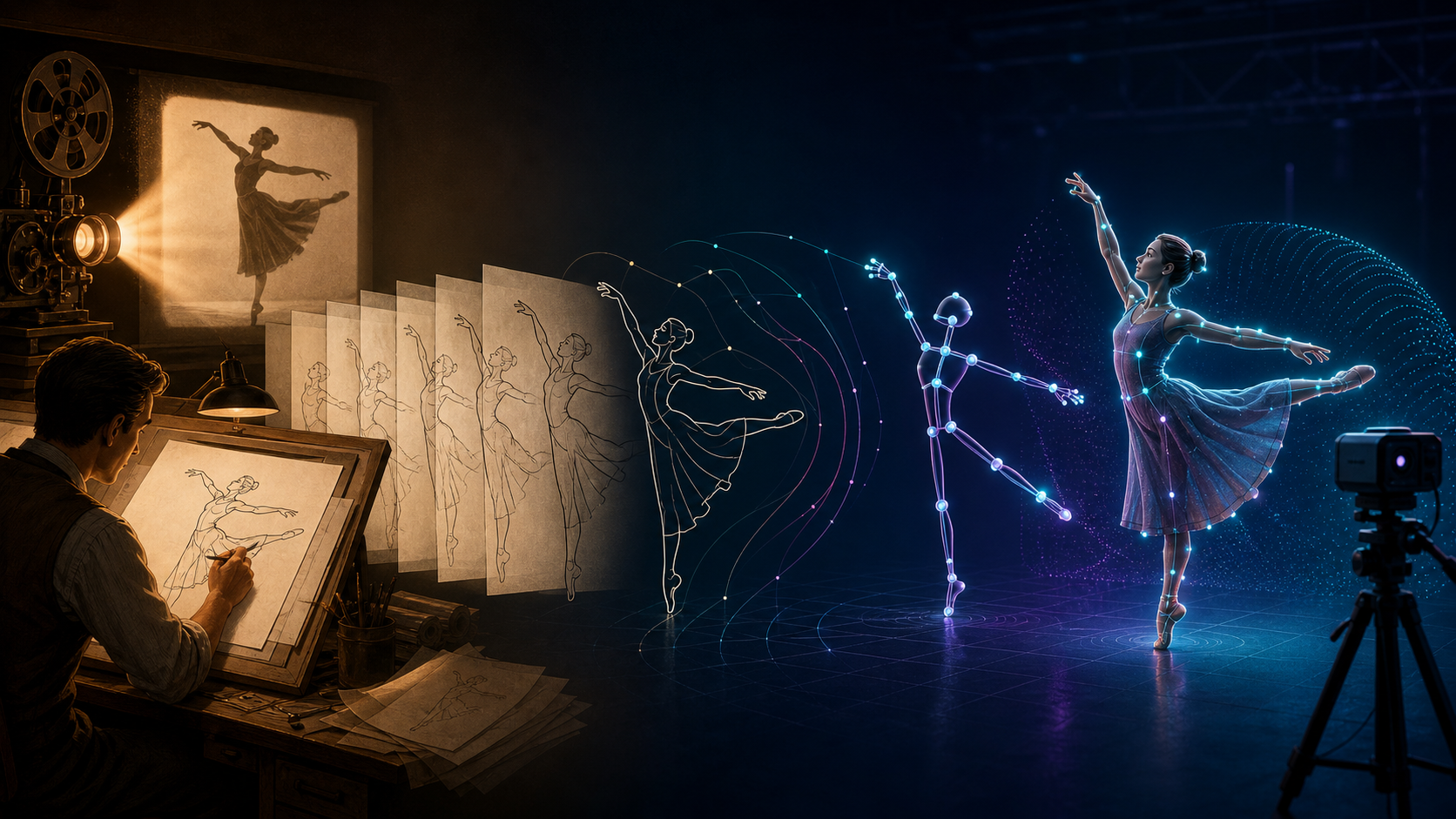
Rotoscope animation begins with a real performance and translates it into drawn motion one frame at a time. Before optical motion-capture stages, sensor suits, or pose-estimation models, this was one of the most reliable ways to give an animated character recognizable human weight and timing.
The method is also labor-intensive. At 24 frames per second, a one-minute shot contains 1,440 individual images. An artist must decide how a silhouette, hand, fold, or facial feature should flow through each one without distracting jitter. Modern software can propagate masks and AI can estimate a moving skeleton from ordinary video, but that does not make every rotoscope task the same.
The clearest way to understand today’s workflow is to separate three outputs: a stylized 2D drawing, a VFX matte, and 3D body motion. AI changes all three, but only markerless mocap can bypass tracing when the desired result is animation data for a rigged 3D character.
What is rotoscope animation?
Rotoscope animation uses live-action footage as a direct visual reference. Traditionally, filmed images were projected onto a glass panel so an animator could draw over the performer. In digital production, the artist works with footage layers, drawing tools, masks, vector paths, onion skins, and frame controls, but the central idea remains the same.
The workflow has three parts:
- Source performance: A person or object is filmed moving through the action.
- Frame interpretation: An artist follows the reference over time, tracing or redesigning selected contours and features.
- Animated result: The new drawings retain much of the source performance’s timing, balance, and physical logic.
Good rotoscoping is not photocopying. Literal tracing can preserve irrelevant wrinkles and perspective changes that make the lines boil. Artists simplify anatomy, hold volumes consistent, adjust arcs, exaggerate poses, and decide where the drawing should depart from the footage. The reference anchors realism; the animation choices create the style.
A short history of rotoscoping
Animator Max Fleischer developed an early rotoscope process in the 1910s and patented the system. Footage of his brother performing supplied reference for Koko the Clown in the Out of the Inkwell series, producing movement that looked unusually fluid for the period.
The technique later became part of both mainstream and experimental filmmaking. Frequently discussed examples show its range:
- Snow White and the Seven Dwarfs used filmed reference to guide lifelike human movement.
- Ralph Bakshi’s films, including The Lord of the Rings, made extensive use of traced performance.
- A-ha’s Take On Me music video turned the transition between live action and pencil-like imagery into its central visual idea.
- A Scanner Darkly used digital rotoscoping to create an unstable, dreamlike surface over filmed actors.
- The glowing lightsaber blades in the original Star Wars involved hand-built animated mattes around filmed props.
These examples also reveal why the word rotoscoping can be confusing. It may describe character drawings based on live action, or the VFX process of drawing mattes around moving elements. The tools overlap, but the deliverables are different.
Why frame-by-frame roto takes so long
The obvious challenge is volume. One second at 24 fps contains 24 frames; ten seconds contains 240. But drawing count is only the beginning.
An artist must maintain:
- stable character proportions as the camera perspective changes;
- coherent line weight and shape language;
- smooth arcs through hands, feet, and head;
- believable contact with the ground or props;
- continuity when one body part crosses another;
- controlled detail through motion blur;
- consistent edges in hair, cloth, transparency, and defocus.
Small errors become visible in motion even when each frame looks acceptable on its own. A hand that shifts a few pixels, a shoulder that changes volume, or a matte edge that vibrates can draw the eye immediately. The artist repeatedly flips, loops, corrects, and smooths the sequence.
Production also includes setup and review. Footage must be prepared, shot boundaries identified, shapes organized, mattes named, versions rendered, and notes addressed. Automation can reduce repetitive work, but final quality is still measured over time rather than on one showcase frame.
Rotoscoping vs motion capture
Both processes start with real movement, yet they capture different information.
| Aspect | Rotoscope animation | Motion capture |
|---|---|---|
| Primary input | Visible live-action footage | Cameras, optical markers, or body sensors |
| Core operation | Trace or interpret shapes through frames | Measure or estimate joint motion |
| Typical output | 2D drawings, masks, or paint | 3D skeletal animation curves |
| What it preserves | The appearance and timing seen by one camera | Movement intended to exist in 3D space |
| Main editing task | Refine contours, drawings, and mattes | Fix joints, contacts, root motion, and retargeting |
| Strongest use | Designed 2D style or VFX isolation | Reusable motion for rigged 3D characters |
Rotoscoping follows how a performance looks from the recorded viewpoint. Motion capture reconstructs how a body moves so that performance can be applied to a different 3D character and viewed from another camera.
That distinction explains why mocap is not a universal replacement. A skeleton does not describe a coat’s fluttering outline, strands of hair, a transparent veil, or the exact boundary needed to composite an actor over a new background. Conversely, tracing a silhouette does not create reusable joint rotations for a game character.
From hand tracing to markerless AI mocap
Performance capture has moved through several broad technological stages.
Hand-traced performance
Rotoscoping translated filmed movement into drawings. It required little more than footage and skilled artists, but every deliverable frame needed attention.
Optical and sensor capture
Marker-based camera stages and inertial suits record movement as data. They remove the drawing step and can capture long performances efficiently, but require equipment, calibration, controlled space, and post-processing.
Markerless capture from video
AI pose-estimation systems identify body landmarks in ordinary footage, infer depth, and build a moving 3D skeleton without a suit. This makes mocap more accessible for previsualization, indie animation, games, and creator projects.
The convenience comes with limits. A single camera cannot directly observe depth, and the model must guess when a limb passes behind the body. Motion blur, cropped feet, loose clothing, unusual poses, rapid spins, and foreground objects can produce jitter or incorrect joints. Retargeting and cleanup remain normal parts of the workflow.
How AI-assisted rotoscoping is different
AI roto tools usually help create and propagate selections. An artist identifies the subject or edge, and the software predicts how that region moves through neighboring frames. This can provide a fast first pass for a person against a clear background.
Hard shots still expose the limits:
- hair and fur contain many fine semi-transparent edges;
- glass and reflections do not behave like opaque objects;
- foreground objects repeatedly reveal and hide the subject;
- heavy motion blur has no single crisp boundary;
- similar foreground and background colors confuse segmentation;
- changing focus alters the softness of an edge over time.
The artist must inspect the entire shot, repair drift, split difficult parts into separate shapes, and preserve appropriate edge softness. AI assists the matte; it does not eliminate the compositing judgment behind it.
When AI mocap can replace tracing
Use markerless mocap instead of rotoscope animation when all of the following are true:
- the desired output is 3D body motion rather than 2D drawings;
- a rigged target character already exists or will be created;
- the source performance is clearly filmed with the full body visible;
- the team can retarget and clean skeletal animation;
- clothing, hair, and props will be handled by the 3D pipeline rather than traced from the footage.
For example, an animator creating a realistic walk for several game characters can capture one performer, retarget the solve to each rig, and adjust the resulting curves. Drawing the walk from one camera angle would create a fixed 2D sequence rather than a reusable motion asset.
Markerless capture is less suitable when the shot depends on subtle finger acting, close facial performance, multiple people in heavy contact, or frequent occlusion. Dedicated sensors, optical capture, manual keyframes, or a hybrid approach may be more reliable.
Where rotoscoping still wins
Rotoscope animation remains the right choice when the traced relationship to live action is the visual language. The slight instability of a hand-drawn contour can create energy that a clean 3D render does not. Artists can simplify a performer into graphic shapes, replace clothing, stretch anatomy, or let the image drift between representation and abstraction.
VFX roto is equally current. Compositors still need precise mattes for actors, props, vehicles, and environmental elements. Automatic segmentation may accelerate the first pass, but human-reviewed shapes remain essential in demanding shots.
Rotoscoping also works well for short accents: animated scribbles around a dancer, a hand-drawn aura, graphic shadows, or selected lines that interact with live action. These are design decisions, not inefficient substitutes for mocap.
A practical hybrid workflow
Many projects benefit from combining methods rather than declaring one winner.
- Film a clean performance with a locked camera and clear silhouette.
- Extract markerless body motion for the 3D character.
- Retarget the animation and fix contacts, root motion, and problem joints.
- Render the character with the intended camera and lighting.
- Use assisted roto to isolate live-action elements or create holdout mattes.
- Draw selected contours, textures, and effects over the render for a handmade finish.
- Review the composite at full speed and frame by frame.
If you are still exploring the visual direction, DeepFake Video to Video can help prototype stylized motion references. Treat generated variants as look-development material, not as frame-accurate roto or guaranteed mocap input. A controlled source recording remains more dependable for tracking.
How to choose the right method
Start with the deliverable, not the trend.
- Need a reusable 3D walk, dance, or gesture? Choose motion capture.
- Need to separate an actor from the background? Choose VFX roto, with AI-assisted masks where useful.
- Need a deliberately traced 2D aesthetic? Choose rotoscope animation.
- Need exact acting on a stylized 3D character? Combine mocap with keyframe cleanup.
- Need drawn effects around captured motion? Capture the body, then rotoscope selected visual layers.
Also compare labor honestly. AI may move work from drawing to cleanup, retargeting, or correction. Measure the time required to reach a finished shot, not the time required to generate a first result.
Frequently asked questions
Is rotoscope animation the same as tracing?
Tracing is part of the process, but strong rotoscope animation interprets the footage. Artists simplify shapes, maintain volume, refine arcs, and make deliberate style choices instead of copying every visible edge.
Can AI fully replace rotoscoping?
No. AI can accelerate masks and can replace frame-by-frame drawing when the goal is 3D skeletal motion. It does not automatically create a designed 2D animation or a production-ready matte for every difficult edge.
Is rotoscoping still used today?
Yes. It remains common in VFX compositing and continues as a distinctive animation style. What has changed is that artists no longer need to trace a body merely to obtain reusable realistic 3D movement.
How long does rotoscoping take?
It depends on duration, frame rate, detail, occlusion, edge complexity, and quality target. A short clean silhouette may be assisted quickly, while hair, transparency, motion blur, or a hand-drawn hero shot can require extensive frame-level work.
Final verdict
AI has not erased rotoscoping. It has clarified when tracing is necessary.
Markerless mocap is a modern shortcut to skeletal body motion, not a replacement for every drawn contour or VFX matte. Assisted segmentation can speed isolation, but difficult edges still need an artist. And when a creator wants the living, imperfect surface of rotoscope animation, the manual interpretation is the point.
Choose the tool by the output: skeleton data for 3D motion, mattes for compositing, or drawings for style. That single distinction prevents the fastest technology from solving the wrong creative problem.